Pterocarya rhoifolia
Siebold & Zucc.
Japanese wingnut, Shui hu tao
iNaturalist· cc-by-nc-sa
(c) harum.koh, some rights reserved (CC BY-NC-SA), uploaded by harum.koh
iNaturalist· cc-by-nc-sa
(c) harum.koh, some rights reserved (CC BY-NC-SA), uploaded by harum.koh
Summary
Source: WikipediaPterocarya rhoifolia, commonly known as Japanese wingnut, is a species of tree in the family Juglandaceae. It is widely distributed throughout Japan, and also found in China in the Laoshan District of eastern Shandong Province. Its natural presence in China is contested. The tree flourishes in moist areas along riverbanks and mountain streams, and attains 30 m (98 ft) in height, flowering from May–July. It is a soft light wood, with the heartwood yellowish-white in color, which has been used as a substitute of kiri (Paulownia tomentosa), for example, to make geta clogs that are imitations of kiri-geta. It is straight-grained and the pore pattern on the surface provides the wood with a handsome appearance.
Description
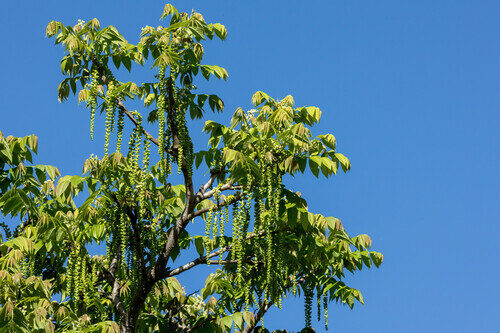
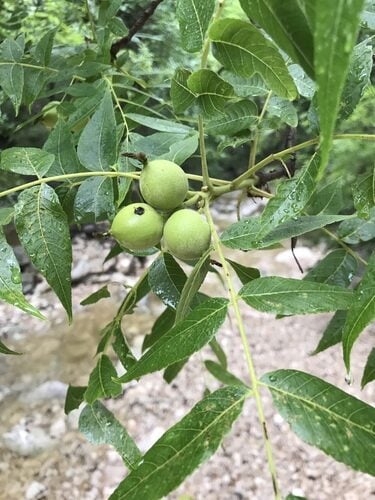
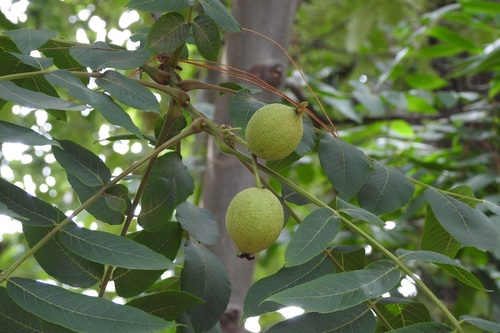
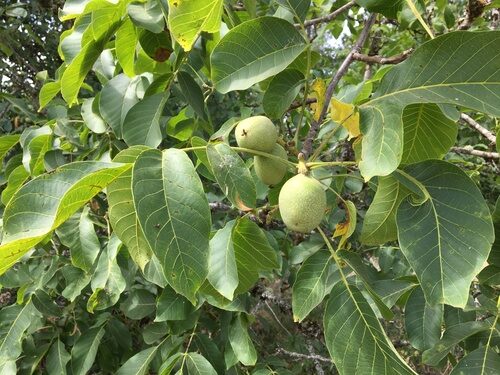
A deciduous tree. It grows to 30 m tall. It spreads 18 m wide. The bark is dark grey and develops cracks along it with age. The leaves have an odd number of leaflets. They are 20-25 cm long. The leaf stalk is 3-7 cm long. It is hairy. There are 11-21 leaflets. The leaflet blade is 6-12 cm long by 1.5-4 cm wide. They are dark green and glossy above and turn yellow in autumn. The male and female flowers are separate on the same plant. They are both in green catkins which hang down. The male catkins are 7.5 cm long and at the base of the young shoots. The female catkins are at the tip. The fruiting spike is 20-30 cm long. The axis is hairy. The nutlets are 8-9 mm long
Edible Uses
The seeds are edible, though no preparation details are recorded. They are very small and would be extremely fiddly to use in any meaningful quantity.
Medicinal Uses
No medicinal uses are known.
Distribution
It is native to Japan. They grow in wet areas along riverbanks. It suits hardiness zones 6-9.
Where It Grows
Asia, Australia, China, Japan, Korea,
Cultivation
Prefers a sunny position in a rich strong loam with abundant moisture at the roots. Succeeds in areas that do not experience prolonged winter temperatures below about -12°c, but young plants and the young shoots of older trees can be cut back by winter frosts. The leaves are aromatic when bruised. Plants in this genus are notably resistant to honey fungus.
Propagation
Seed is best sown as soon as it is ripe in a cold frame. Stored seed should be pre-soaked for 24 hours in warm water, then cold stratified for 2–3 months. Prick seedlings into individual pots once large enough to handle and overwinter them in a greenhouse. Plant out in late spring or early summer the following year. Cuttings of half-ripe wood can be taken in July/August in a frame, or cuttings of mature shoots in November in a frame — use only vigorous shoots. Layering and division of suckers during the dormant season are also viable methods.
Other Uses
The wood is light, soft, and not easily cracked. It is used for making clogs, chopsticks, and similar items.
Synonyms
References (7)
- Abh. Math.-Phys. Cl. Koenigl. Bayer. Akad. Wiss. 4(2):141. 1845
- Coombes, A.J., 2000, Trees. Dorling Kindersley Handbooks. p 187
- Cundall, P., (ed.), 2004, Gardening Australia: flora: the gardener's bible. ABC Books. p 1107
- Flowerdew, B., 2000, Complete Fruit Book. Kyle Cathie Ltd., London. p 209
- Lu Anmin, Stone, D.E., Grauke, L.J., Juglandaceae. Flora of China.
Show all 7 references Hide references
- Plants for a Future database, The Field, Penpol, Lostwithiel, Cornwall, PL22 0NG, UK. http://www.scs.leeds.ac.uk/pfaf/
- Wickens, G.E., 1995, Edible Nuts. FAO Non-wood forest products. FAO, Rome. p 137