Prunus tangutica
(Batalin) Koehne
Tangut plum
gbif· cc0
President and Fellows of Harvard College
gbif· cc0
President and Fellows of Harvard College
Summary
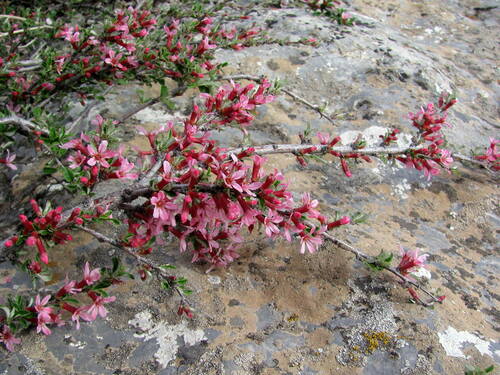
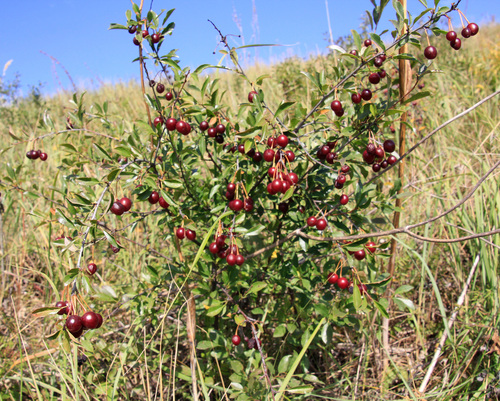
Source: WikipediaPrunus tangutica (Chinese: 西康扁桃 or 唐古特扁桃) is a species of wild peach native to China. Based on its fruit traits it had been considered a wild almond, but genetic and morphological studies have shown that it is more closely related to Prunus persica, the cultivated peach, with its closest relative being Prunus mongolica. It is a very dense spiny shrub or shrubby tree, usually 1 to 2.5 m tall but reaching 4 m, preferring to grow on sunny slopes and alongside streams at 1500 to 2600 m, but found as high as 3400 m. Its flower petals are a pale pink, and its velutinous (velvety) fruit are green when unripe and purplish‑red when ripe. The fruits' mesocarps (fleshy exterior) splits when ripe, which led to it being classified as an almond for over a century, with the exception of Kovalev & Kostina in 1935, who assigned it to Persica.
Description
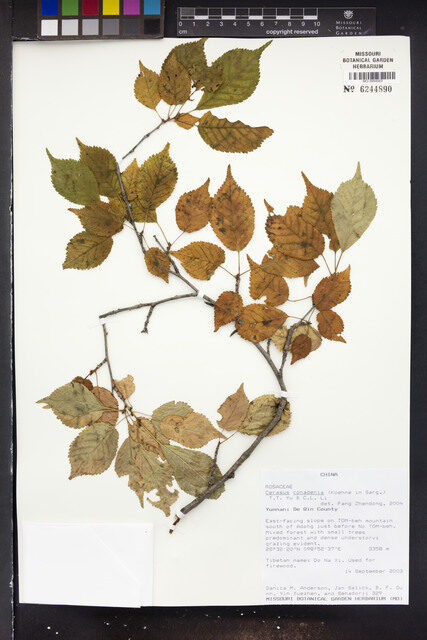
A shrub. It grows 1-2 m tall. The branches are spreading and shiny. The leaves are in short branchlets mostly in clusters. The leaves are oblong or oval and 2-4 cm long by 1-2 cm wide. The fruit are fleshy and purple to red. They are 1-2 cm across. They are hairy.
Edible Uses
The fruit can be eaten raw or cooked, though the flesh is very thin. It is about 20mm in diameter and contains one large seed. The seed is also edible raw or cooked, but should not be eaten if it tastes too bitter.
Traditional Uses
The kernel is eaten raw.
This uses section is brief — help expand it
Medicinal Uses
Like all members of the genus, this species contains amygdalin and prunasin, which break down in water to release hydrocyanic acid (prussic acid). In small amounts, this compound stimulates respiration, aids digestion, and produces a sense of well-being.
Known Hazards
Seeds and plant tissues contain compounds that produce cyanide when broken down. Do not consume excessively bitter seeds.
Distribution
It is a temperate plant. It grows on sunny slopes and beside streams between 1,500-2,600 m above sea level. In Sichuan.
Where It Grows
Asia, China,
Propagation
Seed requires 2–3 months of cold stratification and is best sown in a cold frame as soon as it is ripe. Stored seed should be sown in a cold frame as early in the year as possible and protected from mice. Germination can be slow, sometimes taking 18 months. Prick out seedlings into individual pots when large enough to handle, overwinter in a greenhouse or cold frame, then plant out in late spring or early summer the following year. Cuttings of half-ripe wood with a heel can be taken in July/August in a frame. Softwood cuttings from vigorous plants can be taken in spring to early summer in a frame. Layering can be done in spring.
Other Uses
A green dye can be obtained from the leaves, and a dark grey to green dye from the fruit.
Other Information
It is cultivated.
Notes
There are about 200 Prunus species.
Synonyms
References (5)
- Arora, R. K., 2014, Diversity in Underutilized Plant Species - An Asia-Pacific Perspective. Bioversity International. p 96
- Flora of China @ efloras.org Volume 9
- Plants for a Future, The Field, Penpol, Lostwithiel, Cornwall, PL22 0NG, UK. http://www.scs.leeds.ac.uk/pfaf/
- C. S. Sargent, Pl. wilson. 1:276. 1912
- Zeven, A. C. & de West, J. M. J., 1982, Dictionary of cultivated plants and their regions of diversity. Wageningen. p 84 (As Amygdalus tangutica)