Pouteria pierrei
(A. Chev.) Baehni
wikimedia· cc-by-sa
Wikimedia Commons (via Wikimedia Commons)
Summary
Source: WikipediaMedium-rate deciduous tree reaching 30 m tall and 20 m wide. Hardy to UK zone 10. Tolerates light sandy, medium loamy, and heavy clay soils with well-drained preference. Grows in mildly acid to basic soils. Requires full sun and prefers moist soil.
Description
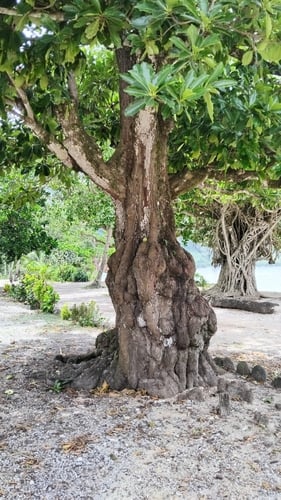
A tree. It grows to 40 m high. The trunk is 1.2 m across. It does not have branches until 25 m up the trunk. The trunk is straight and cylinder shaped with buttresses near the base. These can be 3 m high. The leaves are simple and entire and arranged in spirals. The leaves are densely hairy underneath. The leaves are oval and 8-15 cm long by 4-6 cm wide. The side veins are orange coloured. The flowers are in groups in the axils of the fallen leaves. The flower stalks are hairy and 3 cm long. The fruit are round berries 1.5-2 cm long. They turn red when ripe. They are finely hairy. The seeds are oval and 1.3 cm long.
Edible Uses
The fruit is eaten raw. Each red, globose berry is 15–20mm long and contains a single large seed, with the pulp being the edible portion.
Medicinal Uses
None known.
Known Hazards
Occupational asthma and contact urticaria caused by the wood dust have been recorded in sawmill workers.
Distribution
It is a tropical plant. It grows in rainforest. It suits humid locations. It also grows in semi-deciduous forest.
Where It Grows
Africa, Benin, Cameroon, Central Africa, Central African Republic, CAR, Côte d'Ivoire, Ghana, Guinea, Guinée, Guinea-Bissau, Ivory Coast, Liberia, Nigeria, Sierra Leone, Togo, West Africa,
Cultivation
Plants are grown from seeds. Seeds germinate in 2-3 weeks.
Propagation
Grow from seed. Germination takes 2–3 weeks, and initial growth is slow.
Other Uses
A latex exudes from the bark, though no uses for it are recorded. The heartwood is creamy white to pale pinkish-brown, indistinctly separated from the 3–6cm wide sapwood band. The grain is straight, sometimes slightly interlocked, with a fine texture and lustrous surface. The wood is moderately light, not durable, and susceptible to fungi, termites, and dry-wood borers. Drying generally causes few problems, though there is a slight risk of distortion, checking, and blue staining in the early stages of air drying. Once dry, it is moderately stable in service. The wood contains about 0.3% silica, giving it a high blunting effect on tools; stellite-tipped saw teeth and tungsten-carbide tools are recommended. Nailing and screwing properties are good, and the wood stains, paints, and glues well. Slicing properties are excellent, making it especially suited to high-quality sliced veneer. It is also used for light carpentry, interior joinery, high-class furniture, and moulding.
Production
Seedlings grow slowly. In Sierra Leone fruit are ripe in February and March.
Synonyms
Also Known As
Abam, Aningueri, Aningeria, Inon, Mondongue, Samfena, Teyei, Tolongo, Valui, Vao-muli
References (9)
- Abbiw, D.K., 1990, Useful Plants of Ghana. West African uses of wild and cultivated plants. Intermediate Technology Publications and the Royal Botanic Gardens, Kew. p 46 (As Aningeria robusta)
- FAO Corporate Document Repository. The Major Significance of 'Minor' Forest Products. Appendix 3 (As Aningera robusta)
- Ingram, V. & Schure, J. 2010, Review of Non Timber Forest Products (NTFPs) in Central Africa, Cameroon. Center for International Forestry Research (CIFR). p 34 (As Aningeria robusta)
- Jardin, C., 1970, List of Foods Used In Africa, FAO Nutrition Information Document Series No 2.p 120 (As Aningeria robusta)
- Lemmens, R.H.M.J., 2007. Pouteria aningeri Baehni. [Internet] Record from Protabase. Louppe, D., Oteng-Amoako, A.A. & Brink, M. (Editors). PROTA (Plant Resources of Tropical Africa), Wageningen, Netherlands. < http://database.prota.org/search.htm>. Accessed 22 October 200919 October 2009. (As Pouteria aningeri)
Show all 9 references Hide references
- Savill, P. S. & Fox, J. E. D., Trees of Sierra Leone. p 217 (As Aningeria robusta)
- Vivien, J. & Faure, J.J., 1985, Abres des forets dense d'Afrique Centrale. Agence de Cooperation Culturelle et Technique. Paris. p 412 (As Aningeria robusta)
- Vivien, J., & Faure, J.J., 1996, Fruitiers Sauvages d'Afrique. Especes du Cameroun. CTA p 315 (As Aningeria robusta)
- World Checklist of Useful Plant Species 2020. Royal Botanic Gardens, Kew