Prunus caroliniana
Aiton
Wild orange, American cherry laurel, Carolina laurel-cherry
iNaturalist· cc0
no rights reserved, uploaded by Nonbinary-Naturalist
iNaturalist· cc-by-nc
(c) mbkeane, some rights reserved (CC BY-NC)
iNaturalist· cc-by-nc
(c) Mart Hughes, some rights reserved (CC BY-NC), uploaded by Mart Hughes
Summary
Source: WikipediaPrunus caroliniana, known as the Carolina laurelcherry, Carolina cherry laurel, Carolina cherry, or Cherry laurel, is a small evergreen flowering tree native to the lowlands of Southeastern United States, from North Carolina south to Florida and westward to central Texas. The species also has escaped into the wild in a few places in California. Prunus caroliniana is not to be confused with its European relative, Prunus laurocerasus, which also is called Cherry Laurel, although mainly known as English Laurel in the U.S.
Description
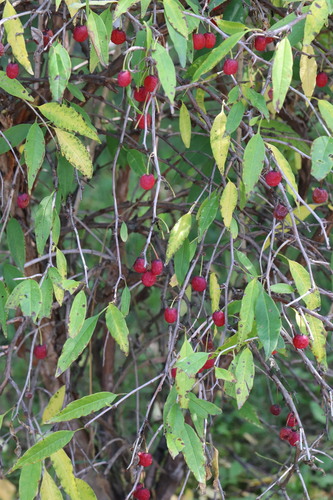
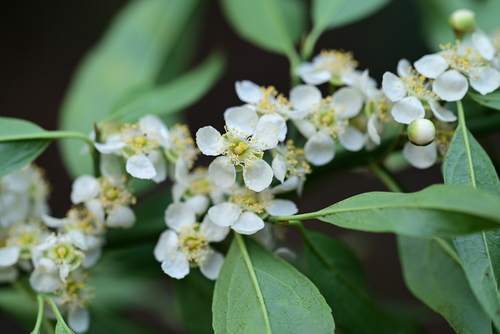
An evergreen tree. It grows 12 m high and spreads 6 m wide. The leaves are glossy green and have smooth edges. They are 5-10 cm long and 2-4 cm wide. The leaves are narrowly oval and slightly turned under at the edge. The leaves have an aroma when crushed. The leaves are shiny dark green above and paler underneath. The flowers are 5 mm wide with 5 small rounded cream petals. They occur in dense masses. The fruit are small and shiny and black. They are 10-12 mm long.
Edible Uses
The fruit, about 13mm in diameter with a thick skin and thin dry flesh, is not truly edible and is slightly toxic to humans. The seed can be eaten raw or cooked, but should be avoided if it tastes too bitter.
Medicinal Uses
No specific medicinal uses have been recorded for this species, but like all members of the genus it contains amygdalin and prunasin. These compounds break down in water to release hydrocyanic acid (prussic acid or cyanide), which in small amounts stimulates respiration, improves digestion, and produces a sense of well-being, despite being exceedingly poisonous in larger quantities.
Known Hazards
The leaves and branches contain high amounts of cyanogenic glycosides that break down into hydrogen cyanide when damaged, making it a potential toxic hazard to grazing livestock and children. Due to this, it is considered highly deer-resistant.
Distribution
Temperate. It grows up to 150 m altitude in SE region of USA. It suits hardiness zones 7-11.
Where It Grows
Australia, North America, USA,
Cultivation
Requires a well-drained moisture retentive soil. Succeeds in a hot dry position. Succeeds in light shade but fruits better in a sunny position. Thrives in a loamy soil, doing well on limestone. Prefers some chalk in the soil but apt to become chlorotic if too much is present. Fairly wind-resistant. One report says that this species is tender in most of Britain, whilst another says that it succeeds in climatic zone 7 (tolerating frosts down to about -15°c). A fast-growing but short-lived tree. Most members of this genus are shallow-rooted and will produce suckers if the roots are damaged. Plants in this genus are notably susceptible to honey fungus.
Propagation
Seed requires 2–3 months of cold stratification and is best sown in a cold frame as soon as it is ripe. Stored seed should be sown in a cold frame as early in the year as possible, with protection from mice. Germination can be slow, sometimes taking 18 months. Prick seedlings into individual pots when large enough to handle, overwinter in a greenhouse or cold frame, then plant out in late spring or early summer the following year. Cuttings of half-ripe wood with a heel can be taken in July/August in a frame. Softwood cuttings from vigorous plants can be taken in spring to early summer in a frame. Layering can be done in spring.
Other Uses
This plant tolerates trimming well and can be grown as a screen or hedge, and is also suitable for shelterbelt plantings. Green dye can be obtained from the leaves, and a dark grey to green dye from the fruit. The wood is hard, heavy, strong, and close-grained, though trees are seldom large enough to be commercially exploited for timber.
Notes
There are about 200 Prunus species.
Synonyms
References (4)
- Cundall, P., (ed.), 2004, Gardening Australia: flora: the gardener's bible. ABC Books. p 1092
- Hort. kew. 2:163. 1789
- Little, E.L., 1980, National Audubon Society Field Guide to North American Trees. Alfred A. Knopf. p 496
- Plants for a Future database, The Field, Penpol, Lostwithiel, Cornwall, PL22 0NG, UK. http://www.scs.leeds.ac.uk/pfaf/