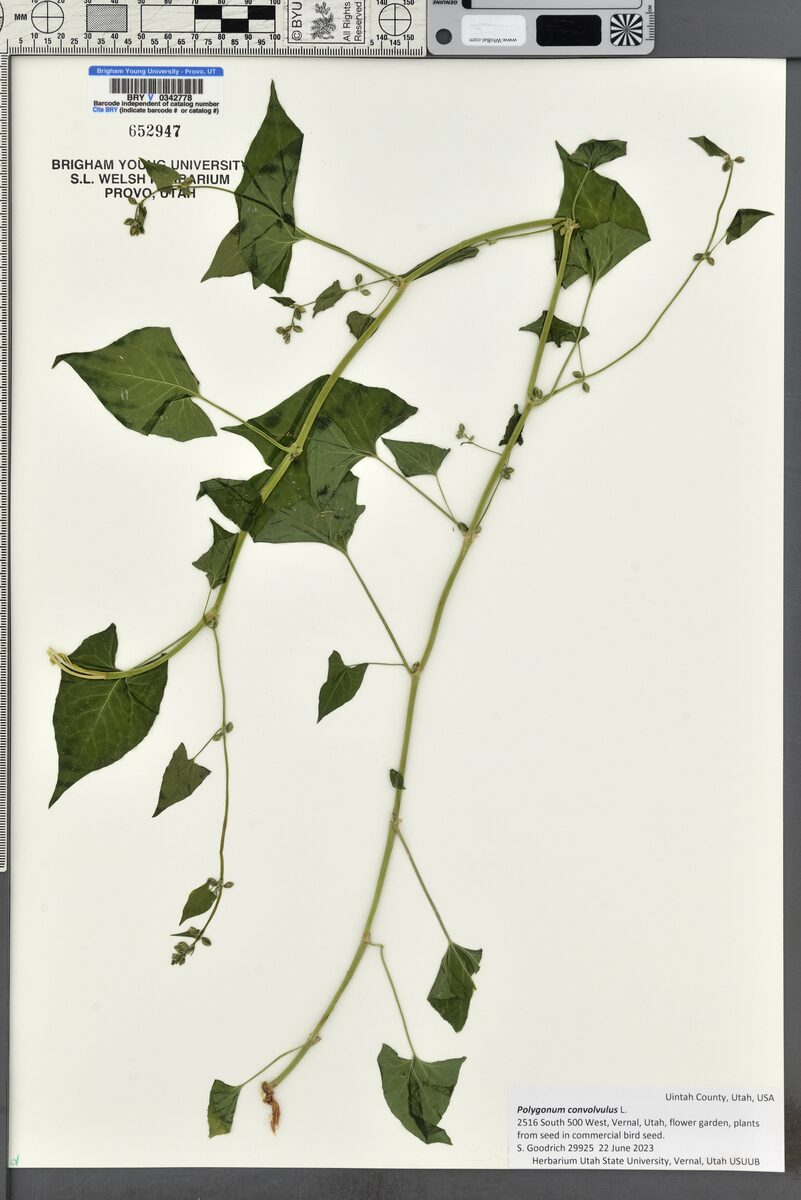
Persicaria perfoliata
(L.) H. Gross
Asiatic tearthumb
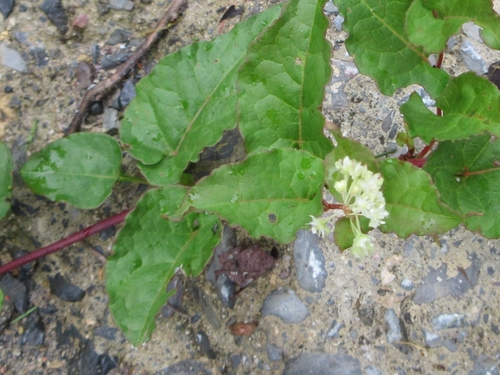
iNaturalist· cc-by-nc-sa
(c) Tom Potterfield, some rights reserved (CC BY-NC-SA)
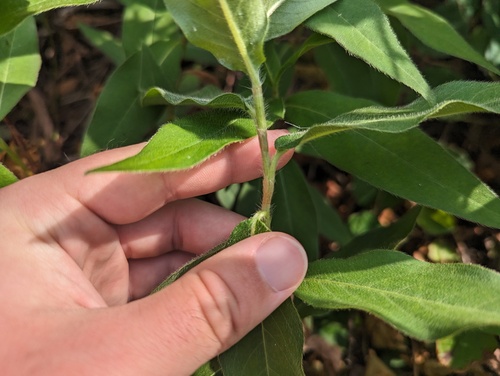
iNaturalist· cc-by-sa
(c) Douglas Goldman, some rights reserved (CC BY-SA), uploaded by Douglas Goldman
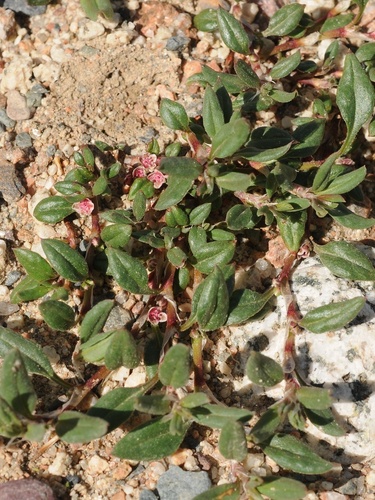
iNaturalist· cc-by-nc-sa
(c) 潘立傑 LiChieh Pan, some rights reserved (CC BY-NC-SA)
Summary
Source: WikipediaPersicaria perfoliata (basionym Polygonum perfoliatum) is a species of flowering plant in the buckwheat family. Common names include mile-a-minute, devil's tail, giant climbing tearthumb, and Asiatic tearthumb. It is a trailing herbaceous annual vine with barbed stems and triangular leaves. It is native to most of temperate and tropical eastern Asia, occurring from eastern Russia and Japan in the north, and the range extending to the Philippines and India in the south. P. perfoliata can be an aggressive, highly invasive weed outside of its native range. In Europe, Persicaria perfoliata is included since 2016 in the list of Invasive Alien Species of Union concern (the Union list). This implies that this species cannot be imported, cultivated, transported, commercialized, planted, or intentionally released into the environment in the whole of the European Union.
Description
A trailing annual herb. It can grow for one or more years. It is 2-3 m long. It has prickles which are hooked. The limb is triangular in cross section. The leaves are D shaped. They are 2-8 cm across. There can be bristles which curve backwards on the edges. The flowers are in spike like heads. These are at the top of the plant or in the axils of leaves. There can be one to many flowers. They are white or pink. The fruit is almost round and 3 mm across. They are black and shiny.
Edible Uses
The tender leaves and shoots are cooked and eaten as a vegetable, or cooked with other greens as a side salad with rice. Leaves are prepared into chutney for their pleasantly acid flavor, and used as a sour flavoring in soups, stews, and fish dishes. The ripe fruit are eaten fresh, particularly by children. Leaves are sold in local markets and can be used for tea.
Traditional Uses
The leaves are used for preparing chutney. They are pleasantly acid. The tender leaves and shoots are cooked and eaten as a vegetable. The young leaves and stem tips and young fruit are cooked with other greens and used as a side salad with rice. It is also used as a sour flavouring for soups, stews and fish dishes. The ripe fruit are eaten fresh. Caution: It can be high in oxalates.
Medicinal Uses
In traditional Chinese medicine, Persicaria perfoliata is known as gangbangui (Chinese: 杠板归; pinyin: gāngbǎngūi), and is thought to be useful for various remedies in herbal medicine. It can also be used as a fiber or used in rope making.
Known Hazards
Although no specific mention has been made for this species, there have been reports that some members of this genus can cause photosensitivity in susceptible people. Many species also contain oxalic acid (the distinctive lemony flavour of sorrel) - whilst not toxic this substance can bind up other minerals making them unavailable to the body and leading to mineral deficiency. Having said that, a number of common foods such as sorrel and rhubarb contain oxalic acid and the leaves of most members of this genus are nutritious and beneficial to eat in moderate quantities. Cooking the leaves will reduce their content of oxalic acid. People with a tendency to rheumatism, arthritis, gout, kidney stones or hyperacidity should take especial caution if including this plant in their diet since it can aggravate their condition.
Distribution
It is a tropical and subtropical plant. It grows in open wet places. It grows from 1000-1750 m altitude in Papua in Indonesia. In Nepal plants grow between 900-1400 m altitude. They grow in moist, open land.
Where It Grows
Asia, Bangladesh, Bhutan, China, Himalayas, India, Indochina, Indonesia, Japan, Korea, Malaysia, Nepal, New Guinea, North America, Northeastern India, Papua New Guinea, PNG, Philippines, SE Asia, Taiwan, USA, Vietnam,
Cultivation
Plants are grown from seed. It can also be grown from rooted cuttings.
Propagation
Seed - sow in situ. Germination is usually free and easy.
Other Information
Leaves are sold in local markets. It is cultivated. The fruit are eaten especially by children.
Notes
There are about 50 Polygonum species.
Nutrition
| Part | Moisture | kJ | kcal | Protein | Vit A | Vit C | Iron | Zinc |
|---|---|---|---|---|---|---|---|---|
| Leaves | 79.1 | 176 | 42 | 5.1 | — | 22 | — | — |
Synonyms
Also Known As
Achajay, Amile pire lahara, Baghasora, Bagh asora, Bakhre, Bonoriya ghehu, Ci li tou, Gianbanqui, Ghumauro kanda, Haganturia, Hanserong derot, Hengaturia, Kanta tokpata, Lingthuh, Ma-ngo, Ma-seinthli, Mikhri lai, Moitha sikhla, Nghe xuyen-la, Posikung, Thanlanqui, Wedusan
References (41)
- Ambasta, S.P. (Ed.), 2000, The Useful Plants of India. CSIR India. p 481 (As Polygonum perfoliatum)
- Bajracharya, D., 1980, Nutritive Values of Nepalese Edible Wild Fruits. Z. Lebensm. Unters. Forsch. 171: 363-366 (As Polygonum perfoliatum)
- Barua, U., et al, 2007, Wild edible plants of Majuli island and Darrang districts of Assam. Indian Journal of Traditional Knowledge 6(1) pp 191-194 (As Polygonum perfoliatum)
- Bot. Jahrb. Syst. 49:275. 1913 (As Persicaria perfoliata)
- Dangol, D. R. et al, 2017, Wild Edible Plants in Nepal. Proceedings of 2nd National Workshop on CUAOGR, 2017. (As Polygonum perfoliatum)
Show all 41 references Hide references
- Deka, N. & Devi, N., 2015, Wild edible aquatic and marshland angiosperms of Baka district, BTC area, Assam, India. Asian J. Plant Sci. Res. 5(1):32-48 (As Persicaria perfoliata)
- Dobriyal, M. J. R. & Dobriyal, R., 2014, Non Wood Forest Produce an Option for Ethnic Food and Nutritional Security in India. Int. J. of Usuf. Mngt. 15(1):17-37 (As Polygonum perfoliatum)
- Duke, J.A., 1992, Handbook of Edible Weeds. CRC Press. p 154 (As Polygonum perfoliatum)
- Eisenberg et al, 2009, Kam Local Indigenous Knowledge and Sustainable Resource Management in Ghuizhou and Guangxi Provinces, China. Ethnobotany Research and Applicatons 7:067-113 (As Polygonum perfoliatum)
- Ethnobotany of Karbis. Chapter 4 in p 100 (As Polygonum perfoliatum)
- Facciola, S., 1998, Cornucopia 2: a Source Book of Edible Plants. Kampong Publications, p 186 (As Echinocaulos perfoliatus)
- Flora of China @ efloras.org Volume 5 (As Polygonum perfoliatum)
- Henty, E.E., in Womersley, J.S., (ed), 1978, Handbooks of the Flora of Papua New Guinea. Melbourne University Press,Victoria. Vol 1, p 240 (Drawing) (As Polygonum perfoliatum)
- Hwang, H., et al, 2013, A Study on the Flora of 15 Islands in the Western Sea of Jeollanamdo Province, Korea. Journal of Asia-Pacific Biodiversity Vol. 6, No. 2 281-310 (As Persicaria perfoliata)
- Joshi, N., et al, 2007, Traditional neglected vegetables of Nepal: Their sustainable utilization for meeting human needs. Tropentag 2007. Conference on International Agricultural Research for Development. (As Persicaria perfoliata)
- Kar, A., 2004, Common wild vegetables of Aka tribe of Arunachal Pradesh. Indian Journal of Traditional Knowledge 3(3) pp 305-313 (As Polygonum perfoliatum)
- Karki, S., et al, 2017, Minor Fruits in Nepal: Utilization and Conservation Efforts. Proceedings of 2nd National Workshop on CUAPGR, 2017. (As Polygonum perfoliatum)
- Li, D. et al, 2017, Ethnobotanical survey of herbal tea plants from the traditional markets in Chaoshan, China. Journal of Ethnopharmacology. 205 (2017) 195-206 (As Polygonum perfoliatum)
- Luo, B., et al, 2019, Wild edible plants collected by Hani from terraced rice paddy agroecosystem in Honghe Prefecture, Yunnan, China. Journal of Ethnobiology and Ethnomedicine 15:56 (As Polygonum perfoliatum)
- Manandhar, N.P., 2002, Plants and People of Nepal. Timber Press. Portland, Oregon. p 355 (As Persicaria perfoliata)
- Martin, F.W. & Ruberte, R.M., 1979, Edible Leaves of the Tropics. Antillian College Press, Mayaguez, Puerto Rico. p 214 (As Polygonum perfoliatum)
- Medhi, P. & Borthakur, S. K., 2012, Phytoresources from North Cachur Hills of Assam -3: Edible plants sold at Hflong market. Indian Journal or Natural Products and Resources. 3(1) pp 84-109 (As Polygonum perfoliatum)
- Medhi, P. & Borthakur, S. K., 2013, Wild edible plants sold by the Zeme Nagas at the makeshift market of Mahur, Dima Hasao district of Assam. Pleione 7(1): 84 - 93. 2013 (As Persicaria perfoliata)
- Medhi, P., Sarma, A and Borthakur, S. K., 2014, Wild edible plants from the Dima Hasao district of Assam, India. Pleione 8(1): 133-148 (As Persicaria perfoliata)
- Mot So Rau Dai an Duoc O Vietnam. Wild edible Vegetables. Ha Noi 1994, p 206 (As Polygonum perfoliatum)
- Ochse, J. J. et al, 1931, Vegetables of the Dutch East Indies. Asher reprint. p 590 (Also as Persicaria perfoliata)
- Pasha, M. K. & Uddin, S. B., 2019, Minor Edible Fruits of Bangladesh. Bangladesh J. Plant Taxon. 26(2): 299–313 (As Chylocalyx perfoliatus)
- Patiri, B. & Borah, A., 2007, Wild Edible Plants of Assam. Geethaki Publishers. p 116 (As Polygonum perfoliatum)
- Pfoze, N. L., et al, 2012, Survey and assessment of floral diversity on wild edible plants from Senapati district of Manipur, Northeast India. Journal or Biodiversity and Environmental Sciences. 1(6):50-52 (As Polygonum perfoliatum)
- Pham-Hoang Ho, 1999, An Illustrated Flora of Vietnam. Nha Xuat Ban Tre. p 744 (As Polygonum perfoliatum)
- Plants for a Future database, The Field, Penpol, Lostwithiel, Cornwall, PL22 0NG, UK. http://www.scs.leeds.ac.uk/pfaf/ (As Polygonum perfoliatum)
- Romanowski, N., 2007, Edible Water Gardens. Hyland House. p 77 (As Persicaria perfoliata)
- Sarma, H., et al, 2010, Updated Estimates of Wild Edible and Threatened Plants of Assam: A Meta-analysis. International Journal of Botany 6(4): 414-423 (As Polygonum perfoliatum)
- Singh, H.B., Arora R.K.,1978, Wild edible Plants of India. Indian Council of Agricultural Research, New Delhi. p 33 (As Polygonum perfoliatum)
- Srivastava, R. C., 2010, Traditional knowledge of Nyishi (Daffla) tribe of Arunachal Pradesh. Indian Journal of Traditional Knowledge. 9(1):26-37 (As Polygonum perfoliatum)
- Syst. nat. ed. 10, 2:1006. 1759 (As Polygonum perfoliatum)
- Teron, R. & Borthakur, S. K., 2016, Edible Medicines: An Exploration of Medicinal Plants in Dietary Practices of Karbi Tribal Population of Assam, Northeast India. In Mondal, N. & Sen, J.(Ed.) Nutrition and Health among tribal populations of India. p 154 (As Polygonum perfoliatum)
- Terra, G.J.A., 1973, Tropical Vegetables. Communication 54e Royal Tropical Institute, Amsterdam, p 68 (As Polygonum perfoliatum)
- Thothathri, K., & Pal, G.D., 1987, Further Contribution to the Ethnobotany of Subansiri District, Aranchal Pradesh. J. Econ. Tax. Bot. Vol. 10 No. 1 pp 149-157 (As Polygonum perfoliatum)
- Tsering, J., et al, 2017, Ethnobotanical appraisal on wild edible plants used by the Monpa community of Arunchal Pradesh. Indian Journal of Traditional Knowledge. Vol 16(4), October 2017, pp 626-637 (As Polygonum perfoliatum)
- World Checklist of Useful Plant Species 2020. Royal Botanic Gardens, Kew