Polygonatum cirrhifolium
(Wall.) Royle
Solomon's seal
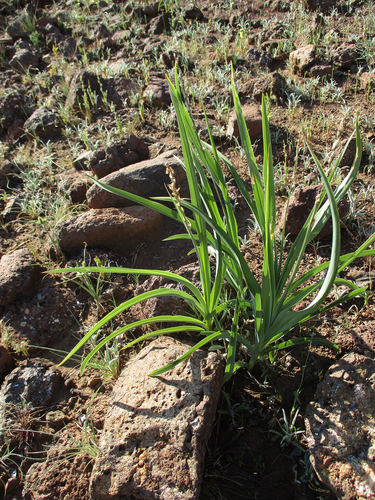
iNaturalist· cc-by-nc
(c) Suresh Ghimire, some rights reserved (CC BY-NC), uploaded by Suresh Ghimire
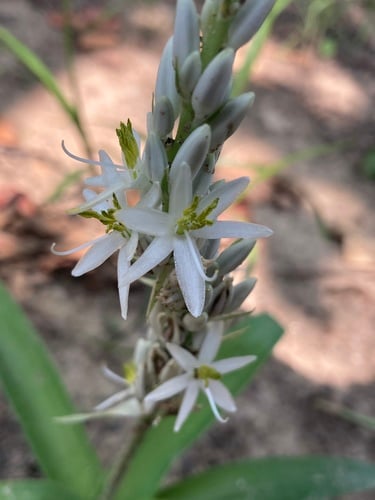
iNaturalist· cc-by-nc-nd
(c) Chief RedEarth, some rights reserved (CC BY-NC-ND), uploaded by Chief RedEarth
Summary
A perennial growing to 1.2m tall, flowering May to July with seeds maturing September to October. Hermaphroditic and self-fertile, bee-pollinated. Adapts to light sandy, medium loamy, or heavy clay soils with good drainage. Tolerates mildly acidic to mildly alkaline pH. Grows well in full shade or semi-shade with preference for moist soil.
Description
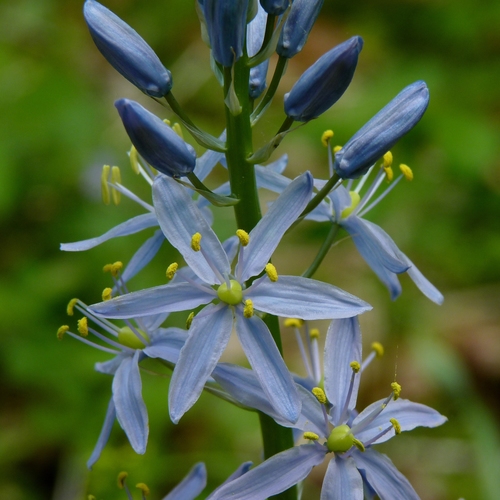
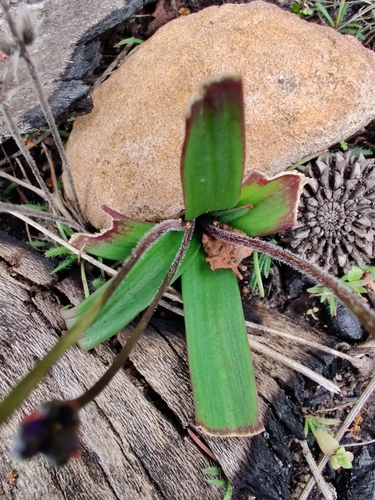
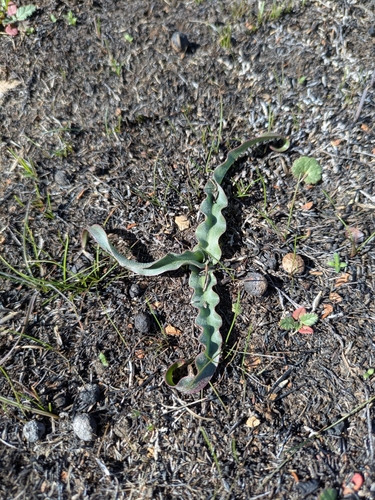
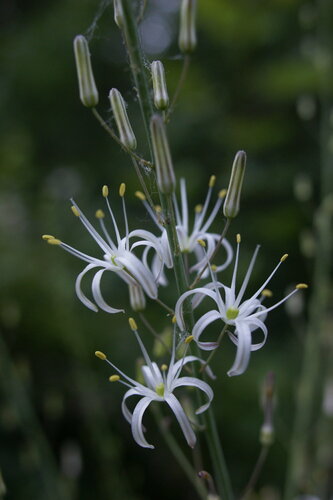
A herb. It grows to about 1-2 m high. The stem is grooved. The leaves do not have leaf stalks. The leaves occur in rings of 3-6. They are 12-16.5 cm long and 0.2-0.7 cm wide. They are narrow and sword shaped. They are curled at the tip. The edges of the leaves are rolled in. The flowers are white. They are arranged as equal stalks flowers along a stalk. The fruit are red berries.
Edible Uses
Tender leaves and young shoots are cooked as a vegetable and can serve as an asparagus substitute.
Traditional Uses
The tender leaves and shoots are cooked as a vegetable. They are boiled and eaten with Chilli sauce. The rhizome is eaten raw in salads or cooked as a vegetable. It is also used as a tonic soup.
Medicinal Uses
The roots are cardiotonic, sialagogue, stimulant, and tonic. In Tibetan medicine, the roots are described as having a sweet taste and neutral potency. They are considered antitussive, carminative, and tonic, and are said to promote bodily heat and dry up serous fluids. They are used to treat loss of vigour, pain in the kidneys and hips, swelling and fullness in the abdominal region, accumulation of fluids in bone joints, skin eruptions, and coughs.
Distribution
A subtropical plant. In Nepal it grows between 1700-4600 m altitude. It grows in Yunnan in China. It suits hardiness zones 6-9. In Sichuan.
Where It Grows
Asia, Australia, Bhutan, China, Himalayas, India, Myanmar, Nepal, Northeastern India, Pakistan, SE Asia, Sikkim, Tibet,
Cultivation
Plants are grown from seed or root tubers.
Propagation
Seed is best sown as soon as it is ripe in early autumn in a shady part of a cold greenhouse. Stored seed should be sown as early in the year as possible. Germination can be slow, seedlings may not come true to type, and it takes several years for plants to reach a good size. When large enough to handle, prick seedlings out into individual pots and grow on in a shady position in the greenhouse for at least the first winter. Plant out into permanent positions in late spring or early summer, after the last expected frosts. Division can be done in March or October. Larger divisions can go directly into permanent positions, while smaller divisions are better potted up and grown on in light shade in a cold frame until well established before planting out in late spring or early summer.
Other Uses
None known.
Other Information
It is sold in local markets.
Notes
There are about 50 Polygonatum species. Also put in the family Convallariaceae.
Synonyms
Also Known As
Bing du jiang, Huo pi da guo, Khirimla, Ma wei gen, Meda, Me ru xia, Ramsikia
References (24)
- Ambasta, S.P. (Ed.), 2000, The Useful Plants of India. CSIR India. p 478
- Cao, Y., et al, 2020, Ethnobotanical study on wild edible plants used by three trans-boundary ethnic groups in Jiangcheng County, Pu’er, Southwest China. Journal of Ethnobiology and Ethnomedicine (2020) 16:66
- Cheng, Z., et al, 2022, Ethnobotanical study on wild edible plants used by Dulong people in northwestern Yunnan, China. Journal of Ethnobiology and Ethnomedicine (2022) 18:3
- Cundall, P., (ed.), 2004, Gardening Australia: flora: the gardener's bible. ABC Books. p 1067
- Dangol, D. R. et al, 2017, Wild Edible Plants in Nepal. Proceedings of 2nd National Workshop on CUAOGR, 2017.
Show all 24 references Hide references
- Ding, X., 2021, Collection calendar: the diversity and local knowledge of wild edible plants used by Chenthang Sherpa people to treat seasonal food shortages in Tibet, China. Journal of Ethnobiology and Ethnomedicine 17:40
- Dobriyal, M. J. R. & Dobriyal, R., 2014, Non Wood Forest Produce an Option for Ethnic Food and Nutritional Security in India. Int. J. of Usuf. Mngt. 15(1):17-37
- Flora of Pakistan. www.eFloras.org
- Gautam, R. S., et al, 2022, Ethnobotanical Review of Wild Edible Plants of Nepal. Journal of Natural History Museum Volume 32, 2021-22 p 105
- Ghimire, S. K., et al, 2008, Non-Timber Forest Products of Nepal Himalaya. WWF Nepal p 99
- Ghorbani, A., et al, 2012, A comparison of the wild food plant use knowledge of ethnic minorities in Naban River Watershed Nature Reserve, Yunnan, SW China. Journal of Ethnobiology and Ethnomedicine; 8:17
- Hui, Y. H., Handbook of Food Science, Technology, and Engineering. Volume 2. Table 98:6
- Ill. bot. Himal. Mts. 1(10):380. 1839
- Joshi, N., et al, 2007, Traditional neglected vegetables of Nepal: Their sustainable utilization for meeting human needs. Tropentag 2007. Conference on International Agricultural Research for Development.
- Khakurel, D., et al, 2021, Foods from the wild: Local knowledge, use pattern and distribution in Western Nepal. PLOS ONE.
- Manandhar, N.P., 2002, Plants and People of Nepal. Timber Press. Portland, Oregon. p 374
- Manju, S., and Sundriyal, R. C., 2001, Wild Edible Plants of the Sikkim Himalaya: Nutritive Values of Selected Species. Economic Botany 55(3): 377-390 (As
- Misra, S. et al, 2008, Wild leafy vegetables: A study of their subsistence dietetic support to the inhabitants of Nanda Devi Biosphere reserve, India. Journal of Ethnobiology and Ethnomedicine. 4:15
- Negi, K.S., 1988, Some little known wild edible plants of U.P. Hills. J. Econ. Tax. Bot. Vol. 12 No. 2 pp 345-360
- Plants for a Future database, The Field, Penpol, Lostwithiel, Cornwall, PL22 0NG, UK. http://www.scs.leeds.ac.uk/pfaf/
- Wang, J. et al, 2013, A Study on the Utilization of Wild Plants for Food in Liangshan Yi Autonomous Prefecture. Plant Diversity and Resources. 35(4): 416-471
- Wujisguleng, W., et al, 2012, Ethnobotanical review of food uses of Polygonatum (Convallariaceae) in China. Acta Societatis Botanicorum Poloniae 81(4):239-244
- Zhang, L. et al, 2013, An Ethnobotanical Study of Traditional Edible Plants Used by Naxi People in Northwestern Yunnan, China. - A Case Study in Wenhai Village. Plant Diversity and Resources. p 484
- Zhang, L., et al, 2016, Ethnobotanical study of traditional edible plants used by the Naxi people during droughts. Journal of Ethnobiology and Ethnomedicine. 12:39