Pinanga copelandii
Becc.
Bagtoan palm
gbif· cc0
President and Fellows of Harvard College
Description
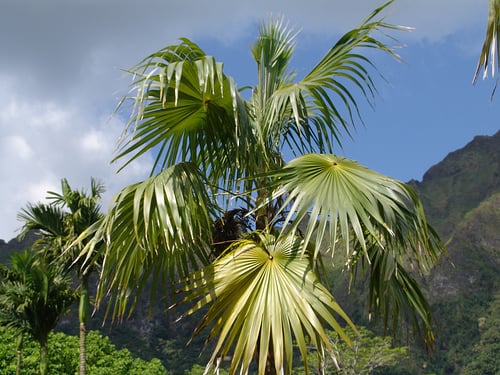
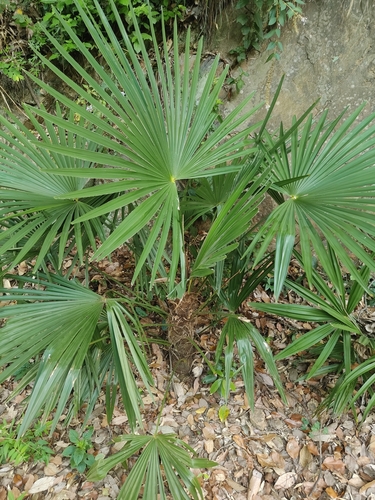
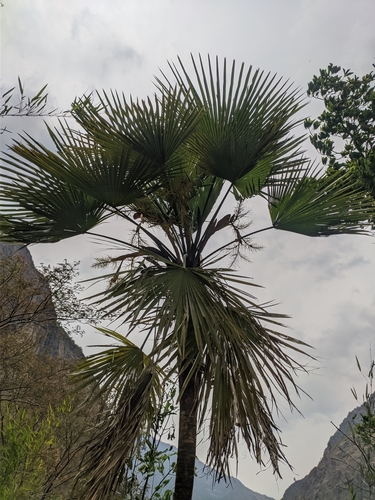
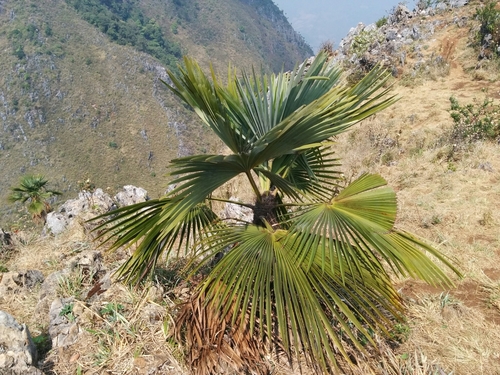
A slender and very small palm. It can grow to 10 m tall. The trunk is 10 cm across. The crown-shaft is 1 m long and dull green. The leaves have many segments and are very unequal. They have one to many ribs. The leaves are 3 m long. They are uniform dark green on the upper surface or slightly mottled. The leaf tips are divided. The flower is a spike around a central axis with the branches arranged in a spiral. The fruit is arranged in 2 rows. They are 8 to 20 mm by 13 mm. The seed is spherical with a horizontal embryo.
Edible Uses
The bud is cooked and eaten, and the palm heart is harvested as a vegetable.
Traditional Uses
The bud is cooked and eaten.
This uses section is brief — help expand it
Distribution
A tropical plant. They occur in damp primary forests at low and medium altitudes and up to 1200 m in the Philippines. It grows in tropical and subtropical regions.
Where It Grows
Asia, Australia, Indonesia, Pacific, Philippines*, SE Asia,
Cultivation
Plants can be grown from seeds.
Also Known As
Abiki, Pinang kopelandi
References (6)
- Jones, D.L., 1994, Palms throughout the World. Smithtonian Institution, Washington. p 295
- Jones, D.L., 2000, Palms of Australia 3rd edition. Reed/New Holland. p 201
- Monsalud, M.R., Tongacan, A.L., Lopez, F.R., & Lagrimas, M.Q., 1966, Edible Wild Plants in Philippine Forests. Philippine Journal of Science. p 513
- Riffle, R.L. & Craft, P., 2003, An Encyclopedia of Cultivated Palms. Timber Press. p 412
- Sukarya, D. G., (Ed.) 2013, 3,500 Plant Species of the Botanic Gardens of Indonesia. LIPI p 805
Show all 6 references Hide references
- World Checklist of Useful Plant Species 2020. Royal Botanic Gardens, Kew