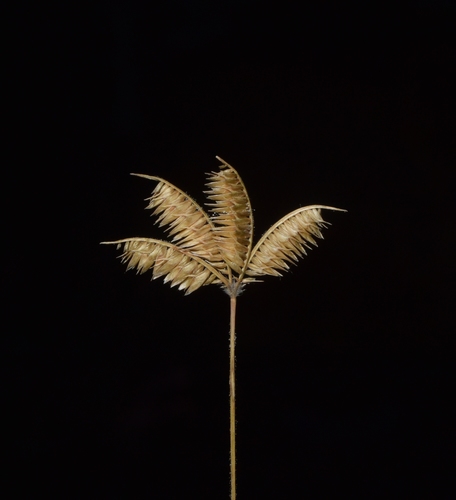
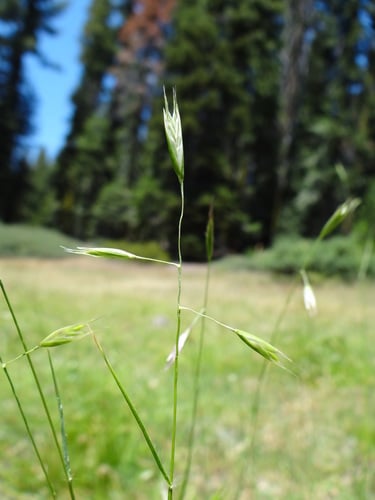
Panicum antidotale
Retz.
Blue Panic Grass, Giant Panic Grass, Little Millet
iNaturalist· cc-by
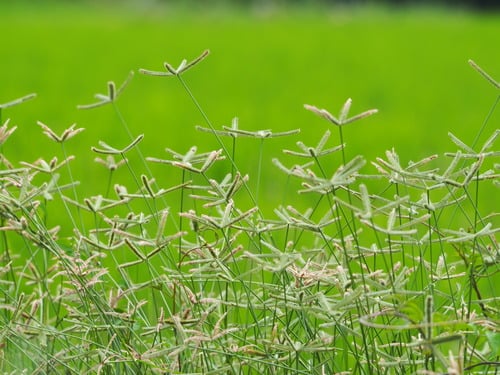
(c) Alex Abair, some rights reserved (CC BY)
iNaturalist· cc-by
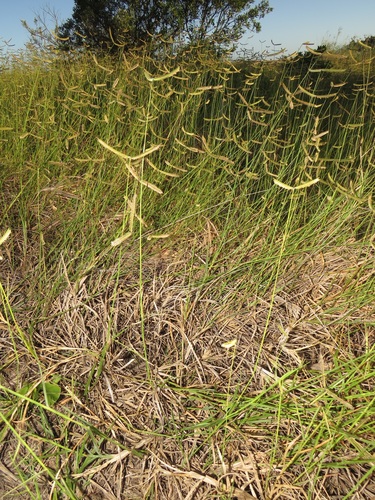
(c) Alex Abair, some rights reserved (CC BY)
iNaturalist· cc-by
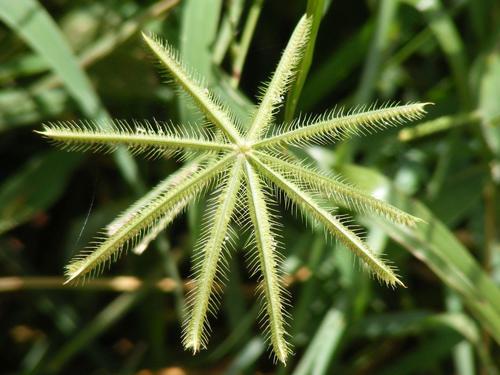
(c) Alex Abair, some rights reserved (CC BY)
Summary
Panicum antidotale is a perennial grass growing to 3 m tall. The hermaphroditic plant is wind-pollinated. It adapts to light sandy, medium loamy, and heavy clay soils with good drainage across mildly acidic to basic pH ranges. The plant requires full sun and prefers moist soil.
Description
A perennial millet grass. It has underground stems or rhizomes. It grows up to 3 m tall. It is woody. The leaf blades are 6-30 cm long and 4-14 mm wide. They are flat and have a sharp point. The flowers are green.
Edible Uses
One report notes the plant is edible but gives no further details; this most likely refers to the seed.
Traditional Uses
The seed is eaten fried. It is also mixed with millet for bread making.
This uses section is brief — help expand it
Medicinal Uses
Smoke from the burning plant is used to fumigate wounds and as a disinfectant in the treatment of smallpox.
Distribution
It is a tropical plant and also grows in temperate places. It grows on sand and sand dunes and on undulating plains. It grows in desert regions. It can grow in salty soils. It can grow in arid places. In Argentina it grows below 500 m above sea level. Western Rajasthan.
Where It Grows
Afghanistan, Africa, Arabia, Argentina, Asia, Australia, Bolivia, Brazil, Burkina Faso, Central Africa, Central America, Central Asia, Colombia, Congo, East Africa, Egypt, Europe, Fiji, France, Himalayas, India, Iran, Iraq, Japan, Kenya, Malaysia, Marianas, Mexico, Middle East, Myanmar, Nepal, Nicaragua, Nigeria, North Africa, North America, Northeastern India, Oman, Pacific, Pakistan, Papua New Guinea, PNG, Saudi Arabia, SE Asia, South America, Sri Lanka, Tajikistan, Tanzania, Turkmenistan, United Arab Emirates, UAE, USA, West Africa, Yemen, Zimbabwe,
Cultivation
We have almost no information on this species and do not know if it will be hardy in Britain. The plant has strong spreading rhizomes. It has been experimentally planted for forage in Missouri, Texas, Oklahoma and California. The following notes are based on the general needs of the genus. Requires a moderately fertile well-drained soil in full sun.
Propagation
Sow seed in spring in a greenhouse, barely covering it. Germination should take place within a week. Prick out seedlings into trays or individual pots and plant out after the last expected frosts.
Other Uses
None known.
Other Information
It is a famine food. It is cultivated.
Notes
There are about 500 Panicum species.
Synonyms
Also Known As
Bangagli, Banwari, Blue Panicgrass, Dhusdo, Dhusghas, Gamna, Ghamur, Gharam, Girni, Git, Gramna, Gunara, Male, Meneri, Nassiam pillu, Pinisu pillu
References (14)
- Ambasta, S.P. (Ed.), 2000, The Useful Plants of India. CSIR India. p 424
- Arora, R. K., 2014, Diversity in Underutilized Plant Species - An Asia-Pacific Perspective. Bioversity International. p 17
- Flora of Pakistan. www.eFloras.org
- Gangwar, A. K. & Ramakrishnan, P. S., 1990, Ethnobotanical Notes on Some Tribes of Arunachal Pradesh, Northeastern India. Economic Botany, Vol. 44, No. 1 pp. 94-105 (As Panicum miliare)
- INFOODSUpdatedFGU-list.xls (As Panicum miliare)
Show all 14 references Hide references
- Lazarides, M. & Hince, B., 1993, Handbook of Economic Plants of Australia, CSIRO. p 181
- Observ. bot. 4:17. 1786-1787
- Paczkowska, G. & Chapman, A.R., 2000, The Western Australian Flora. A Descriptive Catalogue. Western Australian Herbarium. p 111
- Plants for a Future database, The Field, Penpol, Lostwithiel, Cornwall, PL22 0NG, UK. http://www.scs.leeds.ac.uk/pfaf/
- Royal Botanic Gardens, Kew (1999). Survey of Economic Plants for Arid and Semi-Arid Lands (SEPASAL) database. Published on the Internet; http://www.rbgkew.org.uk/ceb/sepasal/internet [Accessed 3rd June 2011]
- SHANKARNARAYAN & SAXENA,
- Wilson, J.M. & Witcombe, J.R., Crops for Arid lands, in Wickens, G.E., Goodin, J.R., and Field, D.V.,(Eds.) 1985, Plants for Arid Lands. Unwin Hyman, London, p 39
- World Checklist of Useful Plant Species 2020. Royal Botanic Gardens, Kew
- Zeven, A. C. & de West, J. M. J., 1982, Dictionary of cultivated plants and their regions of diversity. Wageningen. p 74