Pandanus monticola
F. Muell.
Rainforest Screw Pine, Urchin-fruited pandan
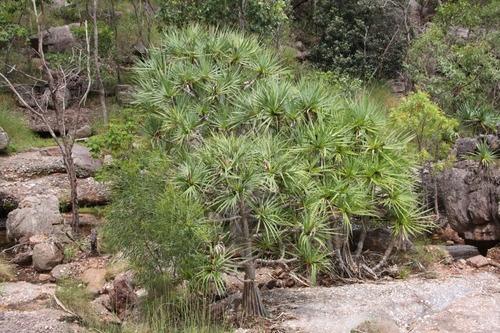
iNaturalist· cc-by-nc
(c) Penny Taylor, some rights reserved (CC BY-NC)
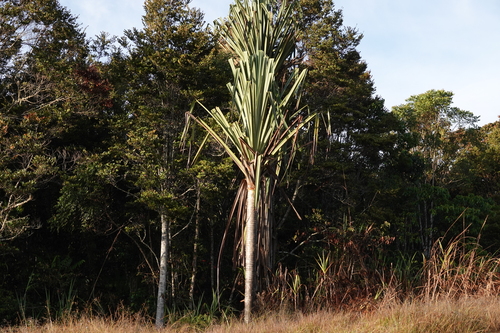
iNaturalist· cc-by-nc
(c) Penny Taylor, some rights reserved (CC BY-NC)
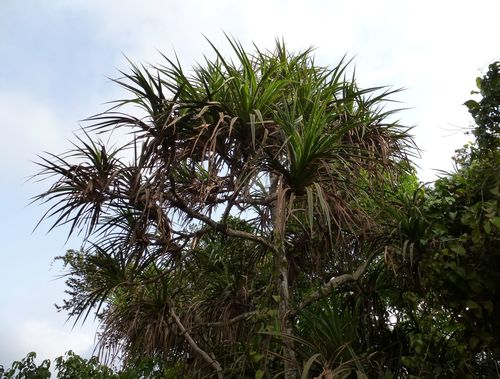
iNaturalist· cc-by-nc
(c) Justin Garwood, some rights reserved (CC BY-NC)
Description
A shrub or small tree. It grows up to 3-5 m tall and spreads 1-4 m wide. The stems are slender and almost climbing. There are no prop roots. The leaves are simple and 1-2 m long by 5-7 cm wide. The edges of the leaves have teeth. The midrib also has teeth. The tips of the leaves are often drooping. The male flowering stalk is branched and 10-15 cm long. The male spike is 5-7 cm long. It has cream or white bracts below it. The female flower is unbranched and has white bracts. The fruiting heads are up to 12 cm long by 8 cm wide. They occur singly and are very prickly. They contain many seeds. The seeds are 4-10 mm long. The flesh is edible.
Edible Uses
The fruit flesh is edible.
Traditional Uses
The flesh is edible but it can irritate the mouth.
This uses section is brief — help expand it
Known Hazards
The flesh can irritate the mouth.
Distribution
A tropical plant. It grows naturally in rainforest in NE Queensland in Australia. It grows from sea level to 840 m altitude. They grow in shade. Plants fruit better in sunny locations. It needs well drained soil. In Cairns BG. In Townsville Anderson BG.
Where It Grows
Australia*,
Cultivation
Plants are grown from fresh seed.
Notes
There are about 600 Pandanus species. They grow in the tropics.
Synonyms
Also Known As
Urchin-fruited pandan, Scrub breadfruit
References (6)
- Bodkin, F., 1991, Encyclopedia Botanica. Cornstalk publishing, p 758
- Cooper W & Cooper W T, 1994, Fruits of the Rain Forest. RD Press p 214
- Cooper, W. and Cooper, W., 2004, Fruits of the Australian Tropical Rainforest. Nokomis Editions, Victoria, Australia. p 387
- Cronin, L., 1989, The Concise Australian Flora. Reed. p 252
- Elliot, W.R., & Jones, D.L., 1997, Encyclopedia of Australian Plants suitable for cultivation. Vol 7. Lothian. p 154 (Drawing)
Show all 6 references Hide references
- Jackes, B.R., 2001, Plants of the Tropics. Rainforest to Heath. An Identification Guide. James Cook University. p 72