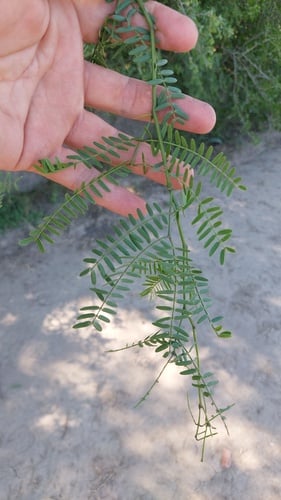
Alysicarpus vaginalis
(L.) DC.
Alyce, Buffalo Clover
iNaturalist· cc0
no rights reserved, uploaded by 葉子
iNaturalist· cc-by-sa
(c) Douglas Goldman, some rights reserved (CC BY-SA), uploaded by Douglas Goldman
iNaturalist· cc-by-nc
(c) coralaviles, some rights reserved (CC BY-NC)
Summary
Source: WikipediaAlysicarpus vaginalis is a species of flowering plant in the legume family, Fabaceae. It is native to parts of Africa and Asia, and it has been introduced to other continents, such as Australia and the Americas. It is cultivated as a fodder for livestock, for erosion control, and as a green manure. Common names include alyce clover, buffalo clover, buffalo-bur, one-leaf clover, and white moneywort.
Description
A spreading low lying shrub or herb. It has many stems. They are 10-60 cm long. These spread out from a rootstock which continues to live from year to year. The leaf has one leaflet. The leaflet is oblong or sword shaped and 0.5-6.6 cm long by 0.3-2.6 cm wide. The leaflets are dark green above and pale underneath. They are oval and have netted veins. They can be notched or with a tip at the end. The flowers are small and not easily seen. They are 6 mm long at the ends of branches. The flowers occur in clusters 2-13 cm long. The flower colour varies. The pods are deep red and not quite round. They stick upwards. They contain 4-7 seeds. The seeds are brown and sometimes they are mottled.
Edible Uses
The herb and leaves are eaten, and it has been used as an emergency or famine food in India.
Traditional Uses
The herb is eaten.
This uses section is brief — help expand it
Medicinal Uses
The herb is used in medicine for coughs.
Distribution
A tropical plant. In Papua New Guinea it grows from sea level to 840 m altitude. In Nepal it grows between 200 and 1200 m altitude. It grows in bare patches in grassland. It grows on sandy sea sides. In Yunnan.
Where It Grows
Africa, American Samoa, Asia, Australia, Cambodia, China, Dominican Republic, East Africa, Eswatini, Fiji, Guam, Guiana, Guianas, Guyana, Haiti, Himalayas, India, Indochina, Indonesia, Laos, Malaysia, Maldives, Mozambique, Myanmar, Nepal, Pacific, Papua New Guinea, PNG, Philippines, Rotuma, Sao Tome and Principe, SE Asia, Sierra Leone, South Africa, Southern Africa, South America, Sri Lanka, Suriname, Swaziland, Thailand, Tuvalu, Venezuela, Vietnam, West Africa, West Indies, Zimbabwe,
Cultivation
Plants are grown from seed.
Propagation
Like many species within the family Fabaceae, once they have been dried for storage the seeds of this species may benefit from scarification before sowing in order to speed up and improve germination. This can usually be done by pouring a small amount of nearly boiling water on the seeds (being careful not to cook them!) and then soaking them for 12 - 24 hours in warm water. By this time they should have imbibed moisture and swollen - if they have not, then carefully make a nick in the seedcoat (being careful not to damage the embryo) and soak for a further 12 hours before sowing.
Other Uses
The plant is a useful component of native pastures in Fiji and northern Australia, especially where fertilizer has been applied. It has been used as a cover crop in Papua New Guinea and in rubber plantations in Java, and also as a hay crop in the United States. It is considered to be a good ground cover in Malaysia for preventing erosion on clay soils in rubber plantations. It can be used for soil improvement and conservation, providing effective erosion control on newly established terraces.
Production
Plants were flowering and fruiting in March to May in northern Australia. A plant will continue to grow for 3 years.
Other Information
An emergency or famine food used in India. It is used in medicine for coughs. It is not known if it is used for food in Papua New Guinea.
Synonyms
Also Known As
Brobos, Brobos sapi, Gude oyod, Hange-the, Lian jia dou, One-leaf clover, Sesenep, Tebalan, Than-ma-naing-kyauk-ma-naing, Vihafilaa, White moneywort
References (20)
- Ambasta S.P. (Ed.), 2000, The Useful Plants of India. CSIR India. p 33
- Burkill, I.H., 1966, A Dictionary of the Economic Products of the Malay Peninsula. Ministry of Agriculture and Cooperatives, Kuala Lumpur, Malaysia. Vol 1 (A-H) p 122
- Franklin, J., Keppel, G., & Whistler, W., 2008, The vegetation and flora of Lakeba, Nayau and Aiwa Islands, Central Lau Group, Fiji. Micronesica 40(1/2): 169–225, 2008
- Huang Puhua; H. Ohashi, FABACEAE (Draft), Trib. Desmodieae (Bentham) Hutchinson. Flora of China.
- Hussey, B.M.J., Keighery, G.J., Cousens, R.D., Dodd, J., Lloyd, S.G., 1997, Western Weeds. A guide to the weeds of Western Australia. Plant Protection Society of Western Australia. p 148
Show all 20 references Hide references
- Jackes, B.R., 2001, Plants of the Tropics. Rainforest to Heath. An Identification Guide. James Cook University. p 54
- Kenneally, K.E., Edinger, D. C., and Willing T., 1996, Broome and Beyond, Plants and People of the Dampier Peninsula, Kimberley, Western Australia. Department of Conservation and Land Management. p 152
- Manandhar, N.P., 2002, Plants and People of Nepal. Timber Press. Portland, Oregon. p 84
- McMakin, P.D., 2000, Flowering Plants of Thailand. A Field Guide. White Lotus. p 95 (As Alysicarpus nummularifolius)
- Paczkowska, G . & Chapman, A.R., 2000, The Western Australian Flora. A Descriptive Catalogue. Western Australian Herbarium. p 416
- Pham-Hoang Ho, 1999, An Illustrated Flora of Vietnam. Nha Xuat Ban Tre. p 935
- Plants of Haiti Smithsonian Institute http://botany.si.edu/antilles/West Indies
- Prodr. 2:353. 1825
- Singh, H.B., Arora R.K.,1978, Wild edible Plants of India. Indian Council of Agricultural Research, New Delhi. p 39
- Sujanapal, P., & Sankaran, K. V., 2016, Common Plants of Maldives. FAO & Kerala FRI, p 30
- Swaziland's Flora Database http://www.sntc.org.sz/flora
- Thaman, R. R, 2016, The flora of Tuvalu. Atoll Research Bulletin No. 611. Smithsonian Institute p 88
- Verdcourt, B., 1979, Manual of New Guinea Legumes. Botany Bulletin No 11, Division of Botany, Lae, Papua New Guinea. p 421
- WATT
- Wheeler, J.R.(ed.), 1992, Flora of the Kimberley Region. CALM, Western Australian Herbarium, p 367