Halleria lucida
L.
African honeysuckle, Tree-fucsia
iNaturalist· cc-by-nc
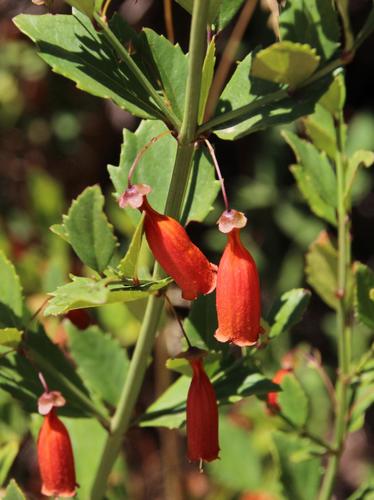
(c) Malcolm Douglas, some rights reserved (CC BY-NC), uploaded by Malcolm Douglas
iNaturalist· cc-by-sa
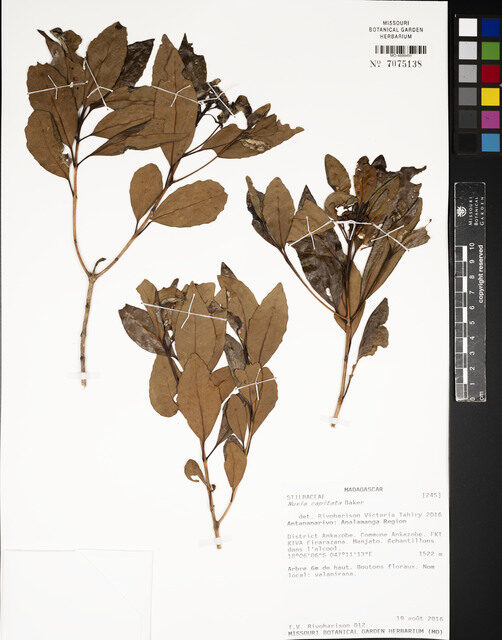
(c) Tony Rebelo, some rights reserved (CC BY-SA)
iNaturalist· cc-by-sa
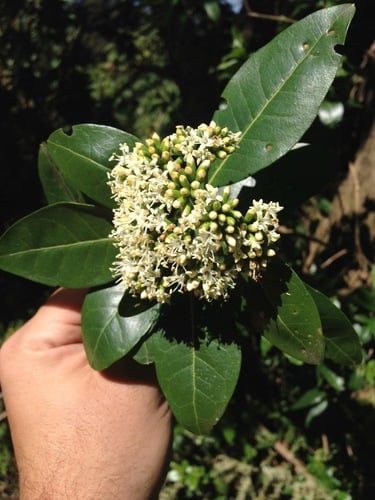
(c) Tony Rebelo, some rights reserved (CC BY-SA)
Summary
Source: WikipediaHalleria lucida (also known as tree fuchsia, umBinza or notsung) is a small, attractive, evergreen tree that is indigenous to Southern Africa. It is increasingly grown as an ornamental tree in African gardens.
Description
A slender tree. It grows up to 12 m tall. It can be a bush in poorer growing conditions. The trunk can be 38 cm across. The bark is grey or brown and has grooves and often peels off in long strips. The leaves are simple and in opposite pairs. The base is often unequal and broad. Leaves are 1.3-10 cm long by 0.6-7 cm wide. The leaves are light green and the edges toothed. The flowers are 2.5 cm long and trumpet-shaped. The flowers can be red, orange or cream. The fruit are berries. They are black when ripe. They have a jelly-like flesh and many small seeds. They are 18 mm across. They are edible.
Edible Uses
The black berries are eaten raw and are very sweet, used fresh in fruit salads or stored for later use. The flowers are sucked for their nectar.
Traditional Uses
The fruit are eaten raw. They are very sweet. They are used in fruit salads. They can be stored. The flowers are sucked for their nectar.
This uses section is brief — help expand it
Medicinal Uses
Dry leaves are soaked in water and squeezed into the ear to relieve earache.
Distribution
A subtropical plant. It grows on the edge of mountain and river forests. It can tolerate some frost but does not thrive in cold conditions. It suits hardiness zones 8-10.
Where It Grows
Africa, Angola, Australia, Botswana, Central Africa, Congo, East Africa, Eswatini, Ethiopia, Lesotho, Malawi, Middle East, Mozambique, Slovenia, South Africa, Southern Africa, Sudan, Swaziland, Yemen, Zambia, Zimbabwe,
Cultivation
Plants can be grown from seed. The flesh should be removed from the seeds. These take about 6 weeks to germinate. Plants can also be grown from cuttings. These are best treated with a rooting hormone. Roots develop in about 6 weeks. Plants can also be grown by layering. A spacing of 1-4 m is suitable.
Propagation
Seed - sow in a container or nursery seed bed. Trays can be placed over a bottom heat of 25°c although this is not essential for germination to occur. Seed should germinate within 6 weeks. Seedlings can be transplanted as soon as they are large enough to handle. Softwood cuttings should be taken from actively growing shoots early in the growing season. Place in a propagator with intermittent mist and bottom heat of 28°c. Rooting should occur within 6 weeks, and the newly rooted cuttings require a weaning period of 1 month. Heeled cuttings should be taken at the end of the growing season. Place in a propagator with intermittent mist and bottom heat of 28°c. Rooting should occur within 6 weeks, and the newly rooted cuttings require a weaning period of 1 month.
Other Uses
The wood can be used to start a fire by friction. The wood is light coloured tinged with yellow, hard, heavy, tough and strong. It is well suited to carpentry, but is not much used because it is seldom available in large enough sizes. It was once valued for wagon poles, tools and spear shafts. The wood is used for fuel. The plant is suitable for use as an informal hedge. One of the best bird attracting trees, drawing in nectar-feeding sunbirds when in flower and fruit-eating birds when in fruit.
Production
Trees can produce fruit after 2 years but yields increase in later years. In times of famine the green fruit are harvested and stored in a hole for several days to ripen.
Other Information
Fruit are eaten especially by children.
Notes
There are 4-5 Halleria species. They grow in southern Africa. Also put in the Scrophulariaceae.
Synonyms
Also Known As
Iliminza, Indomela, Lebetsa, Liminta, Londomela, Morebve, Mubaratsotsa, Mudula, Murevhe, Mutapahuro, Notsung, Ouhout, Songodorere, Tree fuchsia, Umbinda, Umbindza, Umbinta, Umbinza, Umbita, Umhlahlakanya, Umminta, Unobibi, Unondomela, White olive, Wild fuchsia
References (32)
- Cundall, P., (ed.), 2004, Gardening Australia: flora: the gardener's bible. ABC Books. p 670
- Etherington, K., & Imwold, D., (Eds), 2001, Botanica's Trees & Shrubs. The illustrated A-Z of over 8500 trees and shrubs. Random House, Australia. p 368
- Facciola, S., 1998, Cornucopia 2: a Source Book of Edible Plants. Kampong Publications, p 229
- Fox, F. W. & Young, M. E. N., 1982, Food from the Veld. Delta Books. p 340
- Glowinski, L., 1999, The Complete Book of Fruit Growing in Australia. Lothian. p 184
Show all 32 references Hide references
- Guillarmod, J., 1971,
- Hibbert, M., 2002, The Aussie Plant Finder 2002, Florilegium. p 119
- http://plants.newplant.co.za/
- https://growwild.co.za Edible Indigenous plants
- Joffe, P., 2007, Creative Gardening with Indigenous Plants. A South African Guide. Briza. p 76
- John, L., & Stevenson, V., 1979, The Complete Book of Fruit. Angus & Robertson p 292
- Long, C., 2005, Swaziland's Flora - siSwati names and Uses http://www.sntc.org.sz/flora/
- Lyle, S., 2006, Discovering fruit and nuts. Land Links. p 234
- Magwede, K., van Wyk, B.-E., & van Wyk, A. E., 2019, An inventory of Vhavenḓa useful plants. South African Journal of Botany 122 (2019) 57–89
- Mason, 1971,
- Palgrave, K.C., 1996, Trees of Southern Africa. Struik Publishers. p 822
- Palmer, E and Pitman, N., 1972, Trees of Southern Africa. Vol. 2. A.A. Balkema, Cape Town p 1987
- Peters, C. R., O'Brien, E. M., and Drummond, R.B., 1992, Edible Wild plants of Sub-saharan Africa. Kew. p 185
- Reis, S. V. and Lipp, F. L., 1982, New Plant Sources for Drugs and Foods from the New York Botanical Garden herbarium. Harvard. p 275
- Ruiters-Welcome, A. K., 2019, Food plants of southern Africa. Ph.D. thesis. Univ. of Johannesburg p 104
- Schatz, G.E., 2001, Generic Tree Flora of Madagascar. Royal Botanical Gardens, Kew and Missouri Botanical Garden. p 387 (Genus)
- Schmidt, E., Lotter, M., & McCleland, W., 2007, Trees and shrubs of Mpumalanga and Kruger National Park. Jacana Media p 600
- Sp. Pl. 2:625. 1753
- Swaziland's Flora Database http://www.sntc.org.sz/flora
- van Wyk, B, van Wyk, P, and van Wyk B., 2000, Photographic guide to Trees of Southern Africa. Briza. p 173
- Venter, F & J., 2009, Making the most of Indigenous Trees. Briza. p 188
- Vinnicombe, 1976,
- von Breitenbach, F., 1985, Southern Cape Tree Guide. Department of Environment Affairs, Forestry Branch. Pamphlet 360 Pretoria p 31
- Welcome, A. K. & Van Wyk, B.-E., 2019, An inventory and analysis of the food plants of southern Africa. South African Journal of Botany 122 (2019) 136–179
- White, F., Dowsett-Lemaire, F. and Chapman, J. D., 2001, Evergreen Forest Flora of Malawi. Kew. p 549
- World Checklist of Useful Plant Species 2020. Royal Botanic Gardens, Kew
- www.zimbabweflora.co.zw 2011