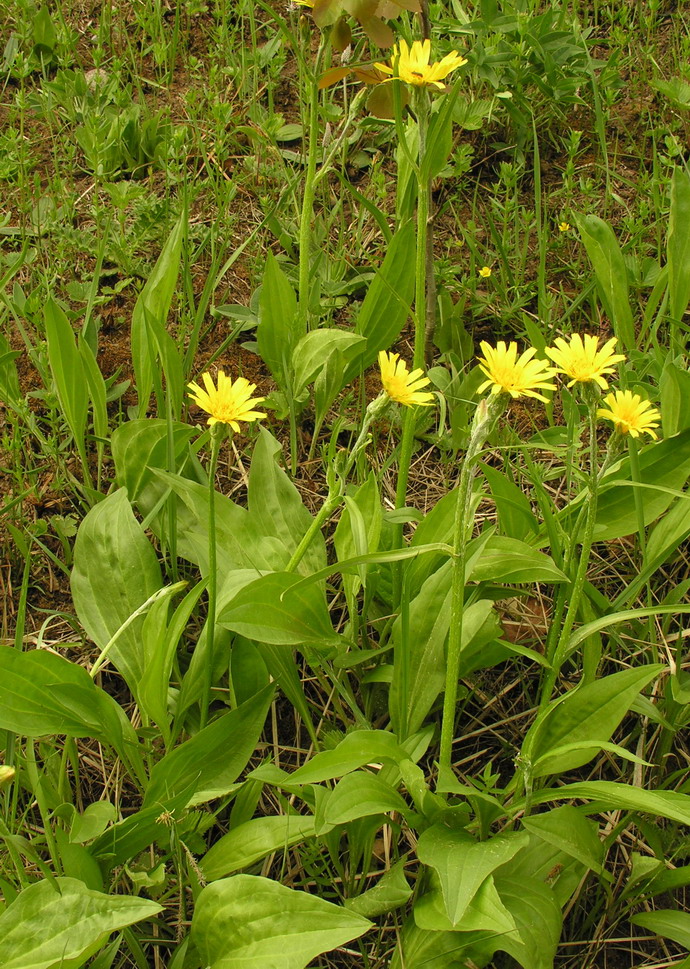
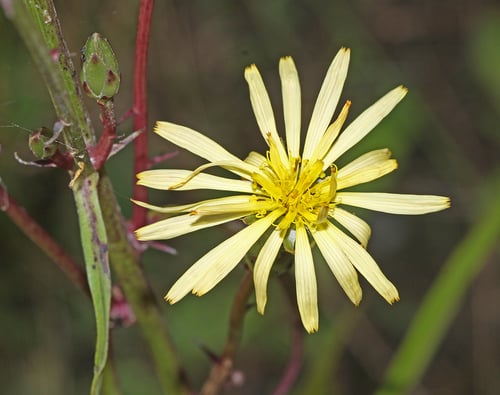
Guizotia abyssinica
(L.f.) Cassini
Niger Seed
iNaturalist· cc-by-nc
(c) Helena Yarova, some rights reserved (CC BY-NC)
iNaturalist· cc-by-nc
(c) Helena Yarova, some rights reserved (CC BY-NC)
iNaturalist· cc-by-nc
(c) Helena Yarova, some rights reserved (CC BY-NC)
Summary
Source: WikipediaGuizotia abyssinica is an erect, stout, branched annual herb, grown for its edible oil and seed. Its cultivation originated in the Eritrean and Ethiopian Highlands, and has spread to other parts of Ethiopia. Common names include noog/nug (Ethio-Semitic and Eritrean ኑግ nūg or ኒህዩግ nihyug); ramtil or ramtilla; niger or nyger seed (all pronounced , NY-jər); inga seed; and blackseed. Noug has been described as semi-domesticated, self-incompatible crop with yellow flowering heads and seeds. Recent studies have revealed the regional genetic diversity of some noug populations grown in Ethiopia based on RAPD and AFLP markers.
Description
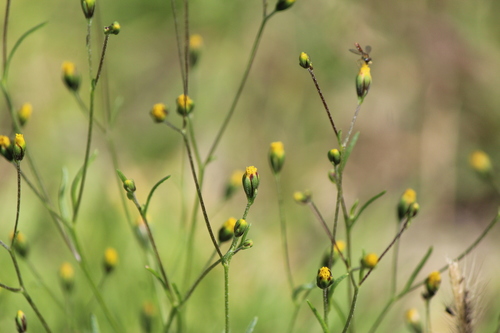
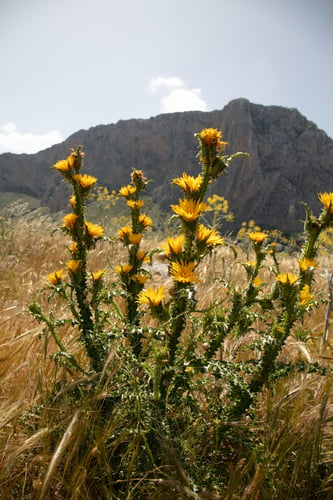
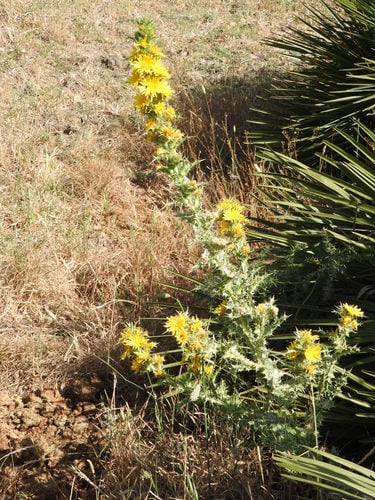
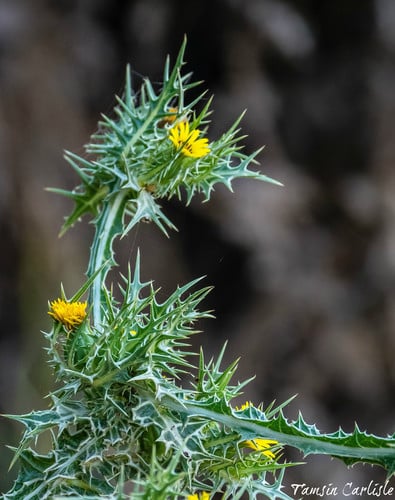
An erect branched herb. It grows 30-180 cm tall. The stems are soft and hairy. The leaves are usually carried opposite one another. The leaves do not have stalks and they clasp the stem. The leaves have teeth along the edge and the surface is a little rough. The flower head is made up of many small flowers each capable of producing a seed. The fruit (called seeds) are black angled structures. They are up to 12 mm long. The seed inside is 3.5-5 mm long. There are about 250-300 seeds per gram.
Edible Uses
The seeds are eaten fried, used as a condiment, or dried and ground into a powder to mix with flour for making sweet cakes. Average seed yields in India range from 100–200 kg/ha when intercropped with ragi, and 300–400 kg/ha in pure stands. In Kenya, monocultural yields average 600 kg/ha, while yields of 1,000–1,200 kg/ha have been achieved on fertile Himalayan soils. Oil yields run to around 235 kg/ha. The seeds yield approximately 30% of a clear, slow-drying edible oil with a pleasant nutty taste. It can be used as a substitute for olive oil, mixed with linseed oil, or used as an adulterant for rape or sesame oil, and is used in cooking as a ghee substitute and in salad dressings.
Traditional Uses
The seeds can be fried and used as snacks. They are also used in sauces. They are also used for chutney and pickles. The seed cake is mixed with honey to make a sweet bread. The seed oil is edible. It is used in cooking.
Medicinal Uses
The seed oil is used in the treatment of rheumatism and applied to burns. A paste made from the seeds is applied as a poultice to treat scabies.
Distribution
It is grown in both temperate and tropical zones. It can compete well with weeds. It has some salt tolerance. The temperatures are between 16°C and 20°C where Niger does best. It cannot tolerate temperatures above 28°C average and must have temperatures above 6°C. In Africa it grows between 300 and 2300 m altitude but does best at 1800-2000 m altitude in Ethiopia. The rainfall is 100-1300 mm per year where it grows most. At lower altitudes a lower rainfall is satisfactory if it is spread through the growing season. It grows on a wide range of soils. It can grow on poorly drained soils. It needs short day lengths for flowering. In Nepal it grows between 900-2000 m altitude. It grows in open places. It can grow in arid places. Tasmania Herbarium. In Sichuan and Yunnan.
Where It Grows
Africa, Asia, Australia, Bangladesh, Bhutan, Britain, Cameroon, Canada, Central Africa, China, Congo, Czech Republic, East Africa, Eritrea, Ethiopia*, Europe, Germany, Ghana, Himalayas, India, Italy, Kenya, Malawi, Mediterranean, Myanmar, Nepal, North America, Northeastern India, Pakistan, SE Asia, Sikkim, Slovakia, Southern Africa, Spain, Sudan, Tanzania, Tasmania, Uganda, USA, West Africa, West Indies, Zimbabwe,
Cultivation
It is grown from seed. It is often sown mixed with finger millet. Seeds can be broadcast or planted in rows. 10-15 kg of seed per hectare are used for broadcast crops. When planted in rows 5-8 kg per hecatre of seed are used. Fertilisers do not improve seed yield much. As petals drop, seeds are harvested to avoid seed loss. Stems are cut near the ground, then dried for a few days before threshing.
Propagation
Sow seed in spring in situ, barely covering it, in soil that must be kept consistently moist — drying out will delay germination. In warm weather, germination typically occurs within 3–4 days. For larger areas, seed can be broadcast at a rate of 10 kg/ha, or sown in rows 40–50 cm apart at a rate of 5 kg/ha.
Other Uses
A drying oil obtained from the seed is used for burning and in the manufacture of soap and paints. The plant can be used as a green manure, typically dug in just as the plants are coming into flower.
Production
Flowering occurs 3 months after sowing. Seeds are ready for harvest 4-6 weeks later. It can take 5 months at altitudes over 2000 m. Yields can be 300-700 kg per hectare. Yields of 1400 kg are possible.
Other Information
It is a cultivated food plant. About 300,000 tons per year of oil are produced in Ethiopia and India.
Notes
The seeds have good food value.
Nutrition
| Part | Moisture | kJ | kcal | Protein | Vit A | Vit C | Iron | Zinc |
|---|---|---|---|---|---|---|---|---|
| Seed | 6.2 | 2019 | 483 | 17.3 | — | — | — | — |
Synonyms
Also Known As
Alashi, Gizkoa, Gurellu, Huchellu, Jhuse til, Kadellu, Kalatel, Kalatil, Karale, Khurasni, Khurosui, Negrillo, Neuk, Nigersaat, Noog, Nook Abessin, Nuga, Nughi, Nughio, Nuk, Pan-hnan, Payellu, Philunge, Rameli, Ramtal, Ramtil, Ramtilla, Sarguza, Sorguja, Surguja, Uchellu, Verrinuvvulu
References (37)
- Ambasta, S.P. (Ed.), 2000, The Useful Plants of India. CSIR India. p 250
- Arora, R. K., 2014, Diversity in Underutilized Plant Species - An Asia-Pacific Perspective. Bioversity International. p 112
- Bandyopadhyay, S. et al, 2009, Wild edible plants of Koch Bihar district, West Bengal. Natural Products Radiance 8(1) 64-72
- Bianchini, F., Corbetta, F., and Pistoia, M., 1975, Fruits of the Earth. Cassell. p 238
- Brouk, B., 1975, Plants Consumed by Man. Academic Press, London. p 235
Show all 37 references Hide references
- Bulcha, W., 2007. Guizotia abyssinica (L.f.) Cass. [Internet] Record from Protabase. van der Vossen, H.A.M. & Mkamilo, G.S. (Editors). PROTA (Plant Resources of Tropical Africa), Wageningen, Netherlands. < http://database.prota.org/search.htm>. Accessed 16 October 2009.
- Burkill, H. M., 1985, The useful plants of west tropical Africa, Vol. 1. Kew.
- Cobley, L.S. (rev. Steele, W.M.) 2nd Ed., 1976, An Introduction to the Botany of Tropical Crops. Longmans. p 294
- F. Cuvier, Dict. sci. nat. 59:248. 1829
- Dangol, D. R. et al, 2017, Wild Edible Plants in Nepal. Proceedings of 2nd National Workshop on CUAOGR, 2017.
- Facciola, S., 1998, Cornucopia 2: a Source Book of Edible Plants. Kampong Publications, p 38
- FAO, 1988, Traditional Food Plants, FAO Food and Nutrition Paper 42. FAO Rome p 315
- GAMMIE
- Gautam, R. S., et al, 2020, Wild Edible Fruits of Nepal. Int. J. Appl. Sci. Biotechnol. Vol 8(3): 289-304
- Gautam, R. S., et al, 2022, Ethnobotanical Review of Wild Edible Plants of Nepal. Journal of Natural History Museum Volume 32, 2021-22 p 107
- Getinet, A. and S.M. Sharma. 1996. Niger. Guizotia abyssinica (L. f.) Cass. Promoting the conservation and use of underutilized and neglected crops. 5. Institute of Plant Genetics and Crop Plant Research, Gatersleben/International Plant Genetic Re-sources Institute, Rome.
- Grubben, G. J. H. and Denton, O. A. (eds), 2004, Plant Resources of Tropical Africa 2. Vegetables. PROTA, Wageningen, Netherlands. p 562
- Hedrick, U.P., 1919, (Ed.), Sturtevant's edible plants of the world. p 335
- Jardin, C., 1970, List of Foods Used In Africa, FAO Nutrition Information Document Series No 2.p 43
- Kiple, K.F. & Ornelas, K.C., (eds), 2000, The Cambridge World History of Food. CUP p 1823
- Lazarides, M. & Hince, B., 1993, Handbook of Economic Plants of Australia, CSIRO. p 126
- Manandhar, N.P., 2002, Plants and People of Nepal. Timber Press. Portland, Oregon. p 252
- Menninger, E.A., 1977, Edible Nuts of the World. Horticultural Books. Florida p 103
- Molla, A., Ethiopian Plant Names. http://www.ethiopic.com/aplants.htm
- Plants for a Future database, The Field, Penpol, Lostwithiel, Cornwall, PL22 0NG, UK. http://www.scs.leeds.ac.uk/pfaf/
- Polunin, O., & Stainton, A., 2006, Flowers of the Himalaya, Oxford India Paperbacks. p 188
- Purseglove, J.W., 1968, Tropical Crops Dicotyledons, Longmans. p 65
- Rashid, H. E., 1977, Geography of Bangladesh. Westview. p 290 (As Guizotia abysinaica)
- Royal Botanic Gardens, Kew (1999). Survey of Economic Plants for Arid and Semi-Arid Lands (SEPASAL) database. Published on the Internet; http://www.rbgkew.org.uk/ceb/sepasal/internet [Accessed 11th April 2011]
- Rubaihayo, E. B., Conservation and use of traditional vegetables in Uganda. Bioversity International.
- Savita, et al, 2006, Studies on wild edible plants of ethnic people in east Sikkim. Asian J. of Bio Sci. (2006) Vol. 1 No. 2 : 117-125
- Seidemann J., 2005, World Spice Plants. Economic Usage, Botany, Taxonomy. Springer. p 171
- Smith, P.M., 1979, Niger seed, in Simmonds, N.W., (ed), Crop Plant Evolution. Longmans. London. p 305
- van Wyk, B., 2005, Food Plants of the World. An illustrated guide. Timber press. p 205
- Vickery, M.L. and Vickery, B., 1979, Plant Products of Tropical Africa, Macmillan. p 33
- Wiersema, J. H. & Leon, B., 2013, World Economic Plants. A Standard Reference CRC Press. 2nd Ed. p 333
- World Checklist of Useful Plant Species 2020. Royal Botanic Gardens, Kew