Grevillea pteridifolia
Knight
Golden Grevillea, Green-leaved Grevillea
iNaturalist· cc-by-nc
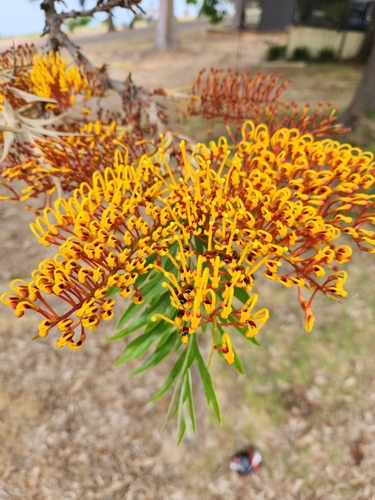
(c) awkastrait, some rights reserved (CC BY-NC)
iNaturalist· cc-by-nc
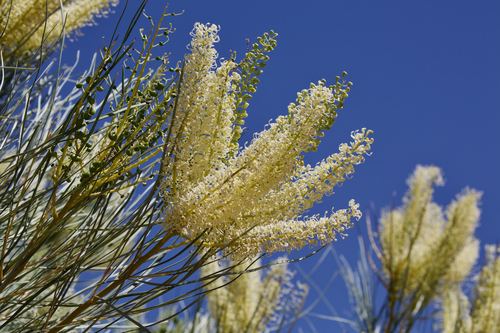
(c) Hannah Brown, some rights reserved (CC BY-NC)
iNaturalist· cc-by-nc
(c) Hannah Brown, some rights reserved (CC BY-NC)
Summary
Source: WikipediaGrevillea pteridifolia is a species of flowering plant in the family Proteaceae and is endemic to northern Australia. It is also known by many common names, including golden grevillea, silky grevillea, fern-leaved grevillea, golden parrot tree, golden tree, manbulu, yawuny and tjummula. It is a shrub or tree usually with pinnatisect leaves, and bright orange-yellow or reddish flowers.
Description
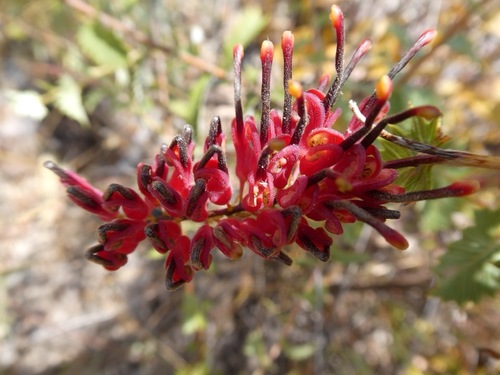
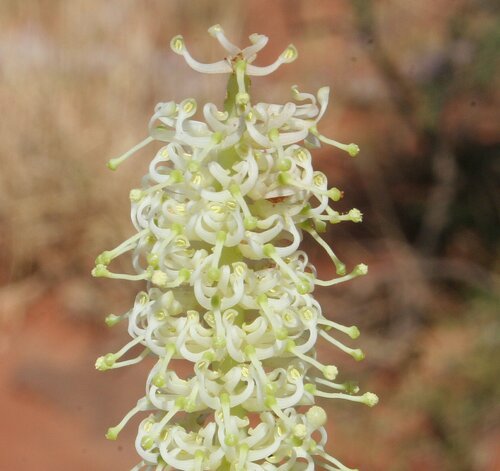
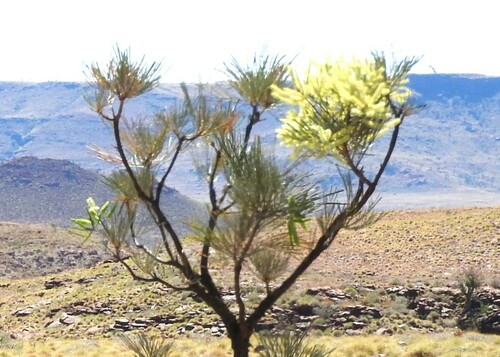
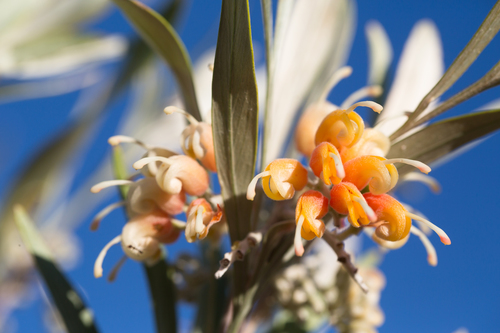
A slender tree. It grows 5-8 m high. It spreads 3-7 m wide. The leaves are silvery. The whole leaf is 15-43 cm long and it is divided into narrow lobes. These can be 7-30 cm long by 0.5 cm wide. They are fine. The flowers are bright orange or red. The style sticks out. They are 1.5-3 cm long and are arranged along a long stalk 10-20 cm long. These are produced near the ends of branches. The fruit is a somewhat woody follicle. It is 1.5-2 cm long and 1 cm wide. They occur in dense clusters and contain 2 brown seeds.
Edible Uses
The nectar is sucked from the flowers or shaken into water and drunk. The leaves are used as flavouring when cooking emus.
Traditional Uses
The nectar is sucked from the flowers or shaken into water and drunk. The leaves have also been used to add flavouring when cooking emus.
This uses section is brief — help expand it
Distribution
It is a tropical plant. Plants can grow on a wide range of soils. It can stand occasionally water-logging. It grows naturally in open forests often on sandy soils. It is damaged by frost. It cannot stand wet winters. It suits hardiness zones 9-12.
Where It Grows
Australia, East Africa, Indochina, Kenya, SE Asia, Southern Africa, Thailand, USA, Zimbabwe,
Cultivation
Plants can be grown from seed or from tip cuttings. The seed coat needs to be peeled off.
Propagation
Seed - pre-soak in water for 24 hours prior to sowing. Germination usually takes 25 - 30 days. Seedlings are ready for planting when they are 10 - 15 cm tall and bearing 7 - 8 leaves. Suckers, planted out at any time that the soil is moist enough.
Other Uses
The dried foliage has been used as an elastic stuffing for mattresses. The wood is a source of fuel wood and poles. The plant is an effective wind-break. Plants are suitable for planting on wasteland soils with a texture varying from pulverized lateritic soil to sandy loam, including loose soils on dumps of coal and bauxite mines, where it regenerates spontaneously.
Production
Plants are fast growing. They are short lived. They may only live 6-8 years.
Other Information
The nectar is sucked especially by children.
Notes
There are 250 Grevillea species. It is a declared noxious weed in the USA.
Nutrition
| Part | Moisture | kJ | kcal | Protein | Vit A | Vit C | Iron | Zinc |
|---|---|---|---|---|---|---|---|---|
| Seed wings | 6.2 | 1728 | 413 | 23.5 | — | — | 67.8 | 30 |
| Seed | 7.5 | 1246 | 298 | 21.7 | — | — | 4.5 | 3.6 |
| Flower | 70.5 | 602 | 144 | 1.9 | — | 30 | 67.8 | 30 |
Synonyms
Also Known As
Abergubber, Andadjek, Fern-leaved Grevillea, Golden Parrot Tree, Golden Toothbrush Grevillea, Kimberley Christmas Tree, Manbarnku, Manbulu, Silky Grevillea, Tjummula, Watbarr, Wigun, Yawuny, Yinungkwurra
References (36)
- Beasley, J., 2011, Plants of Tropical North Queensland - the compact guide. Footloose publications. p 55
- Bodkin, F., 1991, Encyclopedia Botanica. Cornstalk publishing, p 515
- Brock, J., 1993, Native Plants of Northern Australia, Reed. p 206
- Calvert, G., 2010, The Burdekin Delta Tree Guide. Lower Burdekin Landcare Association., Inc., Ayr p 99
- Cherikoff V. & Isaacs, J., The Bush Food Handbook. How to gather, grow, process and cook Australian Wild Foods. Ti Tree Press, Australia p 157
Show all 36 references Hide references
- Cooper, W. and Cooper, W., 2004, Fruits of the Australian Tropical Rainforest. Nokomis Editions, Victoria, Australia. p 411
- Cronin, L., 1989, The Concise Australian Flora. Reed. p 124
- Cult. Prot. 121. 1809
- Doran, J.C., & Turnbull, J.W. (Eds), 1997, Australian Trees and Shrubs: species for land rehabilitation and farm plantings in the tropics. ACIAR Monograph No 24. p 296
- Dunlop, C.R., Leach, G.J. & Cowie, I.D., 1995, Flora of the Darwin Region. Vol 2. Northern Territory Botanical Bulletin No 20. p 125
- Elliot, W.R., & Jones, D.L., 1990, Encyclopedia of Australian Plants suitable for cultivation. Vol 5. Lothian. p 97
- Etherington, K., & Imwold, D., (Eds), 2001, Botanica's Trees & Shrubs. The illustrated A-Z of over 8500 trees and shrubs. Random House, Australia. p 356
- Greig, D., 1996, Flowering Natives for Home Gardens. Angus & Robertson. p 206
- Hearne, D.A., & Rance, S.J., 1975, Trees for Darwin and Northern Australia. AGPS, Canberra p 75, Pl 20, Colour Pl 4
- Hibbert, M., 2002, The Aussie Plant Finder 2002, Florilegium. p 115
- Hiddins, L., 1999, Explore Wild Australia with the Bush Tucker Man. Penguin Books/ABC Books. p 143
- Holliday, I., 1989, A Field Guide to Australian Trees. Hamlyn. p 218
- Isaacs, J., 1987, Bush Food, Aboriginal Food and Herbal Medicine. Weldons. p 137
- Lazarides, M. & Hince, B., 1993, Handbook of Economic Plants of Australia, CSIRO. p 125
- Levitt, D., 1981, Plants and people. Aboriginal uses of plants on Groote Eylandt. Australian Institute of Aboriginal Studies, Canberra. p 116
- Lord, E.E., & Willis, J.H., 1999, Shrubs and Trees for Australian gardens. Lothian. p 168
- Low, T., 1991, Wild Food Plants of Australia. Australian Nature FieldGuide, Angus & Robertson. p 143
- Milson, J., 2000, Trees and Shrubs of north-west Queensland. DPI p 258
- Molyneux, B. and Forrester, S., 1997, The Austraflora A-Z of Australian Plants. Reed. p 111
- Norrington, L., & Campbell, C., 2001, Tropical Food Gardens. Bloomings Books. p 63
- Olde, P & Marriott, N., 1995, The Grevillea Book. Kangaroo Press. Vol 3. p 115
- Paczkowska, G . & Chapman, A.R., 2000, The Western Australian Flora. A Descriptive Calatogue. Western Australian Herbarium. p 487
- Petheram, R.J. and Kok, B., 2003, Plants of the Kimberley Region of Western Australia. UWA Press p 479
- Scarth-Johnson, V., 2000, National Treasures. Flowering Plants of Cooktown and Northern Australia. Vera Scarth-Johnson Gallery Association. Cooktown, Australia. p 86
- Townsend, K., 1994, Across the Top. Gardening with Australian Plants in the tropics. Society for Growing Australian Plants, Townsville Branch Inc. p 237
- Townsend, K., 1999, Field Guide to Plants of the Dry Tropics. Society for Growing Australian Plants, Townsville Branch Inc. p 61
- Vigilante, T., et al, 2013, Island country: Aboriginal connections, values and knowledge of the Western Kimberley islands in the context of an island biological survey. Records of the Western Australian Museum Supplement 81: 145-182
- Wheeler, J.R.(ed.), 1992, Flora of the Kimberley Region. CALM, Western Australian Herbarium, p 473
- Wightman, Glenn et al. 1991.Alawa Ethnobotany: Aboriginal Plant Use from Minyerri, Northern Australia. Northern Territory Botanical Bulletin No 11. Parks and Wildlife Commission of the Northern Territory. p 17, 18.
- Wightman, Glenn et al. 1992, Mangarrayi Ethnobotany: Aboriginal Plant Use from the Elsey Area Northern Australia. Northern Territory Botanical Bulletin No 15. Parks and Wildlife Commission of the Northern Territory. p 28.
- Wightman, G. & Brown, J., 1994, Jawoyn Plant Identikit, Common Useful Plants in the Katherine Area of Northern Australia. Concervation Commission Northern Territory. p 26