Grevillea banksii
R. Br.
Red Silky Oak, Dwarf Silky Oak, Bank's Grevillea
iNaturalist· cc-by-sa
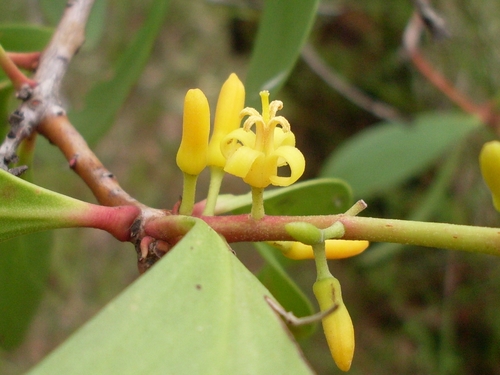
(c) alessandradalia, some rights reserved (CC BY-SA), uploaded by alessandradalia
iNaturalist· cc-by-nc
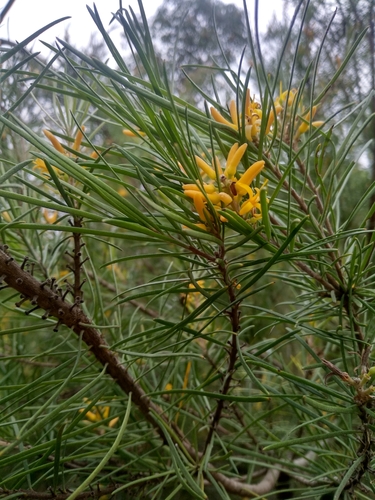
(c) fidymbg, some rights reserved (CC BY-NC)
iNaturalist· cc-by-nc
(c) fidymbg, some rights reserved (CC BY-NC)
Summary
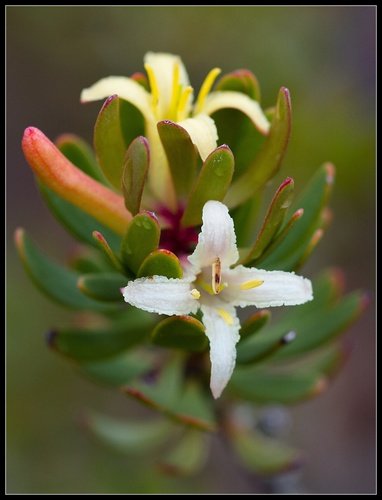
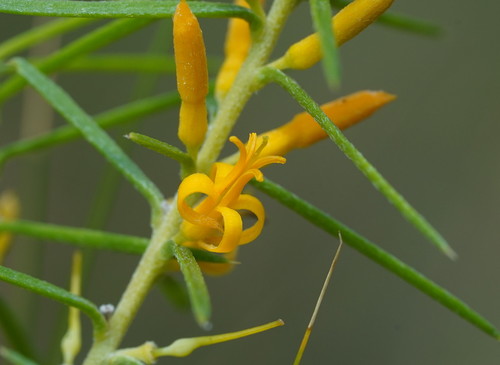
Source: WikipediaGrevillea banksii, commonly known as Banks' grevillea, Byfield waratah, red flowered silky oak and dwarf silky oak, and in Hawaii as kāhili flower, is a species of flowering plant in the family Proteaceae and is endemic to Queensland. It is an erect shrub or slender tree with divided leaves with four to twelve narrow lobes, and creamy white to bright scarlet and yellow flowers.
Description
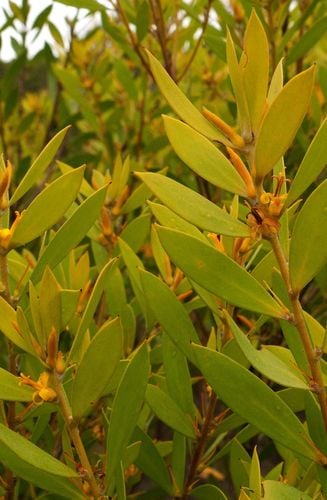
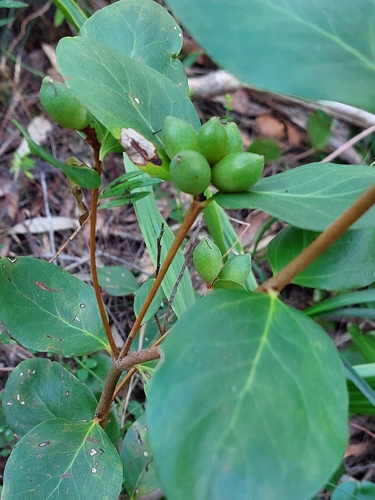
A shrub or small tree. It grows 2.4-9 m high. It can spread to 2 m wide. The small branches and flowers have a soft brown covering over them. Some coastal forms almost lie along the ground. The leaf stalk is 3-5 cm long. The leaf blade is 7-20 cm long and deeply divided. There are 3-11 segments and these are 50-100 mm long by 4-7 mm wide. The edges curve back. They are brown and silky underneath. The flowering racemes are at the ends and 5-13 cm long. They occur either singly or as 2 or 3 in a group. The flowers are red. The fruit is oval but not straight. It is 1.5-2 cm long and hairy. The seeds have narrow wings.
Edible Uses
The nectar is edible.
Traditional Uses
CAUTION: There are poisonous hairs on the ovaries of the flowers. These can cause a skin rash.
This uses section is brief — help expand it
Known Hazards
The flowers and seed pods contain toxic hydrogen cyanide. The alkyl resorcinols in G. banksii and Grevillea 'Robyn Gordon' are responsible for contact dermatitis.
Distribution
A subtropical species. It grows in warm temperate regions. It is cultivated in S China as an ornamental below 100 m altitude. It needs well drained soils. It suits dry limy soils. It can stand light frost. It suits hardiness zones 9-11. In Townsville Anderson BG.
Where It Grows
Africa, Asia, Australia, China, East Africa, Hawaii, Indonesia, Madagascar, Malaysia, Mozambique, Pacific, SE Asia, Slovenia, South Africa, Southern Africa, USA, Zimbabwe,
Cultivation
Plants are grown from seed. The seeds grow easily and can remain viable for a couple of years. It produces chemicals which stop plants near it from growing.
Propagation
Seed - Cuttings
Other Uses
The wood is used as a fuel. Used as a shade tree and windbreak for plantations of coffee and tea. The shrubby cultivar 'Fosteri' is a dense shrub that is used as a fence.
Notes
There are 250 Grevillea species. It can be invasive.
Synonyms
Also Known As
Banksova grevilka, Hong yin hua, Kahili flower, Scarlet Grevillea
References (22)
- Barwick, M., 2004, Tropical and Subtropical Trees. A Worldwide Encyclopedic Guide. Thames and Hudson p 205
- Bodkin, F., 1991, Encyclopedia Botanica. Cornstalk publishing, p 508
- Brickell, C. (Ed.), 1999, The Royal Horticultural Society A-Z Encyclopedia of Garden Plants. Convent Garden Books. p 481
- Cronin, L., 1989, The Concise Australian Flora. Reed. p 65
- Cundall, P., (ed.), 2004, Gardening Australia: flora: the gardener's bible. ABC Books. p 649
Show all 22 references Hide references
- Elliot, W.R., & Jones, D.L., 1990, Encyclopedia of Australian Plants suitable for cultivation. Vol 5. Lothian. p 30
- Etherington, K., & Imwold, D., (Eds), 2001, Botanica's Trees & Shrubs. The illustrated A-Z of over 8500 trees and shrubs. Random House, Australia. p 352
- Greig, D., 1996, Flowering Natives for Home Gardens. Angus & Robertson. p 191
- Hearne, D.A., & Rance, S.J., 1975, Trees for Darwin and Northern Australia. AGPS, Canberra p 74, Pl 19
- Hibbert, M., 2002, The Aussie Plant Finder 2002, Florilegium. p 113
- Holliday, I., 1979, A Field Guide to Australian Native Shrubs. Rigby. p 92
- Lord, E.E., & Willis, J.H., 1999, Shrubs and Trees for Australian gardens. Lothian. p 166
- Low, T., 1991, Wild Food Plants of Australia. Australian Nature FieldGuide, Angus & Robertson. p 143
- Marinelli, J. (Ed), 2004, Plant. DK. p 455
- Melzer, R. & Plumb, J., 2011, Plants of Capricornia. Belgamba, Rockhampton. p 280
- Molyneux, B. and Forrester, S., 1997, The Austraflora A-Z of Australian Plants. Reed. p 99
- Olde, P & Marriott, N., 1995, The Grevillea Book. Kangaroo Press. Vol 2. p 49
- Schatz, G.E., 2001, Generic Tree Flora of Madagascar. Royal Botanical Gardens, Kew and Missouri Botanical Garden. p 307
- Staples, G.W. and Herbst, D.R., 2005, A tropical Garden Flora. Bishop Museum Press, Honolulu, Hawaii. p 468
- Townsend, K., 1994, Across the Top. Gardening with Australian Plants in the tropics. Society for Growing Australian Plants, Townsville Branch Inc. p 230
- Trans. Linn. Soc. London 10:176. 1810
- Young, J., (Ed.), 2001, Botanica's Pocket Trees and Shrubs. Random House. p 416