Gloiopeltis furcata
(Post. et Rupr.) J. Agardh
Gumweed
iNaturalist· cc-by-nc
(c) Ian Cruickshank, some rights reserved (CC BY-NC), uploaded by Ian Cruickshank
iNaturalist· cc-by-nc
(c) rolandwirth, some rights reserved (CC BY-NC)
iNaturalist· cc-by-nc
(c) Elora, some rights reserved (CC BY-NC)
Summary
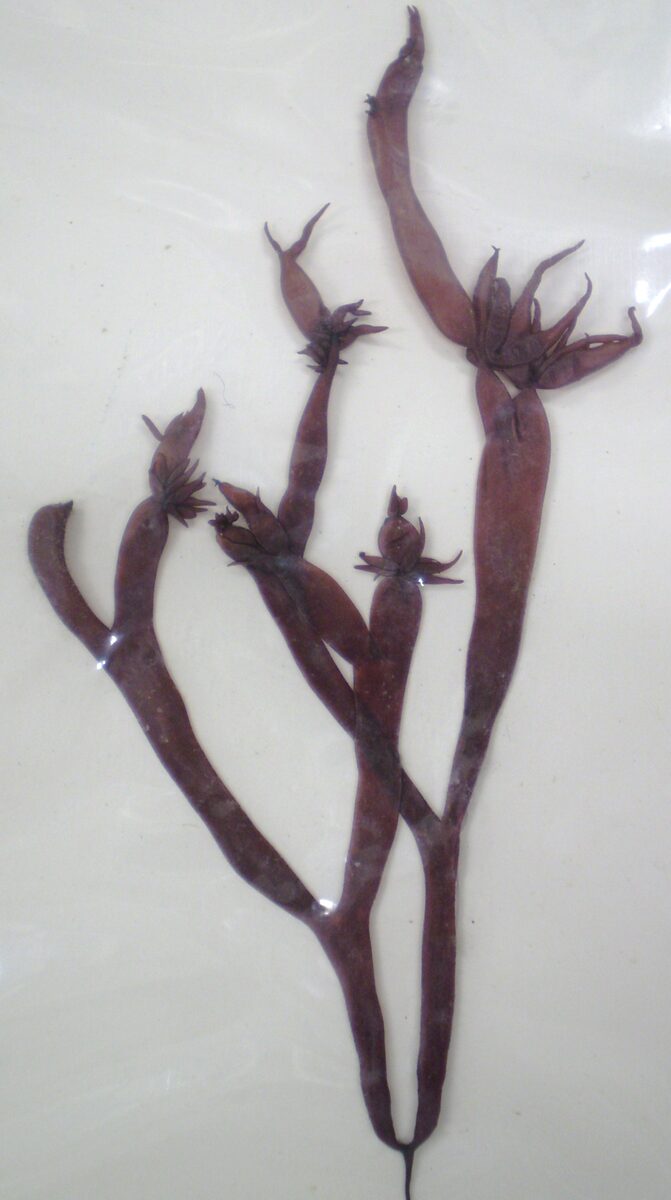
Source: WikipediaGloiopeltis furcata, commonly known as glueweed, jelly moss and fukuro-funori (Japan), is a marine alga that is widely distributed in the North Pacific Ocean, along the shorelines of China, Taiwan, Korea, Japan, and the Pacific shores of Russia; and from the Aleutian Islands south to Baja California. G. furcata has long been utilized as a food source in Asia, where it is also used as a sizing material in silk and other textiles. G. furcata is also a raw material for textile binders. Studies show that extracts of G. furcata inhibit the growth of several human cancer cell lines, and can significantly lower blood glucose levels. G. furcata's thallus is reddish brown to golden yellow, up to 5 cm (2 in) tall. The plant appears black when dry. The cylindrical branches are smooth. The basal crust is perennial, and produces a new crop of branches every year. Gloiopeltis furcata inhabits the mid to high intertidal zone of rocky coasts where it grows abundantly, on the tops and sides of rocks and rocky ledges. G. furcata is very similar to Gloiopeltis tenax and Gloiopeltis complanata. The three species are grown, harvested, and often used interchangeably. G. furcata is commercially harvested in China and Japan.
Description
A temperate seaweed with fronds that are eaten fresh or pickled.
This description is brief — help expand it
Edible Uses
It is eaten fresh or pickled only.
Traditional Uses
It is eaten fresh or pickled only.
This uses section is brief — help expand it
Distribution
It is a temperate plant.
Where It Grows
America, Asia, China, Japan, Korea, Taiwan,
Also Known As
Funori
References (6)
- Chapman, V.J. and Chapman, D.J., 1980, Seaweeds and their uses. London. (Also as Gloiopeltis coliformis)
- http://www.seavegetables.com
- Kiple, K.F. & Ornelas, K.C., (eds), 2000, The Cambridge World History of Food. CUP p 237 (Also as Gloiopeltis coliformis)
- Surey-Gent, S. & Morris G., 1987, Seaweed. A User's Guide. Whirret Books. London. p 140
- Xia, B., and Abbott, I.A., 1987, Edible seaweeds of China and their place in the Chinese diet. Economic Botany 41:341-53
Show all 6 references Hide references
- Zemke-White, W. L. & Ohno, M., 1999, World seaweed utilisation: An end-of-century summary. Journal of Applied Phycology 11: 369-376