Alhagi maurorum
Medikus
Camel thorn, Caspian manna, Persian manna plant
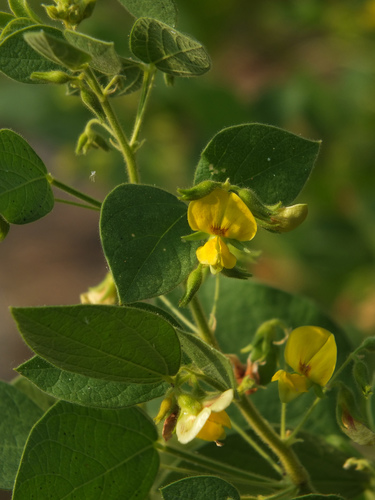
iNaturalist· cc-by-nc
(c) Conor and Alexandra, some rights reserved (CC BY-NC), uploaded by Conor and Alexandra
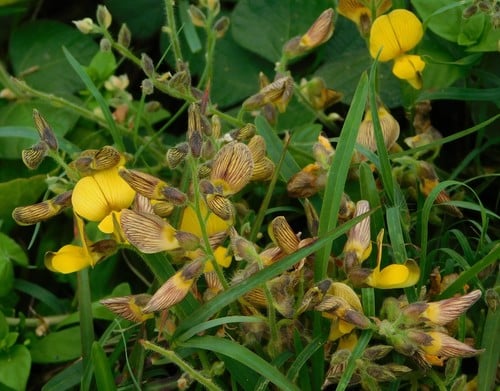
iNaturalist· cc-by-nc
(c) Jugal Patel, some rights reserved (CC BY-NC), uploaded by Jugal Patel
iNaturalist· cc-by-nc
(c) nicole_eiten, some rights reserved (CC BY-NC), uploaded by nicole_eiten
Summary
Source: WikipediaAlhagi maurorum is a species of legume commonly known, variously, as camelthorn, Caspian manna, and Persian mannaplant. This shrub is native to Eurasia, but has been introduced to many other areas of the world.
Description
A small shrub. It has thorns. It grows 30-60 cm high. There are 3-8 flowers in short racemes. The flowers are small white pea flowers. The pods are hairless. They are constricted between the seeds.
Edible Uses
At flowering time, a sweet-tasting manna is exuded from the twigs, produced during hot weather. It contains approximately 47% melizitose, 26% sucrose, and 12% invert sugar. A separate manna obtained from the pods is also sweet but has a laxative effect. The root can be cooked and eaten but is considered a famine food, used only in times of need.
Traditional Uses
A sweet sugary secretion is obtained from the plant. This is exuded in the hot season. A sweet-tasting manna is exuded from the twigs at flowering time. The root is cooked and eaten as a famine food. It can be ground into flour.
Medicinal Uses
The whole plant is diaphoretic, diuretic, expectorant, and laxative. An oil from the leaves is used to treat rheumatism. The flowers are used in the treatment of piles.
Distribution
It is a temperate and Mediterranean climate plant. It grows in salty places where the water is not far below the surface. It grows naturally in waste places and sand dunes in Turkey. It needs a sunny position and a light well drained soil. It can be in alkaline soil. It grows below 1,200 m altitude. It grows in areas with a rainfall below 1,016 mm. It can grow in arid places.
Where It Grows
Afghanistan, Africa, Algeria, Arabia, Asia, Australia, Armenia, Azerbaijan, Bahrain, Caucasus, Central Asia, China, Cyprus, Egypt, Europe, France, Georgia, Greece, Himalayas, India, Iran, Iraq, Israel, Jordan, Kazakhstan, Kuwait, Kyrgyzstan, Lebanon, Libya, Mediterranean, Middle East, Mongolia, Morocco, Niger, North Africa, Pakistan, Palestine, Qatar, Russian Federation - Ciscaucasia, Dagestan, Sahara, Sahel, Saudi Arabia, Western Siberia, South Africa, Southern Africa, Syria, Tajikistan, Turkey, Türkiye, Turkmenistan, United Arab Emirates, UAE, USA, Uzbekistan, West Africa,
Cultivation
Requires a sunny position in a well-drained light or medium soil. Plants are not very hardy in Britain, they can be grown outdoors in the summer but require protection in the winter. The stems of the plant are covered in sharp spines. Like the closely related gorse (Ulex europaea) the flowers have a pineapple scent. (A slightly strange report because the gorse flowers have a strong coconut fragrance.) This species has a symbiotic relationship with certain soil bacteria, these bacteria form nodules on the roots and fix atmospheric nitrogen. Some of this nitrogen is utilized by the growing plant but some can also be used by other plants growing nearby.
Propagation
Pre-soak seed for 12 hours in warm water, then sow in March or April in a warm greenhouse. Prick seedlings into individual pots once large enough to handle, and grow on under glass through at least the first winter. Plant out into permanent positions the following summer. Cuttings of young shoots can be taken in a frame.
Other Uses
No other uses are known for this plant.
Notes
Also as Papilionaceae.
Synonyms
Also Known As
Aguldikeni, Barbharram, Billiduruva, Durlava, Girikarmika, Hebrew manna, Jawasa, Jawaso, Sinai manna, Tamiya, Tella giniya chettu, Zoz, Zozani
References (24)
- Ambasta S.P. (Ed.), 2000, The Useful Plants of India. CSIR India. p 27 (As Alhagi pseudalhagi)
- Bircher, A. G. & Bircher, W. H., 2000, Encyclopedia of Fruit Trees and Edible Flowering Plants in Egypt and the Subtropics. AUC Press. p 18 (Also as Alhagi camelorum)
- Blamey, M and Grey-Wilson, C., 2005, Wild flowers of the Mediterranean. A & C Black London. p 109
- Burkill, H. M., 1985, The useful plants of west tropical Africa, Vol. 5. Kew.
- Burkill, H. M., 1985, The useful plants of west tropical Africa, Vol. 5. Kew. (As Alhagi mannifera)
Show all 24 references Hide references
- Ertug, F, Yenen Bitkiler. Resimli Türkiye Florası -I- Flora of Turkey - Ethnobotany supplement
- Flora of Pakistan. www.eFloras.org
- Hedrick, U.P., 1919, (Ed.), Sturtevant's edible plants of the world. p 32 (As Alhagi camelorum) and p 320
- Hepper, E.N., 1993, Illustrated Encyclopedia of Bible Plants, IVP, England. p 38, 56
- ILDIS Legumes of the World http:www;ildis.org/Legume/Web
- Jardin, C., 1970, List of Foods Used In Africa, FAO Nutrition Information Document Series No 2.p 52
- Kew Plants of the World Online
- Lazarides, M. & Hince, B., 1993, Handbook of Economic Plants of Australia, CSIRO. p 13
- Macmillan, H.F. (Revised Barlow, H.S., et al) 1991, Tropical Planting and Gardening. Sixth edition. Malayan Nature Society. Kuala Lumpur. p 341
- Norton, J., et al, 2009, An Illustrated Checklist of the Flora of Qatar. UNESCO Office in Doha.
- Paczkowska, G . & Chapman, A.R., 2000, The Western Australian Flora. A Descriptive Catalogue. Western Australian Herbarium. p 416
- Phillips, D.C., 1988, Wild Flowers of Bahrain. A Field Guide to Herbs, Shrubs, and Trees. Privately published. p 31
- Plants for a Future database, The Field, Penpol, Lostwithiel, Cornwall, PL22 0NG, UK. http://www.scs.leeds.ac.uk/pfaf/ (As Alhagi mannifera)
- Rivera, D. et al, 2006, Gathered Mediterranean Food Plants - Ethnobotanical Investigations and Historical Development, in Heinrich M, Müller WE, Galli C (eds): Local Mediterranean Food Plants and Nutraceuticals. Forum Nutr. Basel, Karger, 2006, vol 59, pp 18–74
- Royal Botanic Gardens, Kew (1999). Survey of Economic Plants for Arid and Semi-Arid Lands (SEPASAL) database. Published on the Internet; http://www.rbgkew.org.uk/ceb/sepasal/internet [Accessed 28th April 2011]
- Urgamal, M., Oyuntsetseg, B., Nyambayar, D. & Dulamsuren, Ch. 2014. Conspectus of the vascular plants of Mongolia. (Editors: Sanchir, Ch. & Jamsran, Ts.). Ulaanbaatar, Mongolia. “Admon“ Press. 334pp. (p. 121-143).
- Vorles Churpfalz. Phys.-Ocon. Ges. 2:397. 1787
- Wiersema, J. H. & Leon, B., 2013, World Economic Plants. A Standard Reference CRC Press. 2nd Ed. p 32
- World Checklist of Useful Plant Species 2020. Royal Botanic Gardens, Kew