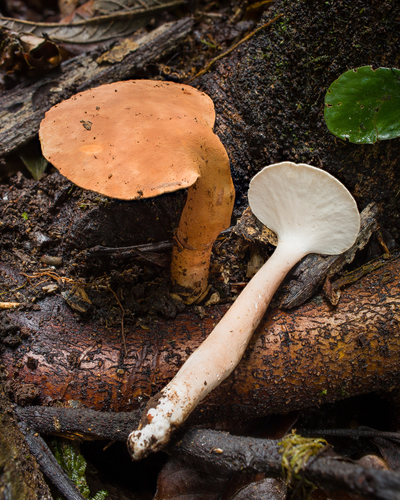
Fistulina hepatica
J.C. Schaeffer: E.M. Fries.
Beefsteak Fungus, Liver fistulina, Oak tongue, Vegetable beafsteak, Jelly tongue, Beefsteak mushroom
iNaturalist· cc-by-sa
(c) mycowalt, some rights reserved (CC BY-SA), uploaded by mycowalt
iNaturalist· cc-by-nc
(c) Heather A Davis, some rights reserved (CC BY-NC)
iNaturalist· cc-by-nc
(c) Heather A Davis, some rights reserved (CC BY-NC)
Summary
Source: WikipediaFistulina hepatica, commonly known as the beefsteak fungus, beefsteak polypore, poor man's steak, ox tongue, or tongue mushroom, is a bracket fungus classified in the Agaricales. As its common names suggest, it visually resembles a slab of meat. The species can be found in Europe, Africa, Australia, and North America. It is edible when cooked, although older specimens may need special preparation.
Description
A mushroom. It has a rough reddish surface.
This description is brief — help expand it
Edible Uses
It is edible and considered "reminiscent of raw meat" in texture by some, although older specimens should be soaked overnight, as their juice can cause gastric upset. It does not tend to preserve well.
Traditional Uses
It has a meaty taste when cooked. It needs to be eaten young. It is eaten in salads and added to tomato sauce and preserved in olive oil.
This uses section is brief — help expand it
Distribution
It is a temperate plant. A wood rotting fungus.
Where It Grows
Asia, Australia, Balkans, Britain, Bulgaria, Caucasus, Central America, Chile, China, Costa Rica, Europe, Georgia, Greece, Himalayas, Hungary, India, Italy, Malaysia, Mediterranean, Nepal, North America, Norway, Portugal, Scandinavia, SE Asia, Sicily, Slovenia, South America, Turkey, Türkiye,
Synonyms
Also Known As
Ganse niupaijun, Gvidzla, Lengua de vaca
References (25)
- Ambasta, S.P. (Ed.), 2000, The Useful Plants of India. CSIR India. p 224
- Barreau, A., et al, 2016, How Can We Teach Our Children if We Cannot Access the Forest? Generational Change in Mapuche Knowledge of Wild Edible Plants in Andean Temperate Ecosystems of Chile. Journal of Ethnobiology 36(2): 412–432
- Boa, E. R., Wild edible fungi and their importance to people. FAO Non Wood Forest Products Booklet 17
- Bonney, N., 2012, Edible Wild Native Plants for Southern Australia. p 89
- Bougher, N.L. & Syme, K., 1998, Fungi of Southern Australia, UWA Press. p 19, 318
Show all 25 references Hide references
- Bussman, R. W., et al, 2021, Unity in diversity—food plants and fungi of Sakartvelo (Republic of Georgia), Caucasus. Journal of Ethnobiology and Ethnomedicine (2021) 17:72 p 16
- Cerne, M., 1992, Wild Plants from Slovenia used as Vegetables. Acta Horticulturae 318
- Cherubini, A. & Landi, S., Andar per Funghi, Edizioni DieRre, p 43
- Daly, A. B., 20014, Narrating changing foodways: wild edible plant knowledge and traditional food systems in Mapuche lands of the Andean Temperate Forests, Chile. Masters Thesis Vancouver. p 45
- Dongol, et al, 1995, Edible Mushrooms in Nepal
- Fuhrer, B., 2005, A field guide to Australian Fungi. Bloomings Books. p 250
- Guedes de Piniho, P., et al, 2008, Correlation between the Pattern Volatiles and the Overall Aroma of Wild Edible Mushrooms. Journal of Agricultural and Food Chemistry. 56: 1704-1712
- Hall, I. R., et al, 2003, Edible and Poisonous Mushrooms of the World. Timber Press. p 256
- Hamil and Chiltoskey, 1975,
- Jordan, P., 2000, The Mushroom Guide and Identifier, Hermes House, p 56
- Kaufmann, B. et al, 1999, The Great Encyclopedia of Mushrooms. Konemann. p 218
- Kiple, K.F. & Ornelas, K.C., (eds), 2000, The Cambridge World History of Food. CUP p 322, 1819
- Lentini, F. and Venza, F., 2007, Wild food plants of popular use in Sicily. J Ethnobiol Ethnomedicine. 3: 15
- Mabey, R., 1973, Food for Free. A Guide to the edible wild plants of Britain, Collins. p 57
- Ouzouni, P. K., et al, 2009, Nutritional value and metal content of wild edible mushrooms collected from West Macedonia and Epirus, Greece. Food Chemistry 115: 1575-1580
- Pace, G., 1998, Mushrooms of the world. Firefly books. p 213
- Pfister, D. H., 2016, Fungi and Forests. ReVista 16(1) p 14
- Vetner, J., 2004, Arsenic content of some edible mushroom species. Eur. Food Res. Technol. 219: 71-74
- Vetner, J., 2005, Lithium content of some common edible wild-growing mushrooms. Food Chemistry 90:31-37
- www.plantnames.unimelb.edu.au