Eustrephus latifolius
R. Br. ex Ker Gawl.
Wombat Berry, Orange Vine
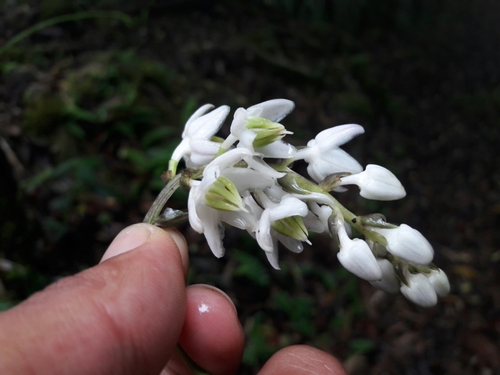
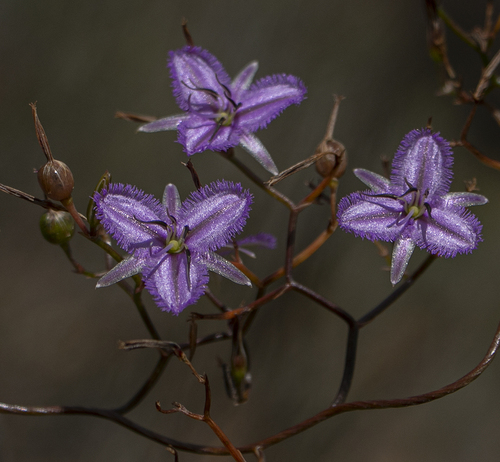
iNaturalist· cc-by-nc
(c) Philippa Gordon, some rights reserved (CC BY-NC), uploaded by Philippa Gordon
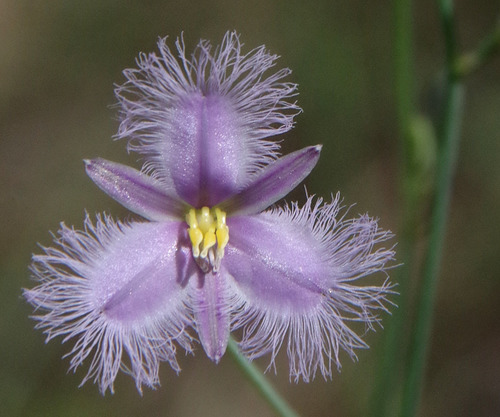
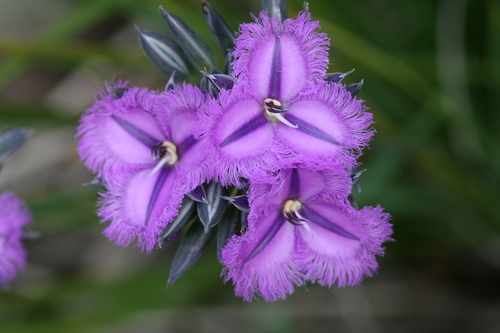
iNaturalist· cc-by-nc
(c) Regent Vale, some rights reserved (CC BY-NC), uploaded by Regent Vale
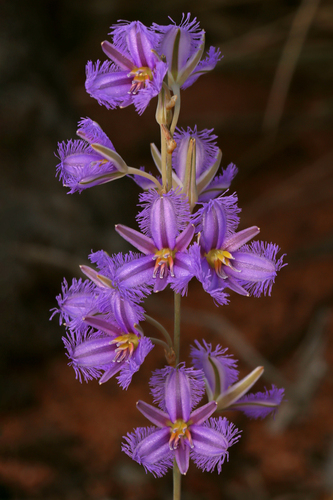
iNaturalist· cc-by-nc-sa
(c) Arthur Chapman, some rights reserved (CC BY-NC-SA)
Summary
Source: WikipediaA perennial climbing vine growing to 5 m with hermaphroditic flowers appearing in June. Tolerates light sandy, medium loamy, and heavy clay soils. Grows in semi-shade and prefers moist conditions. Suitable for mildly acid, neutral, and mildly alkaline soils.
Description
An evergreen vine. It forms a tuber at the base. This is 1-3 cm long. It climbs to a height of 10 m. It can spread over the ground. The stem is slender, wiry and twining and forms many branches. The leaves are oval or sword shaped and taper towards the tip. They are 6-10 cm long and have prominent veins. Sometimes the leaves are wavy along the edge. The flowers are white or pale pink and have 3 petals and 3 petal-like sepals. The flowers are clustered in the axils of the upper leaves. They are bell shaped. The fruit are round, orange berries. These split to reveal the shiny black seeds. The fruit are 1 cm across.
Edible Uses
The orange fruit can be eaten raw, though it offers very little flesh — each berry is around 10mm in diameter. The roots are juicy and sweet-flavoured but require considerable effort to dig up, as the small tubers they bear grow up to 3cm long. It has been suggested that these tubers could likely be enlarged through cultivation.
Traditional Uses
The fleshy root tubers are eaten. They can be eaten raw or cooked. The fruit can be eaten. It is the white flesh around the seed that is eaten. They should probably be roasted before eating.
Medicinal Uses
None known.
Distribution
A tropical plant. It does best in light moist soil. It needs a protected and partly shaded position. It cannot tolerate drought but can withstand a light frost. Normally the temperature needs to be above 5°C. Seeds need a temperature above 13-16°C before planting.
Where It Grows
Australia*, Hawaii, Indonesia, New Caledonia, Pacific, Papua New Guinea, PNG, SE Asia, USA,
Cultivation
Plants are grown from seed. Seed only germinates irregularly. Plants can be pruned after flowering. Plants can be divided after fruiting to give more plants to regrow.
Propagation
Sow seed in spring in a greenhouse. Prick out seedlings into individual pots when large enough to handle and grow on under glass for at least their first winter. Plant out into permanent positions in early summer. Can also be propagated by division in spring.
Other Uses
None known.
Notes
There is only one Eustrephus species. It is to be included in the Laxmanniaceae.
Nutrition
| Part | Moisture | kJ | kcal | Protein | Vit A | Vit C | Iron | Zinc |
|---|---|---|---|---|---|---|---|---|
| Tuber | 89.2 | — | — | 1.8 | — | — | 15.9 | 0.5 |
Synonyms
Also Known As
Buah beri oranye
References (34)
- Beasley, J., 2011, Plants of Tropical North Queensland - the compact guide. Footloose publications. p 71
- Bodkin, F., 1991, Encyclopedia Botanica. Cornstalk publishing, p 466
- Brickell, C. (Ed.), 1999, The Royal Horticultural Society A-Z Encyclopedia of Garden Plants. Convent Garden Books. p 432
- Caton, J.M. & Hardwick, R. J., 2016, Field Guide to Useful Native Plants from Temperate Australia. Harbour Publishing House. p 316
- Cherikoff, V. & Isaacs, J., The Bush Food Handbook. How to gather, grow, process and cook Australian Wild Foods. Ti Tree Press, Australia p 195, 200
Show all 34 references Hide references
- Cooper, W. and Cooper, W., 2004, Fruits of the Australian Tropical Rainforest. Nokomis Editions, Victoria, Australia. p 395
- Cribb, A.B. & J.W., 1976, Wild Food in Australia, Fontana. p 142
- Cronin, L., 1989, The Concise Australian Flora. Reed. p 98
- Elliot, W.R., & Jones, D.L., 1992, Encyclopedia of Australian Plants suitable for cultivation. Vol 4. Lothian. p 262 (Drawing)
- Hardwick, R.J., 2000, Nature's Larder. A Field Guide to the Native Food Plants of the NSW South Coast. Homosapien Books. p 99
- Haslam, S., 2004, Noosa's Native Plants. Noosa Integrated Catchment Assn. Inc. p 236
- Hibbert, M., 2002, The Aussie Plant Finder 2002, Florilegium. p 100
- Hunter, J. T. & Sheringham, P., 2006, Vegetation and Floristics of Melville Range Nature Reserve. A Report to the New South Wales Parks and Wildlife Service. p 172
- Jackes, B.R., 2001, Plants of the Tropics. Rainforest to Heath. An Identification Guide. James Cook University. p 82
- Jackes, B. R., 2010, Plants of Magnetic Island. 3rd Edition. James Cook University, Australia. p 29
- Jones, D. L., 1986, Ornamental Rainforest Plants in Australia, Reed Books, p 288
- Jones, D.L. & Gray, B., 1977, Australian Climbing Plants. Reed. p 61, 102
- Johns, R.J. & Hay, A., 1976, Monocotyledons of Papua New Guinea. Part 1 , Forestry College Bulolo, PNG p 22
- Lim, T. K., 2015, Edible Medicinal and Non Medicinal Plants. Volume 9, Modified Stems, Roots, Bulbs. Springer p 42
- Lord, E.E., & Willis, J.H., 1999, Shrubs and Trees for Australian gardens. Lothian. p 322
- Low, T., 1991, Wild Food Plants of Australia. Australian Nature FieldGuide, Angus & Robertson. p 122
- Low, T., 1992, Bush Tucker. Australia’s Wild Food Harvest. Angus & Robertson. p 17
- Melzer, R. & Plumb, J., 2011, Plants of Capricornia. Belgamba, Rockhampton. p 378
- Morley, B.D., & Toelken, H.R., (Eds), 1983, Flowering Plants in Australia. Rigby. p 339
- Nicholson, N & H., 1996, Australian Rainforest Plants 3, Terania Rainforest Publishing. NSW. p 28
- Pearson, S. & A., 1992, Rainforest Plants of Eastern Australia. Kangaroo Press p 107
- Plants for a Future database, The Field, Penpol, Lostwithiel, Cornwall, PL22 0NG, UK. http://www.scs.leeds.ac.uk/pfaf/
- Prodr. 281. 1810
- Staples, G.W. and Herbst, D.R., 2005, A tropical Garden Flora. Bishop Museum Press, Honolulu, Hawaii. p 753 (Drawing)
- Sukarya, D. G., (Ed.) 2013, 3,500 Plant Species of the Botanic Gardens of Indonesia. LIPI p 927
- Townsend, K., 1994, Across the Top. Gardening with Australian Plants in the tropics. Society for Growing Australian Plants, Townsville Branch Inc. p 208
- Townsend, K., 1999, Field Guide to Plants of the Dry Tropics. Society for Growing Australian Plants, Townsville Branch Inc. p 157
- White, G., 2008, The Bush Tucker Survival Guide. https://www.survival.org.au
- Williams, K.A.W., 1999, Native Plants of Queensland Volume 4. Keith A.W. Williams North Ipswich, Australia. p 194