Eurya chinensis
R. Br.
Chinese eurya
iNaturalist· cc-by-nc
(c) 郭伯川, some rights reserved (CC BY-NC), uploaded by 郭伯川
iNaturalist· cc-by-nc
(c) JODY HSIEH, some rights reserved (CC BY-NC)
Summary
An evergreen tree reaching 2.5 m in height, hardy to UK zone 9. Maintains year-round foliage and flowers in May. Hermaphrodite flowers. Tolerates light sandy, medium loamy, and heavy clay soils with preference for well-drained conditions across mildly acid to basic pH. Grows in semi-shade or full sun and prefers moist soil.
Description
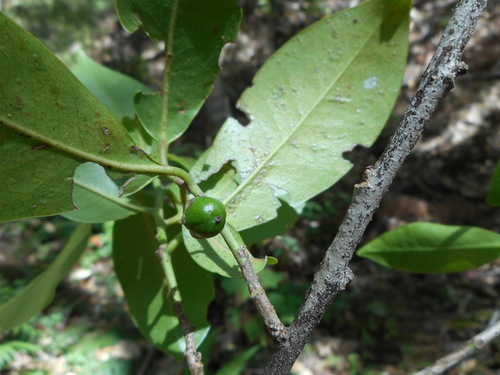
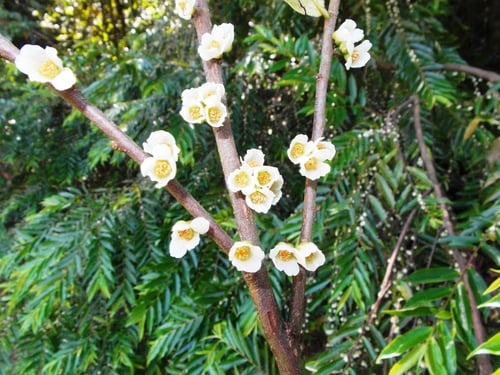
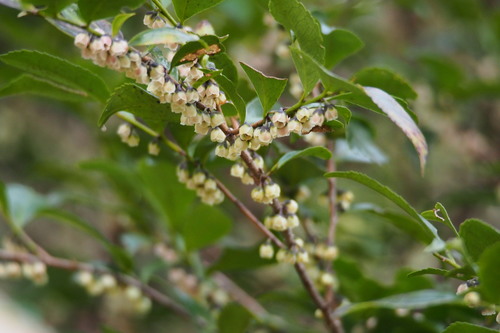
A shrub. It grows 1-3 m tall. The leaves are narrowly oval and 2-6 cm long by 1-2 cm wide. They are pale green underneath. The flowers can occur singly or in groups of up to 4 in the axils of leaves. Male and female flowers are separate. The fruit are purple to black then ripe. They are round and 3-4 mm across. The seeds are blackish brown and kidney shaped.
Edible Uses
The fruit is edible, though no further preparation details are given; it is approximately 5 mm in diameter. The leaves are used as a tea substitute or to adulterate China tea.
Medicinal Uses
No medicinal uses are known.
Distribution
It is a temperate to subtropical plant. It grows in thickets along hills or near streams below 1,000 m above sea level. In Sichuan.
Where It Grows
Asia, China, Indonesia, Myanmar, SE Asia, Taiwan,
Cultivation
Prefers a moderately fertile free-draining moisture retentive soil in sun or part shade with shelter from cold drying winds. Probably best grown in a well-drained lime-free humus-rich soil. Dioecious, male and female plants must be grown if seed is required.
Propagation
Sow seed as soon as it is ripe in a cold frame, or in early spring in a greenhouse. Once large enough to handle, prick seedlings out into individual pots and grow on in a greenhouse for at least their first winter. Plant out into permanent positions in late spring or early summer, after the last expected frosts. Alternatively, take cuttings of half-ripe wood, 6–8 cm with a slight heel, in July or August, and root in individual pots in a frame. Success rate is high.
Other Uses
The wood is soft and close-grained and is used mainly as fuel.
Production
In China plants flower in November to December and fruit June to July.
Notes
There are about 70 Eurya species. Also put in the family Theaceae.
Also Known As
Eurya cina, Ha Hai Ngau Shue
References (4)
- C. Abel, Narr. Journey China 379. 1818
- Altschul, S.V.R., 1973, Drugs and Foods from Little-known Plants. Notes in Harvard University Herbaria. Harvard Univ. Press. Massachusetts. no. 2846
- Plants for a Future database, The Field, Penpol, Lostwithiel, Cornwall, PL22 0NG, UK. http://www.scs.leeds.ac.uk/pfaf/
- Sukarya, D. G., (Ed.) 2013, 3,500 Plant Species of the Botanic Gardens of Indonesia. LIPI p 628