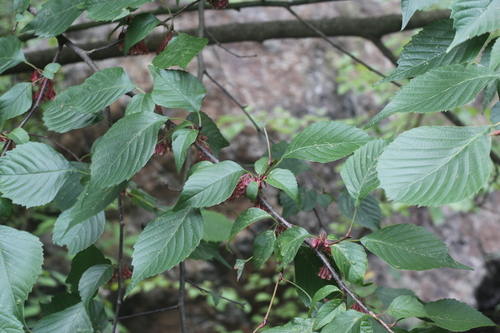
Euptelea polyandra
Siebold & Zucc.
iNaturalist· cc-by
(c) Σ64, some rights reserved (CC BY)
iNaturalist· cc-by-nc
(c) 空猫 T. N, some rights reserved (CC BY-NC)
Summary
Source: WikipediaEuptelea polyandra is a species of flowering plant in the family Eupteleaceae, native to wet areas of central and southern Japan. A suckering small tree, occasionally a many-stemmed shrub, it is used as a street tree in a number of European cities.
Description
A small tree. It grows 8 m tall. The leaves are heart-shaped. They have a long, tail like tip. There are deep jagged teeth around the edge. The leaves turn red and yellow in autumn. The fruit always have one seed.
Edible Uses
The leaves are edible when cooked, but are considered a famine food, used only when other options are unavailable.
Traditional Uses
The leaves are eaten with oil and salt.
This uses section is brief — help expand it
Medicinal Uses
No medicinal uses are known.
Distribution
It suits hardiness zones 6-9.
Where It Grows
Asia, Australia, China, Japan,
Cultivation
Prefers an open moderately rich free soil and full sun. Grows well in an open situation in a woodland garden or shrub border.
Propagation
Seed is best sown as soon as it is ripe in a cold frame. Once seedlings are large enough to handle, prick them out into individual pots and grow on in a greenhouse for at least their first winter. Plant out into permanent positions in late spring or early summer, after the last expected frosts. Can also be propagated by layering.
Other Uses
No other uses are known.
References (7)
- Brickell, C. (Ed.), 1999, The Royal Horticultural Society A-Z Encyclopedia of Garden Plants. Convent Garden Books. p
- Cundall, P., (ed.), 2004, Gardening Australia: flora: the gardener's bible. ABC Books. p 590
- Etherington, K., & Imwold, D., (Eds), 2001, Botanica's Trees & Shrubs. The illustrated A-Z of over 8500 trees and shrubs. Random House, Australia. p 318
- Fl. jap. 1:34, t. 72. 1835
- Heywood, V.H., Brummitt, R.K., Culham, A., and Seberg, O. 2007, Flowering Plant Families of the World. Royal Botanical Gardens, Kew. p 147
Show all 7 references Hide references
- Plants for a Future database, The Field, Penpol, Lostwithiel, Cornwall, PL22 0NG, UK. http://www.scs.leeds.ac.uk/pfaf/
- READ,