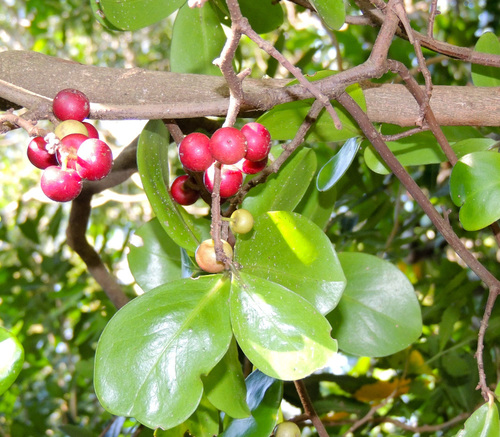
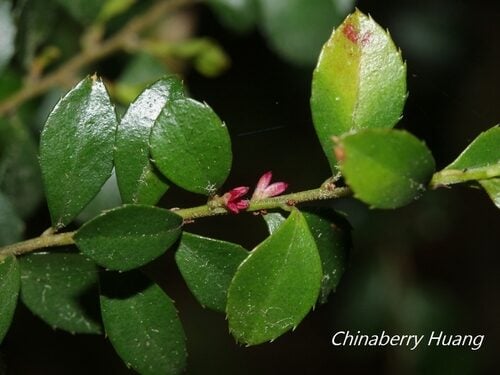
Myrsine semiserrata
Wall.
iNaturalist· cc-by-nc
(c) Wangworn Sankamethawee, some rights reserved (CC BY-NC), uploaded by Wangworn Sankamethawee
Description
Myrsine semiserrata is an evergreen Shrub growing to 4 m (13ft 1in) at a slow rate.It is in leaf all year, in flower in May, and the seeds ripen from October to December. The species is dioecious (individual flowers are either male or female, but only one sex is to be found on any one plant so both male and female plants must be grown if seed is required). . The plant is not self-fertile. Suitable for: light (sandy), medium (loamy) and heavy (clay) soils and prefers well-drained soil. Suitable pH: mildly acid, neutral and basic (mildly alkaline) soils. It can grow in semi-shade (light woodland) or no shade. It prefers moist soil.
Edible Uses
Fruit.
Medicinal Uses
The fruit is used as an anthelmintic, especially in the treatment of tape worm. It is also laxative and is used in the treatment of dropsy and colic. The fruit contains 3% embelic acid and 1% quercitol, the seed contains 4.8% embelic acid and 1% quercitol. These are the active ingredients that work as an anthelmintic. A gum obtained from the plant is used as a warming remedy in the treatment of dysmenorrhoea. A decoction of the leaf is used as a blood purifier.
Distribution
E. Asia - Himalayas from Pakistan to south-western China.
Where It Grows
TEMPERATE ASIA: China (Guangdong Sheng, Guangxi Zhuangzu Zizhiqu, Guizhou Sheng, Hubei Sheng, Hunan Sheng, Sichuan Sheng, Xizang Zizhiqu, Yunnan Sheng) TROPICAL ASIA: India, Nepal, Myanmar
Cultivation
We have very little information on this species and do not know if it will be hardy in Britain, though judging by its native range it is unlikely to succeed outdoors except in the mildest areas of the country. The following notes are based on the general needs of the genus. Succeeds in any well-drained fertile circum-neutral soil in full sun or semi-shade. Dislikes shallow chalky soils. Requires a sunny position according to another report. Plants are very slow-growing. Plants can be polygamous or dioecious. In general, it is best to grow male and female plants if seed is required.
Propagation
Seed - sow late winter or early spring in a warm greenhouse. When they are large enough to handle, prick the seedlings out into individual pots and grow them on in a semi-shaded position in the greenhouse for at least their first winter. Plant them out into their permanent positions in late spring or early summer, after the last expected frosts. Cuttings of half-ripe wood, 3 - 6cm long with a heel in individual pots, July/August in a frame. Good percentage.
Other Uses
Wood. Wood - compact, hard, heavy and handsome. Used for construction. It is usually too small for anything other than firewood, though it is sometimes used in carpentry.