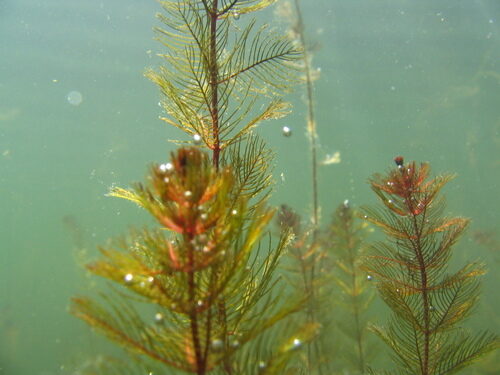
Myriophyllum verticillatum
L.
Myriad Leaf, Whorl-leaf watermilfoil
iNaturalist· cc-by-nc
(c) Valentin Hamon, some rights reserved (CC BY-NC), uploaded by Valentin Hamon
iNaturalist· cc-by-nc
(c) Mikhail Prigarov, some rights reserved (CC BY-NC), uploaded by Mikhail Prigarov
iNaturalist· cc-by-nc
(c) Екатерина Юхнина, some rights reserved (CC BY-NC), uploaded by Екатерина Юхнина
Description
Myriophyllum verticillatum is a PERENNIAL growing to 1 m (3ft 3in). See above for USDA hardiness. It is hardy to UK zone 3. It is in flower from July to August. The species is monoecious (individual flowers are either male or female, but both sexes can be found on the same plant) and is pollinated by Wind. Suitable for: light (sandy) and medium (loamy) soils. Suitable pH: mildly acid, neutral and basic (mildly alkaline) soils and can grow in very alkaline soils. It cannot grow in the shade. It can grow in water.
Edible Uses
The plant is used as a potherb.
Distribution
Most of Europe, including Britain, to N. Africa, Asia, N. and S. America..
Where It Grows
TEMPERATE ASIA: Afghanistan, Syria, Turkey, Russian Federation-Ciscaucasia (Ciscaucasia), Armenia, Azerbaijan, Georgia, Russian Federation (Dagestan), Russian Federation-Western Siberia (Western Siberia), Russian Federation-Eastern Siberia (Eastern Siberia), Kazakhstan, Tajikistan, Mongolia, Russian Federation (Kamcatskij kraj), China (n., s.w., & c.) TROPICAL ASIA: Pakistan (north) NORTHERN AMERICA: Canada (Northwest Territories, Yukon, Québec, Nova Scotia, Ontario, Prince Edward Island, New Brunswick, Newfoundland and Labrador, Saskatchewan, Alberta, Manitoba), United States (Alaska, Connecticut, Indiana (north), Maine, Massachusetts, Michigan, New Hampshire, New York, Ohio (northwest), Pennsylvania (northwest), Vermont, Minnesota, Nebraska, North Dakota, South Dakota, Illinois (north), Wisconsin, Colorado, Montana, Oregon, Washington, Wyoming (northwest), Delaware, Maryland (east). Texas, California (north), Utah (north)) EUROPE: Denmark, Finland, United Kingdom, Ireland, Iceland, Norway, Sweden, Austria, Belgium, Switzerland, Czech Republic, Germany, Hungary, Netherlands, Poland, Slovakia, Russian Federation (European part), Belarus, Estonia, Lithuania, Latvia, Ukraine (incl. Krym), Albania, Bulgaria, Greece, Croatia, Italy (incl. Sicily), Romania, Slovenia, Spain (incl. Baleares), France, Portugal AFRICA: Algeria (north), Morocco
Cultivation
Requires a sandy medium, rich in decaying organic matter, in full sun. Hardy to about -15°c, the plants overwinter as resting buds at the bottom of the pond. A good water oxygenator, it is also ideal in providing a repository for fish spawn.
Propagation
Seed - we have no information for this species but the seed is quite probably of limited germination, especially if it becomes dry, and so is best sown as soon as it is ripe in a cold frame if this is possible. Otherwise store the seed in a cool place in a jar of water and sow in the spring. Keep the pots in trays of water. When they are large enough to handle, prick the seedlings out into individual pots and plant them out in the spring. Cuttings can be inserted directly into the soil of the pond at any time in the growing season. Division.