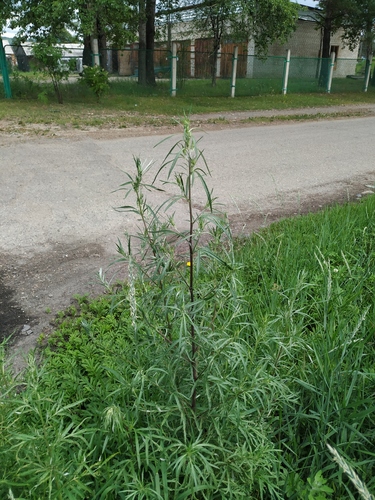
Matricaria recutita
L.
German Camomile
gbif· cc-by-nc
Toomas Kukk
gbif· cc-by-nc
Toomas Kukk
gbif· cc-by
Meise Botanic Garden
Description
Matricaria recutita is a ANNUAL growing to 0.5 m (1ft 8in) by 0.3 m (1ft). See above for USDA hardiness. It is hardy to UK zone 6 and is not frost tender. It is in flower from June to July, and the seeds ripen from July to August. The species is hermaphrodite (has both male and female organs) and is pollinated by Bees, flies. Suitable for: light (sandy), medium (loamy) and heavy (clay) soils, prefers well-drained soil and can grow in nutritionally poor soil. Suitable pH: mildly acid, neutral and basic (mildly alkaline) soils and can grow in saline soils. It cannot grow in the shade. It prefers dry or moist soil.
Edible Uses
Tea. The young sprigs are used as a seasoning. The dried flowers are used to make herb teas. It is aromatic but with a very bitter flavour.
Medicinal Uses
Anodyne Antiinflammatory Antiseptic Antispasmodic Carminative Cholagogue Diaphoretic Homeopathy Nervine Stomachic Tonic Vasodilator. German camomile is a well known herbal remedy and is much used in the West. In particular it is an excellent herb for treating various digestive disorders, nervous tension and irritability and is also used externally to treat skin problems. An infusion of the flowers is taken internally as an anodyne, anti-inflammatory, antiseptic, antispasmodic, carminative, cholagogue, diaphoretic, emmenagogue, febrifuge, sedative, stomachic, tonic and vasodilator. An infusion is particularly useful as a stomachic, nervine and sedative for young children, especially when they are teething. It is also used in the treatment of irritable bowel syndrome, Crohn's disease, peptic ulcers and hiatus hernia. In large doses, or when taken regularly for several times each day, the tea can be emetic and can also cause the symptoms it is intended to cure. The flowers are also used externally to treat wounds, sunburn, burns, haemorrhoids, mastitis and leg ulcers. The flowers are harvested when fully open and are dried for later use. The flowers contain various volatile oils including proazulenes. Upon steam distillation these proazulenes produce chamazulene, this is remarkably anti-allergenic and is useful in the treatment of asthma and hay fever. The flowers are sometimes added to cosmetics as an anti-allergenic agent. The whole plant, harvested when in flower, is used to make a homeopathic remedy. It is especially suited to teething children and those who have been in a highly emotional state over a long period of time. The German Commission E Monographs, a therapeutic guide to herbal medicine, approve Camomile for coughs and bronchitis, fevers and colds, inflammations of the skin, inflammation of the mouth and pharynx, tendency to infection - improve immunity, wounds and burns (see for critics of commission E).
Known Hazards
Allergic reactions (tongue thickening, tightness in the throat,swelling of the lips, throat and eyes, itching over the body) have been reported with German chamomile but are infrequent. Patients with severe allergic responses to ragweed (ragwort) should be warned about the possible cross-sensitivity to chamomile and other members of the Asteraceae/Compositae family (e.g. echinacea, feverfew, milk thistle).
Distribution
Europe, including Britain, east to W. Asia and the Himalayas.
Where It Grows
TEMPERATE ASIA: Afghanistan, Cyprus, Iran, Iraq (north), Israel, Lebanon, Syria, Turkey, Russian Federation-Ciscaucasia (Ciscaucasia), Azerbaijan, Georgia, Russian Federation (Dagestan), Russian Federation-Western Siberia (Western Siberia), Russian Federation-Eastern Siberia (Eastern Siberia), Kazakhstan, Kyrgyzstan, Uzbekistan, Mongolia, China (Anhui Sheng, Hebei Sheng, Jiangsu Sheng, Liaoning Sheng, Shaanxi Sheng, Shandong Sheng, Sichuan Sheng, Xinjiang Uygur Zizhiqu) TROPICAL ASIA: India (Himachal Pradesh, Jammu and Kashmir, Punjab, Uttar Pradesh) EUROPE: Denmark, Finland, United Kingdom, Norway, Sweden, Austria, Belgium, Switzerland, Czech Republic, Germany, Hungary, Netherlands, Poland, Slovakia, Russian Federation (European part), Belarus, Ukraine (incl. Krym), Albania, Bulgaria, Bosnia and Herzegovina, Greece (incl. Crete), Croatia, Italy (incl. Sardinia, Sicily), Montenegro, Romania, Serbia, Slovenia, Spain, France (incl. Corsica), Portugal AFRICA: Algeria, Morocco
Cultivation
An easily grown plant, it succeeds in any well-drained soil in a sunny position. It prefers neutral to slightly acid conditions and succeeds in poor soils. It usually self-sows freely when well-sited. Chamomile has a long history as a gentle and effective folk medicine for a wide variety of disorders, being especially effective and safe for children. There is some confusion between this plant and Chamaemelum nobile as to which is the genuine camomile. This species is said to be more bitter and inferior to Chamaemelum nobile in some reports and to be more active medicinally in other reports. Both have similar properties and can probably be used interchangeably. The whole plant has a pungent aroma.
Propagation
Seed - sow spring or autumn in situ. Germination should take place within 3 weeks.
Other Uses
Dye Essential Hair Liquid feed Repellent StrewingAn infusion of the flowers is used as a hair shampoo, especially for fair hair. It is also used as a liquid feed and general plant tonic, effective against a number of plant diseases. The flowers are also an ingredient of 'Quick Return' herbal compost activator. The whole plant was formerly used as a strewing herb. The whole plant is insect repellent. An essential oil from the whole plant is used as a flavouring and in perfumery. Yellow to gold dyes are obtained from the flowers.