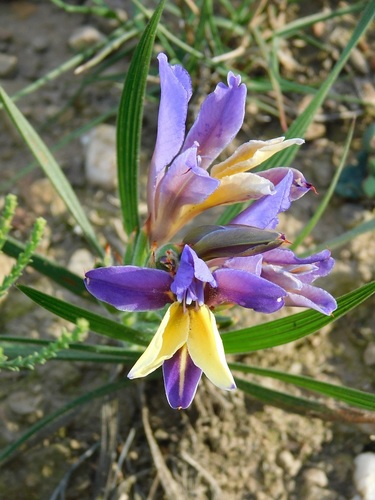
Iris germanica florentina - (L.)Dykes.
(L.)Dykes.
Orris, Orris-root
gbif· cc-by-nc-nd
Hugo Wouters (†) & Monique Giesen
gbif· cc-by
Meise Botanic Garden
Description
Iris germanica florentina is a PERENNIAL growing to 0.9 m (3ft) by 0.6 m (2ft in) at a medium rate. See above for USDA hardiness. It is hardy to UK zone 5 and is not frost tender. It is in flower in May, and the seeds ripen from July to August. The species is hermaphrodite (has both male and female organs) and is pollinated by Insects. The plant is self-fertile. Suitable for: light (sandy) and medium (loamy) soils. Suitable pH: mildly acid, neutral and basic (mildly alkaline) soils. It can grow in semi-shade (light woodland) or no shade. It prefers moist soil.
Edible Uses
Condiment. The root can be dried, ground into a powder and used as a food flavouring. The root may take several years of drying to develop its full fragrance.
Medicinal Uses
Diuretic Purgative Stomachic. The dried root is diuretic, expectorant and stomachic. It is taken internally in the treatment of coughs, catarrh and diarrhoea. Externally it is applied to deep wounds. The root is harvested in late summer and early autumn and dried for later use. The juice of the fresh root is a strong purge of great efficiency in the treatment of dropsy.
Known Hazards
The leaves, and especially the rhizomes, of this species contain an irritating resinous substance called irisin. If ingested this can cause severe gastric disturbances. Plants can cause skin irritations and allergies in some people.
Distribution
Europe - Mediterranean.
Where It Grows
Coming Soon
Cultivation
Prefers a sunny position in a well-drained soil that contains some lime. Grows well in dry soils in light deciduous shade. Succeeds in full sun or partial shade. Prefers a pH in the range 6 to 7.5 or higher. The plant is sometimes cultivated for the essential oil in its root. Members of this genus are rarely if ever troubled by browsing deer or rabbits.
Propagation
Seed - best sown as soon as it is ripe in a cold frame. Stored seed should be sown as early in the year as possible in a cold frame. A sterile plant, it does not produce seed. Division, best done after flowering though it is usually successful at most times of the year. Very easy, larger clumps can be replanted direct into their permanent positions, though it is best to pot up smaller clumps and grow them on in a cold frame until they are rooting well. Plant them out in the spring.
Other Uses
Beads Cosmetic Dye Essential Incense. The root is a source of Orris powder which has the scent of violets. It is obtained by grinding up the dried root. It is much used as a fixative in perfumery and pot-pourri, as an ingredient of toothpastes, breath fresheners etc and as a food flavouring. The root can take several years of drying to fully develop its violet-like fragrance, when fresh it has an acrid flavour and almost no smell. An essential oil is obtained from the fresh root, this has the same uses as the root. The root has been burnt in open fires in order to sweeten the smell of a room. The juice of the root is sometimes used as a cosmetic and also for the removal of freckles from the skin. A black dye is obtained from the root. A blue dye is obtained from the flowers. The seeds are used as rosary beads. Plants can be grown for ground cover, the dense mat of roots excluding all weeds.