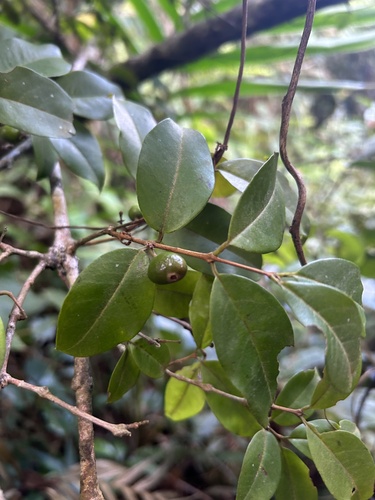
Myrcia tomentosa
(Aubl.) DC.
iNaturalist· cc-by-nc
(c) Angel Fernandez, some rights reserved (CC BY-NC), uploaded by Angel Fernandez
iNaturalist· cc-by-nc
(c) Frederico Acaz Sonntag, some rights reserved (CC BY-NC), uploaded by Frederico Acaz Sonntag
iNaturalist· cc-by-nc
(c) Frederico Acaz Sonntag, some rights reserved (CC BY-NC), uploaded by Frederico Acaz Sonntag
Description
A small tree. It grows 4.5-7.5 m tall. The leaves are hairy. The fruit have downy skins. They are green and turn purple.
This description is brief — help expand it
Edible Uses
The flesh of the fruit is eaten.
Traditional Uses
The flesh of the fruit is eaten.
This uses section is brief — help expand it
Distribution
A tropical plant. It occurs in Brazil.
Where It Grows
Amazon, Asia, Bolivia, Brazil, Central America, Colombia, Ecuador, French Guiana, Guianas, Guyana, Pacific, Panama, Peru, Philippines, SE Asia, South America, Suriname, Trinidad and Tobago, Venezuela,
Cultivation
Presumably from seed.
Propagation
Seed - best sown as soon as it is ripe in a sunny position in a nursery seedbed. A low germination rate can be expected, with the seed sprouting within 20 - 35 days.
Other Uses
The wood is fine-textured, wavy-grained, heavy, hard, with moderate mechanical properties and of good durability. Because of its small dimensions, it is only used locally, for items such as general constructions, rustic furniture, pasture gates, fences etc. The wood is used for fuel and to make charcoal.
Notes
There are about 550 Eugenia species. They are mostly in tropical and subtropical South America.
Synonyms
Also Known As
Cabelluda, Cabeludinha, Goiaba-brava, Guayaro agrio, Jacoticaba-brava, Sanquemula
References (10)
- Coronel, R.E., 1982, Fruit Collections in the Philippines. IBPGR Newsletter p 9
- Garner, R.J., and Chaudhri, S.A., (Ed.) 1976, The Propagation of Tropical fruit Trees. FAO/CAB. p 354
- Grandtner, M. M. & Chevrette, J., 2013, Dictionary of Trees, Volume 2: South America: Nomenclature, Taxonomy and Ecology. Academic Press p 434
- Hist. pl. Guiane 1:504, t. 200. 1775
- Kermath, B. M., et al, 2014, Food Plants in the Americas: A survey of the domesticated, cultivated and wild plants used for Human food in North, Central and South America and the Caribbean. On line draft. p 559
Show all 10 references Hide references
- NYBG Herbarium "edible"
- Peres, M. K., 2011, Diasporos do Cerrado Atrativos para Fauna: Chave Interativa Caracterizacao Visual e Relacoes Ecologicas. Masters thesis. Universidade de Brasilia. (As Myrcia rhodeosepala)
- Popenoe, W., 1920, Manual of tropical and subtropical fruits. Macmillan. New York.
- Roa, J. A. G. & Boada, D. S. G., 2018, Fundación para el Fortalecimiento de la Fruticultura y Plantas Alimenticias no Convencionales en Colombia.
- Silva, S. P., 1991, Frutas Brasil. Empresa das Artes. São Paul (Also as Eugenia tomentosa)