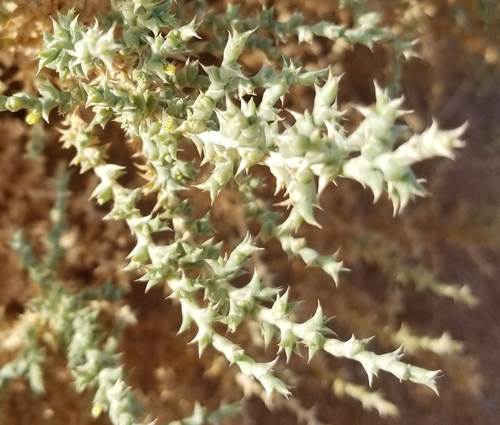
Agriophyllum squarrosum
(L.) Moquin-Tandon;
Sand weed grain, Sand weed
iNaturalist· cc-by
(c) Urgamal Magsar, some rights reserved (CC BY)
iNaturalist· cc-by
(c) Urgamal Magsar, some rights reserved (CC BY)
iNaturalist· cc-by
(c) Urgamal Magsar, some rights reserved (CC BY)
Summary
An annual herb reaching 0.4 m (1 ft 4 in) tall with hermaphrodite flowers appearing August to October and seeds ripening August to October. Grows in light sandy, medium loamy, and heavy clay soils across mildly acidic to mildly alkaline pH ranges. Tolerates semi-shade or full sun and prefers moist soil.
Description
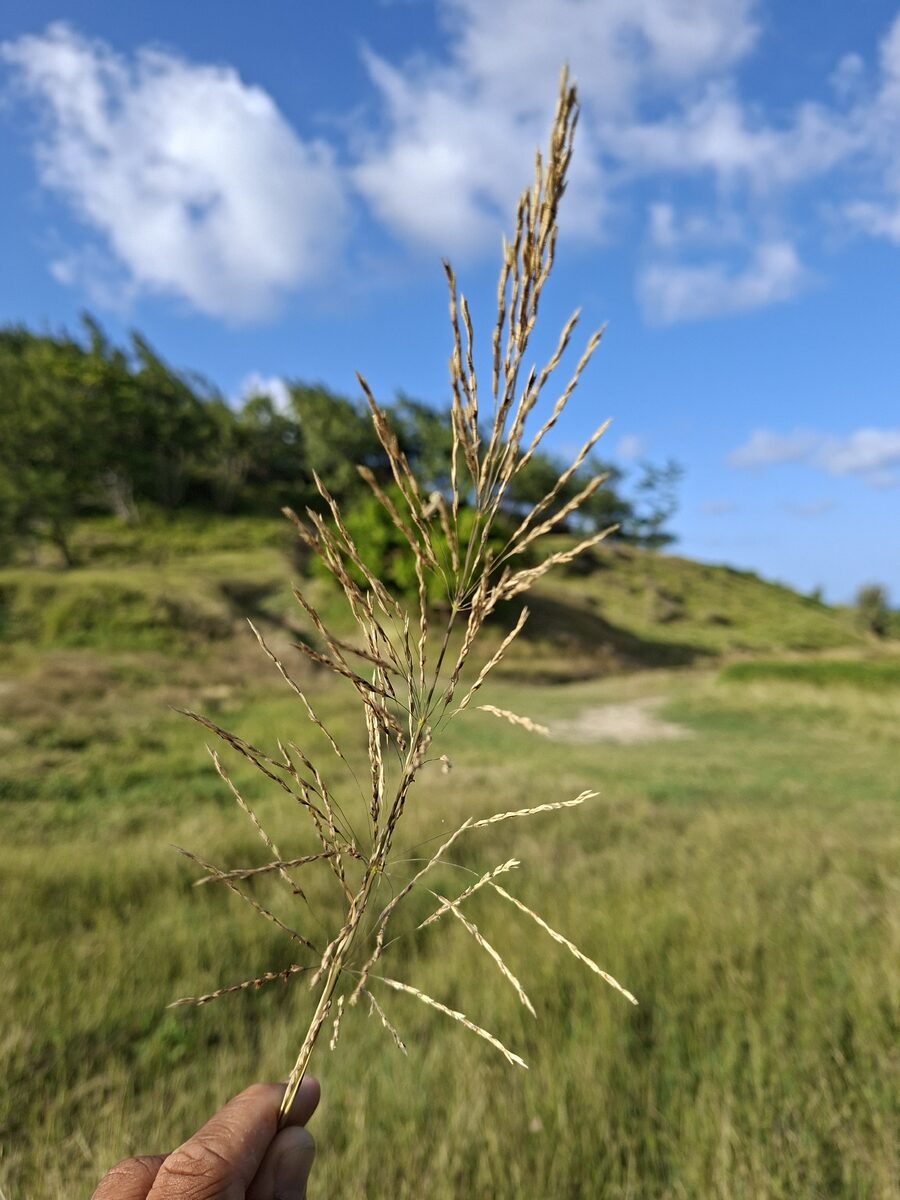
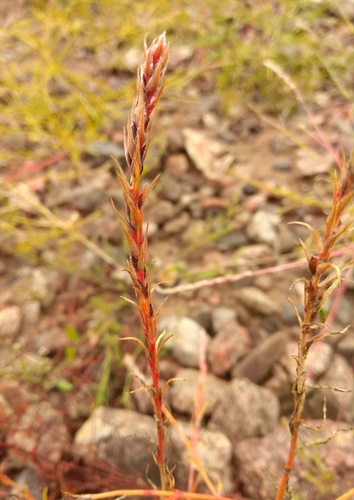
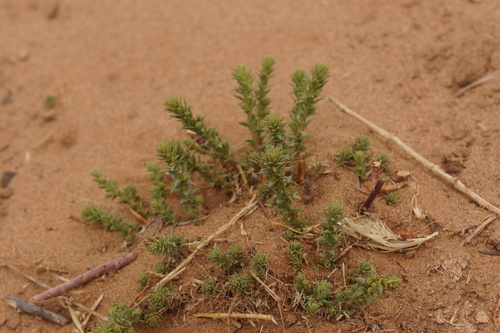
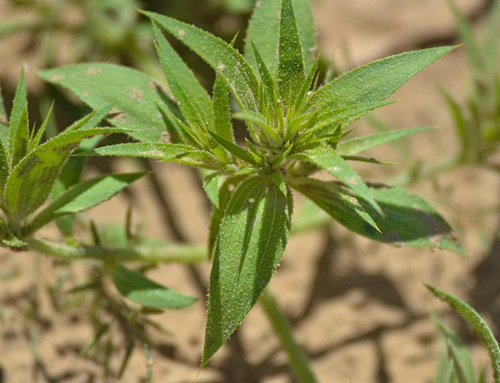
An annual herb. It grows 15-60 cm high. It has long roots. The stems are erect and light green. The branches are covered with branched hairs. The leaves do not have leaf stalks. The leaves are narrowly sword shaped and 2-8 cm long by 4-10 mm wide. There is a spine at the tip. The flowers are small and in spikes in the axils of leaves. They are in spiny and hairy groups. The fruit are crowded in a head. The seeds is like millet. It is 1-5 mm across.
Edible Uses
The seeds can be eaten raw or cooked and are considered an important local food.
Traditional Uses
The shoots and leaves are eaten. The seeds are eaten as a grain. The seed are used to make flour.
This uses section is brief — help expand it
Medicinal Uses
None known.
Distribution
It is a temperate plant. It grows on dunes and sandy places. It grows on sandy soils in the deserts of Central Asia. It can grow in arid places. In Inner Mongolia.
Where It Grows
Asia, Azerbaijan, Caucasus, Central Asia, China, Kazakhstan, Mongolia, Russia, Siberia,
Propagation
No specific propagation information is available for this species. Sowing seed in spring is recommended. With sufficient seed, an outdoor sowing in situ in late spring would likely be effective; otherwise sow in pots in a greenhouse in early spring, prick out seedlings as soon as they are large enough to handle, and plant out in late spring after the last expected frost.
Other Uses
None known.
Notes
There are 6 Agriophyllum species. Also put in the family Chenopodiaceae.
Synonyms
Also Known As
Bodaa ebesu, Chulger, Sha peng, Soulkhir
References (14)
- Bircher, A. G. & Bircher, W. H., 2000, Encyclopedia of Fruit Trees and Edible Flowering Plants in Egypt and the Subtropics. AUC Press. p 15 (As Agriophyllum gobicum)
- Bull. Acad. Imp. Sci. Saint-Petersbourg 25:355. 1879 (As Agriophyllum gobicum)
- Flora of China. Chenopodiaceae
- Fl. taur.-cauc. 3:6. 1819
- Hedrick, U.P., 1919, (Ed.), Sturtevant's edible plants of the world. p 30 (As Agriophyllum gobicum)
Show all 14 references Hide references
- https://en.wikipedia.org/wiki/List of wild edible plants in Mongolian cuisine (As Agriophyllus arenarium)
- Hu, Shiu-ying, 2005, Food Plants of China. The Chinese University Press. p 375 (As Agriophyllum arenarium)
- Khasbagan, Hu-Yin Huai, and Sheng-Ji pei, 2000, Wild Plants in the Diet of Athorchin Mongol Herdsmen in Inner Mongolia. Economic Botany 54(4): 528-536 (As Agriophyllum pungens)
- Khasbagan, Yeruhan and Zhao Hui, 2011, Study on Traditional Knowledge of Wild Edible Plants Used by the Mongolians in Xilingol Typical Steppe Area. Plant Diversity and Resources. 33(2): 239-246 (As Agriophyllum pungens)
- Menninger, E.A., 1977, Edible Nuts of the World. Horticultural Books. Florida p 114 (As Agriophyllum gobicum)
- READ
- Ryabushkina, N., et al, 2008, Brief Review of Kazakhstan Flora and Use of its Wild Species. The Asian and Australasian Journal of Plant Science and Biotechnology (As Agriophyllum arenarium)
- Zhang, Y., et al, Yunatov’s Records of Wild Edible Plant Used by the Mongols in Mongolia During 1940- 1951: Ethnobotanical Arrangements and Discussions. Inner Mongolia Normal University. p 6
- Zhang, Y. et al, 2020, Characteristics and utilization of plant diversity and resources in Central Asia. Regional Sustainability. Elsevier