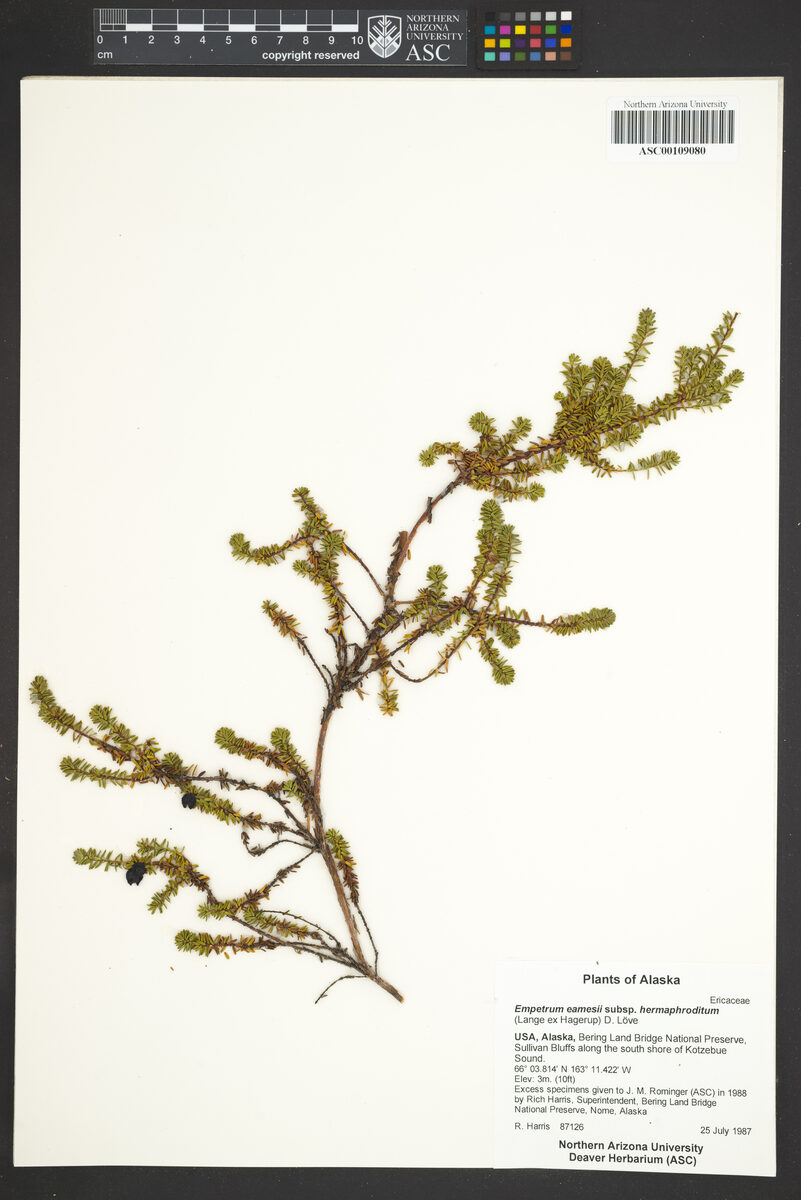
Empetrum atropurpureum
Fernald.&Wiegand.
Purple Crowberry
iNaturalist· cc-by-nc
(c) Aaron Hulsey, some rights reserved (CC BY-NC), uploaded by Aaron Hulsey
iNaturalist· cc-by-nc-nd
(c) Oscar Johnson, some rights reserved (CC BY-NC-ND), uploaded by Oscar Johnson
iNaturalist· cc-by
(c) er-birds, some rights reserved (CC BY), uploaded by er-birds
Description
Empetrum atropurpureum is an evergreen Shrub growing to 0.2 m (0ft 8in). It is not frost tender. It is in leaf all year. The species is dioecious (individual flowers are either male or female, but only one sex is to be found on any one plant so both male and female plants must be grown if seed is required). . The plant is not self-fertile. Suitable for: light (sandy) and medium (loamy) soils. Suitable pH: mildly acid soils and can grow in very acid soils. It can grow in semi-shade (light woodland) or no shade. It prefers moist soil. The plant can tolerates strong winds but not maritime exposure.
Edible Uses
Fruit - raw or cooked. The flavour is watery with a slightly medicinal flavour that is improved by freezing. The fruit is usually mixed with sugar and acid fruits such as cranberries and then cooked. They are a good currant substitute in puddings.
Distribution
Eastern N. America - Labrador to Quebec, south to Michigan.
Where It Grows
Coming Soon
Cultivation
We have very little information on this species and do not know if it will be hardy in Britain, though judging by its native range it should succeed outdoors in most parts of this country. The following notes are based on the general needs of the genus. A calcifuge plant, it is easily grown in a lime-free soil. Prefers a moist sandy peaty soil and some shade. Dioecious. Male and female plants must be grown if seed is required.
Propagation
Seed - best sown as soon as it is ripe in a cold frame. The seed can be very slow to germinate, stored seed requires 5 months warm then 3 months cold stratification at 5°c. When they are large enough to handle, prick the seedlings out into individual pots and grow them on in the greenhouse for at least their first winter. Plant them out into their permanent positions in late spring or early summer, after the last expected frosts. Cuttings of half-ripe wood, 3cm with a heel, July/August in a frame. Takes 3 weeks. Good percentage. Cuttings of mature wood of the current year's growth, 3cm with a heel, October in a frame. Requires shade. Good percentage.
Other Uses
Succeeds as a ground cover plant in exposed positions.