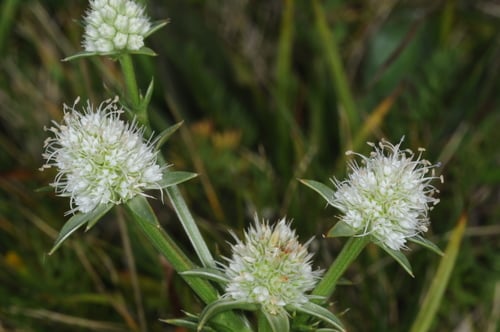
Eryngium creticum
Lam.
Crete eryngo, Small-headed blue eryngo
iNaturalist· cc-by-nc-sa
(c) Tamsin Carlisle, some rights reserved (CC BY-NC-SA), uploaded by Tamsin Carlisle
iNaturalist· cc-by-nc
(c) Σάββας Ζαφειρίου (Savvas Zafeiriou), some rights reserved (CC BY-NC)
Summary
Source: WikipediaEryngium creticum, or the field eryngo, is a species of flowering plant in the family Apiaceae, native to the Northern and Eastern Mediterranean, eastwards to Iran. It is known in Lebanon as قرصعنة and in Israel as חרחבינה מכחילה.
Description
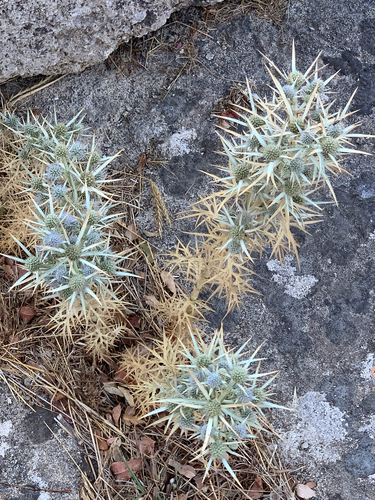
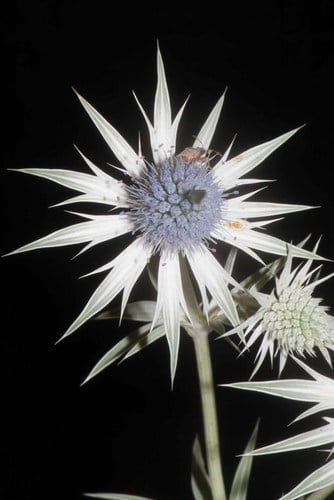
A herb which keeps growing from year to year. Sometimes it is an annual. It grows 1 m tall. The stems are erect and violet-blue. They have many branches. The leaves can be oval or rounded. The base is heart shaped. They have teeth or 3 lobes. The leaves are leathery and on long stalks. The flower head is violet blue and spreading. The flowers are in round heads. These are 5-10 mm across. There are 5-7 bracts. There are 1 or 2 pairs of spines at the base.
Edible Uses
Young basal leaves can be cooked and eaten.
Traditional Uses
The leaves and stems are preserved in vinegar and also eaten raw in salads. They are used in pickles. The roots are eaten raw or cooked.
This uses section is brief — help expand it
Medicinal Uses
Used as an antidote in the treatment of snakebite.
Distribution
It is a Mediterranean plant. It grows in wasteland in grassy and stony areas. It grows in dry habitats in waste places and in cliff crevices.
Where It Grows
Cyprus, Europe, Iran, Israel, Jordan, Lebanon, Mediterranean, Middle East, Palestine, Turkey, Türkiye,
Cultivation
Requires a well-drained soil and a sunny position. Prefers a light sandy soil but tolerates most soil types including lime and poor gravels. Plants should be put in their final position whilst small since they resent root disturbance. Plants are usually short-lived perennials and sometimes are only annual or biennial.
Propagation
Seed is best sown as soon as it is ripe in early autumn, placed on the surface of a well-drained compost in a cold frame. Sowing in spring is also possible. Germination typically occurs in 5–90 days at 20°C. Once large enough to handle, prick seedlings out into individual pots and grow them on in the greenhouse through their first winter, then plant out into permanent positions in late spring or early summer after the last expected frosts. Division can be done in early spring or autumn, though care should be taken as the plant resents root disturbance. Root cuttings can be taken in autumn or winter.
Other Uses
None known.
Notes
There are 230 Eryngium species.
Also Known As
Beektire, Cistok, Deve dikeni, Ecirok, Ekkeyde, Encero, Eryngo, Goz dikeni, Ikkeyde, Kazayagi, Kurs'nneh, Mangallo, Pagkalos, Qarsa'neh, Sifenok, Striye bergan
References (26)
- Ali-Shtayeh, M. S., et al, 2008, Traditional knowledge of wild edible plants used in Palestine (Northern West Bank): A comparative study. J Ethnobiol Ethnomed. 4: 13
- Al-Qura'n, S. A., 2010, Ethnobotanical and Ecological Studies of Wild Edible Plants in Jordan. Libyan Agriculture Research Center Journal International 1(4):231-243
- Batal, M. & Hunter, E., 2007, Traditional Lebanese recipes based on wild plants: An answer to diet simplification? Food and Nutrition Bulletin, vol. 28, no. 2 (supplement) © 2007, The United Nations University.
- Blamey, M and Grey-Wilson, C., 2005, Wild flowers of the Mediterranean. A & C Black London. p 154
- Ciftcioglu, C. G., 2015, Sustainable wild-collection of medicinal and edible plants in Lefke region of North Cyprus. Agroforest Syst. Springer
Show all 26 references Hide references
- Della, A., et al, 2006, An ethnobotanical survey of wild edible plants of Paphos and Larnaca countryside of Cyprus. J. Ethnobiol. Ethnomed. 2:34
- Demir, I. & Ayaz, N., 2022, Wild edible plants contributing to the traditional foods of Mardin (Turkey) Province. Indian Journal of Traditional Knowledge Vol 21(3), July 2022, pp 569-582
- Dogan, A., et al, 2014, A review of edible plants on the Turkish Apiaceae species. J. Fac. Pharm. Istanbul, 44(2) pp 251-262
- Dogan, Y., 2012, Traditionally used wild edible greens in the Aegean Region of Turkey. Acta Societatis Botanicorum Poloniae 81(4): 329-342
- Encycl. 4:754. 1798
- Ertug, F., 2004, Wild Edible Plants of the Bodrum Area. (Mugla, Turkey). Turk. J. Bot. 28 (2004): 161-174
- Ertug, F, Yenen Bitkiler. Resimli Türkiye Florası -I- Flora of Turkey - Ethnobotany supplement
- Food Composition Tables for the Near East. http://www/fao.org/docrep No. 320
- Hancer, C. K., et al, 2020, Traditional Knowledge of Wild Edible Plants of Biga (Çanakkale), Turkey. Acta Societatis Botanicorum Poloniae / 2020 / Volume 89 / Issue 1 / Article 8914
- Hinnawi, N. S. A., 2010, An ethnobotanical study of wild edible plants in the Northern West Bank "Palestine". An-Najah National University. p 91
- http://cypruswildflowers.com
- Jeambey, Z., et al, 2009, Perceived health and medicinal properties of six species of wild edible plants in north-east Lebanon. Public Health Nutrition: 12(10), 1902-1911
- Kaya, O. M., et al, 2020, An ethnobotanical research in Sanhurfa central district and attached Villages (Turkey). Indian Journal of Traditional Knowledge. Vol. 19(1) pp 7-23
- Martin, F.W. & Ruberte, R.M., 1979, Edible Leaves of the Tropics. Antillian College Press, Mayaguez, Puerto Rico. p 222
- Mayer-Chussuck, U & Lev, E., 2014, Wild Edible Plants in Israel Tradition Versus Cultivation. in Z. Yaniv, N. Dudai (eds.), Medicinal and Aromatic Plants of the Middle-East, Springer
- Plants for a Future database, The Field, Penpol, Lostwithiel, Cornwall, PL22 0NG, UK. http://www.scs.leeds.ac.uk/pfaf/
- Sinclair, V., 1992, The Floral Charm of Cyprus. Interworld Publications. p 111
- Terra, G.J.A., 1973, Tropical Vegetables. Communication 54e Royal Tropical Institute, Amsterdam, p 45
- Tukan, S. K., et al, 1998, The use of wild edible plants in the Jordanian diet. International Journal of Food Sciences and Nutrition. 49:225-235
- Wild Edible Plants in Lebanon. Promoting dietary diversity in poor communities in Lebanon. http://www.wildedibleplants.org/
- Yesil, Y., et al, 2019, Wild edible plants in Yeşilli (Mardin-Turkey), a multicultural area. Journal of Ethnobiology and Ethnomedicine (2019) 15:52