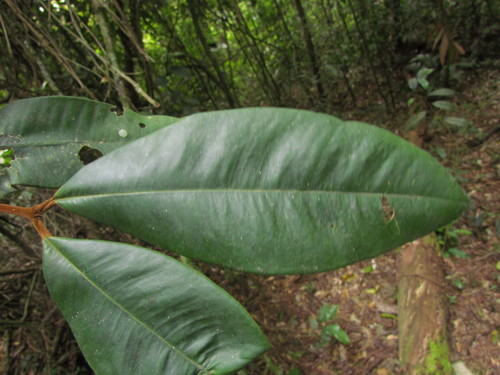
Myrtus communis
L.
Myrtle, Foxtail Myrtle
iNaturalist· cc-by
(c) Daniel Macías Gómez, some rights reserved (CC BY), uploaded by Daniel Macías Gómez
iNaturalist· cc-by-nc
(c) Σάββας Ζαφειρίου (Savvas Zafeiriou), some rights reserved (CC BY-NC), uploaded by Σάββας Ζαφειρίου (Savvas Zafeiriou)
iNaturalist· cc-by
(c) Thomas Dreux, some rights reserved (CC BY), uploaded by Thomas Dreux
Description
Myrtus communis is an evergreen Shrub growing to 4.5 m (14ft) by 3 m (9ft) at a medium rate. See above for USDA hardiness. It is hardy to UK zone 8 and is frost tender. It is in leaf all year, in flower from July to August, and the seeds ripen in October. The species is hermaphrodite (has both male and female organs) and is pollinated by Bees. The plant is self-fertile. It is noted for attracting wildlife. Suitable for: light (sandy), medium (loamy) and heavy (clay) soils and prefers well-drained soil. Suitable pH: mildly acid, neutral and basic (mildly alkaline) soils. It cannot grow in the shade. It prefers dry or moist soil. The plant can tolerate maritime exposure.
Edible Uses
Drink. Fruit - raw or cooked. The fruit has an aromatic flavour, it can be eaten fresh when ripe or can be dried and is then used as an aromatic food flavouring, especially in the Middle East. It can also be made into an acid drink. The fruit is about 8mm in diameter. The leaves are used as a flavouring in cooked savoury dishes. The dried fruits and flower buds are used to flavour sauces, syrups etc. An essential oil from the leaves and twigs is used as a condiment, especially when mixed with other spices. In Italy the flower buds are eaten. The flowers have a sweet flavour and are used in salads.
Medicinal Uses
Antibiotic Antidiarrhoeal Antiseptic Aromatic Astringent Balsamic Carminative Dysentery Epilepsy Haemostatic TB Tonic Urinary. The leaves are aromatic, balsamic, haemostatic and tonic. Recent research has revealed a substance in the plant that has an antibiotic action. The active ingredients in myrtle are rapidly absorbed and give a violet-like scent to the urine within 15 minutes. The plant is taken internally in the treatment of urinary infections, digestive problems, vaginal discharge, bronchial congestion, sinusitis and dry coughs. In India it is considered to be useful in the treatment of cerebral affections, especially epilepsy. Externally, it is used in the treatment of acne (the essential oil is normally used here), wounds, gum infections and haemorrhoids. The leaves are picked as required and used fresh or dried. An essential oil obtained from the plant is antiseptic. It contains the substance myrtol - this is used as a remedy for gingivitis. The oil is used as a local application in the treatment of rheumatism. The fruit is carminative. It is used in the treatment of dysentery, diarrhoea, haemorrhoids, internal ulceration and rheumatism.
Distribution
S. Europe to W. Asia.
Where It Grows
TEMPERATE ASIA: Afghanistan, Cyprus, Iran, Iraq, Israel, Jordan, Lebanon, Syria, Turkey,Yemen. TROPICAL ASIA: Pakistan, EUROPE: Former Yugoslavia, Albania, Greece (incl. Crete), Italy (incl. Sardinia, Sicily), Malta, Spain (incl. Baleares), France (incl. Corsica), Portugal, AFRICA: Spain, Canarias, Portugal, Azores, Madeira Islands, Algeria, Libya, Morocco, Tunisia, Eritrea, Ethiopia.
Cultivation
It can also improve soil quality through leaf litter. Succeeds in reasonably good soil so long as it is well-drained. Prefers a moderately fertile, well-drained neutral to alkaline loam in a sunny position. Succeeds in dry soils. A very ornamental plant, when fully dormant it is hardy to between -10 and -15°c, so long as it is sheltered from cold drying winds, though it does withstand quite considerable maritime exposure. Late frosts can damage the young growth in spring. This species does not succeed outdoors in the colder parts of Britain. A moderately fast-growing plant when young but soon slows with age. There are several named varieties. 'Tarentina' with narrow small leaves is hardier than the type and is especially wind-resistant, 'Microphylla' is a dwarf form and 'Leucocarpa' has white berries. Myrtle is often cultivated in the Mediterranean, where the plant is regarded as a symbol of love and peace and is much prized for use in wedding bouquets. The foliage is intensely aromatic. Any pruning is best carried out in the spring. Plants in this genus are notably resistant to honey fungus. Myrtus communis is generally self-fertile, but cross-pollination can enhance fruit production and quality. Myrtle leaves and berries can be harvested throughout the growing season, but berries are typically picked in late summer to early autumn. The flowering period usually occurs in late spring to early summer. Myrtle is considered a moderate grower, reaching about 3 to 5 feet (1 to 1.5 meters) in height within 3 to 5 years, depending on growing conditions.
Propagation
Pre-soak the seed for 24 hours in warm water and then sow it in late winter in a greenhouse. Prick out the seedlings into individual pots as soon as they are large enough to handle and grow them on in the greenhouse for at least their first winter. Plant them out into their permanent positions in late spring or early summer, after the last expected frosts. Cuttings of half-ripe wood, 7 - 10cm with a heel, July/August in a frame. Pot up in the autumn and overwinter in a cold frame. Plant out in late spring. High percentage. Cuttings of mature wood of the current seasons growth, 7 - 12cm with a heel, November in a shaded and frost free frame. Plant out in late spring or early autumn. High percentage. Layering.
Other Uses
Charcoal Essential Hedge Hedge. The plant is very tolerant of regular clipping and can be grown as a hedge in the milder parts of Britain. An essential oil from the bark, leaves and flowers is used in perfumery, soaps and skin-care products. An average yield of 10g of oil is obtained from 100 kilos of leaves. A perfumed water, known as "eau d'ange", is obtained from the flowers. A high quality charcoal is made from the wood. Wood - hard, elastic, very fine grained. Used for walking sticks, tool handles, furniture etc.
Also Known As
Echte Myrte, Maile haole, Mirto, Mrca, Murta, Myrte, Periwinkle, Rihan, Tassie berry