Cirsium arizonicum - (A.Gray) Petr.
(A.Gray) Petr.
Arizona thistle
gbif· cc-by-nc
Jarrod Rivituso
gbif· cc-by-nc
Jarrod Rivituso
gbif· cc-by-nc
Alison Kim
Description
Cirsium arizonicum is an evergreen Biennial growing to 1 m (3ft 3in) by 0.5 m (1ft 8in) at a fast rate. See above for USDA hardiness. It is hardy to UK zone 5. The flowers are pollinated by Bees, Insects. It is noted for attracting wildlife. Suitable for: light (sandy), medium (loamy) and heavy (clay) soils, prefers well-drained soil and can grow in nutritionally poor soil. Suitable pH: mildly acid, neutral and basic (mildly alkaline) soils. It cannot grow in the shade. It prefers dry or moist soil and can tolerate drought.
Edible Uses
A high-value thistle species, best harvested for roots and young stems, with excellent flavor and nutrition when collected at the right stage. Edible Uses & Rating: The taproot is the most important edible part and is excellent when harvested from first-year rosettes or early in the second year before flowering. Peeled young stems are also highly edible and among the best wild vegetables available. Leaves are technically edible but impractical due to spines and bitterness. Flowers may be chewed or brewed into a sweet beverage, though this use is not well documented. Overall, Arizona thistle ranks as a high-value wild food when roots and stems are harvested at the right stage. Taste, Processing & Kitchen Notes: Roots are mild, starchy, and slightly sweet, with a flavor reminiscent of burdock root and potato. The outer portions are tender, while inner cores may be tougher. Simmering produces a rich, pleasant broth. Young stems, once peeled, are crisp, juicy, and sweet, often surpassing cultivated celery in flavor. Cooking softens strings but does not eliminate them entirely. Leaves are bitter and difficult to prepare. Flowers are sweet but fragile and lose flavor when washed. Seasonality (Phenology): Roots are best harvested from autumn through early spring, before flower stalks emerge. Stems are harvested in spring while still young and tender. Flowers appear from late spring into summer, depending on elevation and moisture. Safety & Cautions (Food Use): Spines pose the primary hazard. Gloves are recommended. Harvest only first-year or pre-flowering roots for best quality. Harvest & Processing Workflow: Locate first-year rosettes or second-year plants before flowering. Dig roots deeply, peel skins, and slice for boiling. For stems, harvest young shoots, peel thoroughly, and eat fresh or cooked. Cultivar/Selection Notes: No cultivars exist. Wild populations vary slightly in spine density and root thickness. Look-Alikes & Confusion Risks: Other Cirsium species are similar and generally edible in the same ways. Avoid confusion with Centaurea species, which lack edible roots. Traditional / Indigenous Use Summary: Arizona thistle was likely used opportunistically by Indigenous peoples, though detailed documentation is limited. Its traits closely match those of other thistles known to be eaten.
Known Hazards
Spines pose the primary hazard. Gloves are recommended. Harvest only first-year or pre-flowering roots for best quality.
Distribution
Native to Arizona and adjacent regions of the Southwest, occurring primarily at mid to high elevations.
Where It Grows
US. USA. Arizona, California, Mexico Northeast, Mexico Northwest, Nevada, New Mexico, Utah.
Cultivation
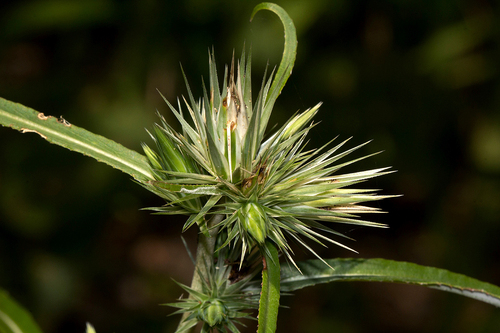
Arizona thistle is a rugged, nutritious, and reliable wild vegetable whose roots and stems deserve far more attention than they receive. When handled skillfully, it provides high returns for the effort invested. Growing Conditions: Arizona thistle thrives in open woodlands, mountain meadows, and disturbed soils with good drainage. It tolerates poor soils well and often appears where competition from other plants is limited. Habitat & Range: This species is native to Arizona and adjacent regions of the Southwest, occurring primarily at mid to high elevations. It is most common in open pine forests, montane grasslands, and rocky slopes. Size & Landscape Performance: Mature flowering plants commonly reach 1–1.5 meters tall. Rosette-stage plants remain low and compact. The species does not form aggressive colonies and is not invasive. Cultivation (Horticulture): Arizona thistle is not cultivated but could be grown intentionally as a root crop in poor soils. Spines make it unsuitable for gardens unless managed carefully. Pests & Problems: Few pests affect Arizona thistle. Spines deter grazing by livestock and wildlife. FAMILY: Sunflower family (Asteraceae) – Cirsium genus. USDA Hardiness Zones: Approx. Zones 4–8. Typical Size: 40–150 cm tall; robust biennial with stout taproot. Identification & Habit: Arizona thistle grows as a basal rosette in its first year, with deeply lobed, sharply spined leaves radiating close to the ground. In its second year it sends up one or more stout flowering stems bearing spiny leaves and purple flower heads. The plant is coarse, rigid, and upright, with thick stems that usually indicate a well-developed taproot below. Flower heads are discoid, composed entirely of purple disk flowers surrounded by strongly spine-tipped bracts. Pollination: Pollinated primarily by bees and butterflies attracted to the purple flower heads.
Propagation
Propagation occurs by seed. Seeds germinate readily on bare or lightly disturbed soil and require no stratification.
Other Uses
Flowers are important nectar sources for native bees and butterflies. Seeds are eaten by birds. Deep roots help stabilize soil.
Synonyms
Also Known As
Arizona thistle. Cnicus arizonicus.