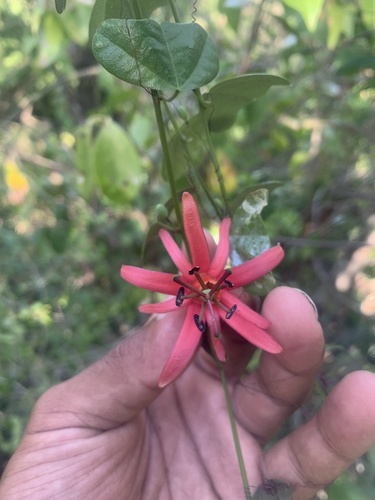
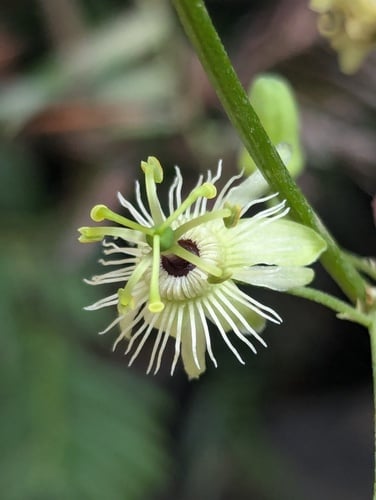
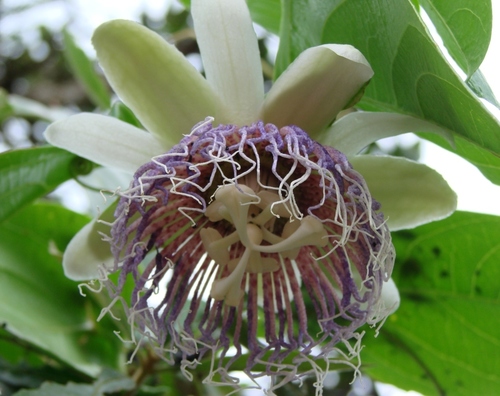
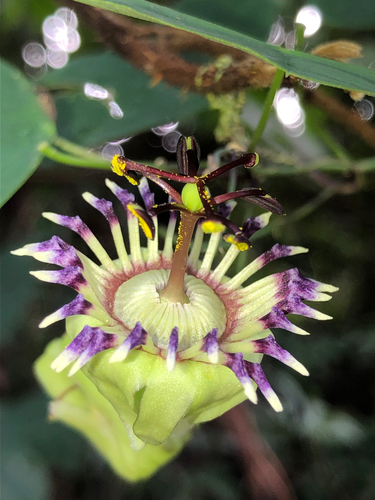
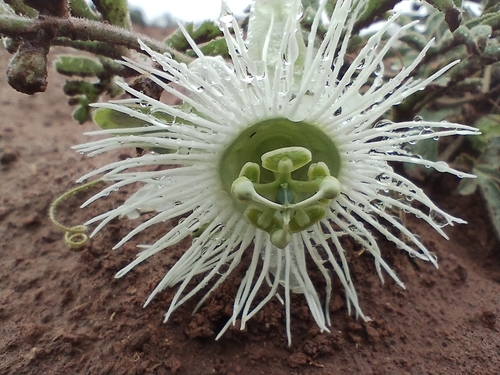
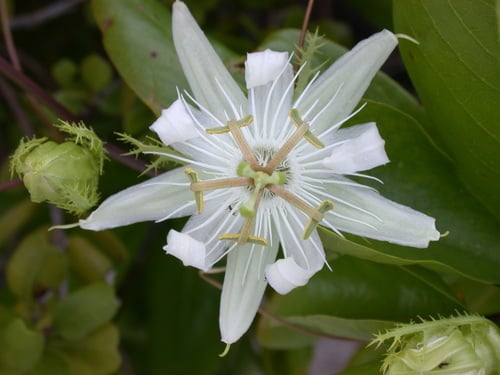
Passiflora tripartita mollissima - (Kunth) Holm
(Kunth) Holm-Niels. & P.M.Jorg.
Banana Passionfruit
gbif· cc-by-nc
Carla
gbif· cc-by-nc
blackbearben
gbif· cc-by-nc
blackbearben
Description
Passiflora tripartita mollissima is an evergreen Climber growing to 5 m (16ft) by 0.5 m (1ft 8in) at a fast rate. See above for USDA hardiness. It is hardy to UK zone 10. The flowers are pollinated by Insects. Suitable for: medium (loamy) and heavy (clay) soils and prefers well-drained soil. Suitable pH: mildly acid, neutral and basic (mildly alkaline) soils. It can grow in semi-shade (light woodland) or no shade. It prefers moist soil.
Edible Uses
Sweetener. Fruit - eaten raw or used in ice creams, fruit salads, pies, jellies, to make drinks etc. The yellow, oblong, aromatic fruits are highly prized for their juice. The fruit is about 70mm long and 35mm wide. The fruits of this species are a pale yellow colour, the pulp is more aromatic and tart and has a somewhat superior flavour to the flesh of the deep yellow to orange fruits of Passiflora tarminiana.
Distribution
Western S. America - Andes.
Where It Grows
SOUTHERN AMERICA: Bolivia, Colombia, Ecuador, Panamá, Peru, Venezuela,
Cultivation
Prefers a cooler, less humid atmosphere than most other members of the genus, growing well at moderate elevations, generally above 1,000 metres in the tropics, and at lower elevations in the subtropics and warm temperate zones. It grows best in areas where annual daytime temperatures are within the range 15 - 18°c, but can tolerate 8 - 30°c. When dormant, the plant can survive temperatures down to about -5°c, but young growth can be severely damaged at -2°c. It prefers a mean annual rainfall in the range 1,300 - 1,700mm, but tolerates 700 - 2,300mm. Requires a humus-rich, moist but well-drained soil and a position in dappled shade where it can grow up towards the sun. Passiflora species tend to flower and fruit more freely when grown in soils of only moderate fertility. Prefers a circumneutral soil, disliking very acid or very alkaline conditions. Prefers a pH in the range 6 - 7, tolerating 4.3 - 8. Plants have escaped from cultivation in several areas of the world, and the plant has been declared a noxious weed in America. Many of these reports refer to the related, but more vigorous Passiflora tarminiana. The plant starts fruiting after about 2 years from seed. Well managed plants can produce 300 - 400 fruits per year, equivalent to 30 - 47 tonnes per hectare.. Plants are very tolerant of pruning and can be cut back to ground level if required to rejuvenate the plant. Plants in this genus are notably resistant to honey fungus.
Propagation
Seed - best sown as soon as it is ripe along with the pulp which will help break down the seed coat and speed up germination. Stored seed should be soaked for 24 hours in warm water and germination time can be reduced if the seed is then mixed with the juice of a fresh passion fruit (of any species). Even so, it can take 12 months for stored seed to germinate. Place the seed tray in a shady position, maintaining a temperature around 19 - 24°c. Prick the seedlings out into individual containers as soon as they are large enough to handle and plant out when large enough. Cuttings of young shoots, taken at the nodes. Layering. Very easy. Air layering.
Other Uses
Other Uses None known
Synonyms
Also Known As
Banana Passionfruit