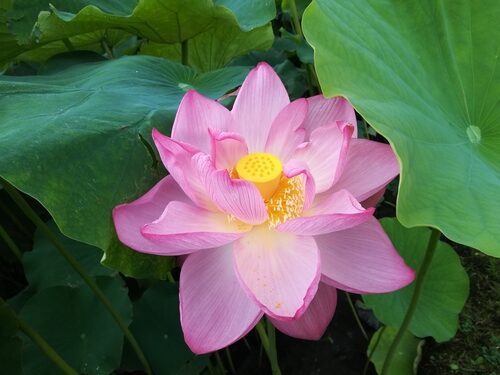
Nelumbo lutea - (Willd.)Pers.
(Willd.)Pers.
American Water Lotus, American lotus
gbif· cc-by-nc
meadow_lark
gbif· cc-by-nc
Barbara Katzenberg
gbif· cc-by-nc
Barbara Katzenberg
Description
Nelumbo lutea is a PERENNIAL growing to 1.8 m (6ft) by 1 m (3ft 3in). See above for USDA hardiness. It is hardy to UK zone 4. It is in flower in July. The species is hermaphrodite (has both male and female organs) and is pollinated by Insects, beetles. Suitable for: light (sandy), medium (loamy) and heavy (clay) soils. Suitable pH: mildly acid, neutral and basic (mildly alkaline) soils. It cannot grow in the shade. It can grow in water.
Edible Uses
Oil. Root - cooked. It is usually steeped in water prior to cooking in order to remove any bitterness. The root is rich in starch, when baked it becomes sweet and mealy, somewhat like a sweet potato. The root is usually harvested in the autumn and will store for several months. Leaves and young stems - cooked. Seed - raw or cooked. A very agreeable taste. The seed can be dried, ground into a powder and used for making bread, thickening soups etc or can be eaten dry. The bitter tasting embryo is often removed. The half-ripe seed is said to be delicious raw or cooked, with a taste like chestnuts. The seed contains up to 19% protein. An edible oil can be extracted from the seed.
Medicinal Uses
Poultice. The root is pounded into a pulp, either fresh or dried, and used as a poultice for many inflammatory diseases.
Distribution
Eastern N. America - Massachusetts to Minnesota, Nebraska and Louisiana.
Where It Grows
NORTHERN AMERICA: Canada (Ontario (southeast)), United States (Connecticut, Indiana, Maine, Massachusetts, Michigan (south), New Jersey, New York, Ohio, Pennsylvania, Rhode Island, West Virginia, Iowa, Kansas, Minnesota (south), Missouri, Nebraska, Illinois, Oklahoma, Wisconsin, Alabama, Arkansas, Delaware, Florida, Georgia, Kentucky, Louisiana, Maryland, Mississippi, North Carolina, South Carolina, Tennessee, Virginia, Texas), Mexico (Tamaulipas, Campeche, Jalisco, Nayarit, Veracruz de Ignacio de la Llave) SOUTHERN AMERICA: Cuba, Dominican Republic, Haiti, Jamaica, Honduras
Cultivation
Historic Crop Staple Crop: Balanced carb. Requires a rich loam and a sunny position. Succeeds in most soils. Succeeds in water up to 0.6m deep. Plants are half-hardy. They should be hardy in the mild areas of Britain. One report says that the plant is almost extinct in the wild, whilst another says that it is sometimes an aggressive, difficult-to-eradicate weed in ponds, lakes, and reservoirs. Grown as a food plant by the N. American Indians, it has been proposed for commercial cultivation. The flowers are fragrant.
Propagation
Seed - file the seed across its centre, being very careful not to damage the flesh of the seed, and soak in warm water, changing the water twice a day until signs of germination are seen, which should be within 3 - 4 weeks at 25°c. Plant in individual pots just covered in water and increase the depth as the plant grows. Division in spring as the plant comes into growth. Be very careful, the plants deeply resent root disturbance.
Other Uses
Oil. None known