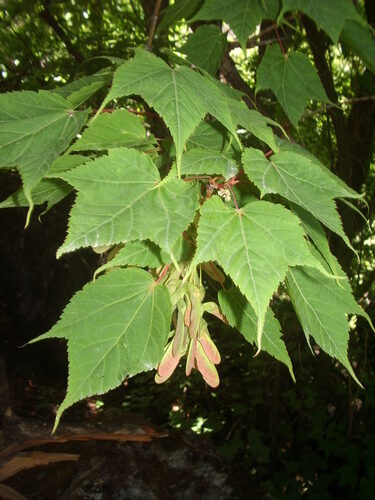
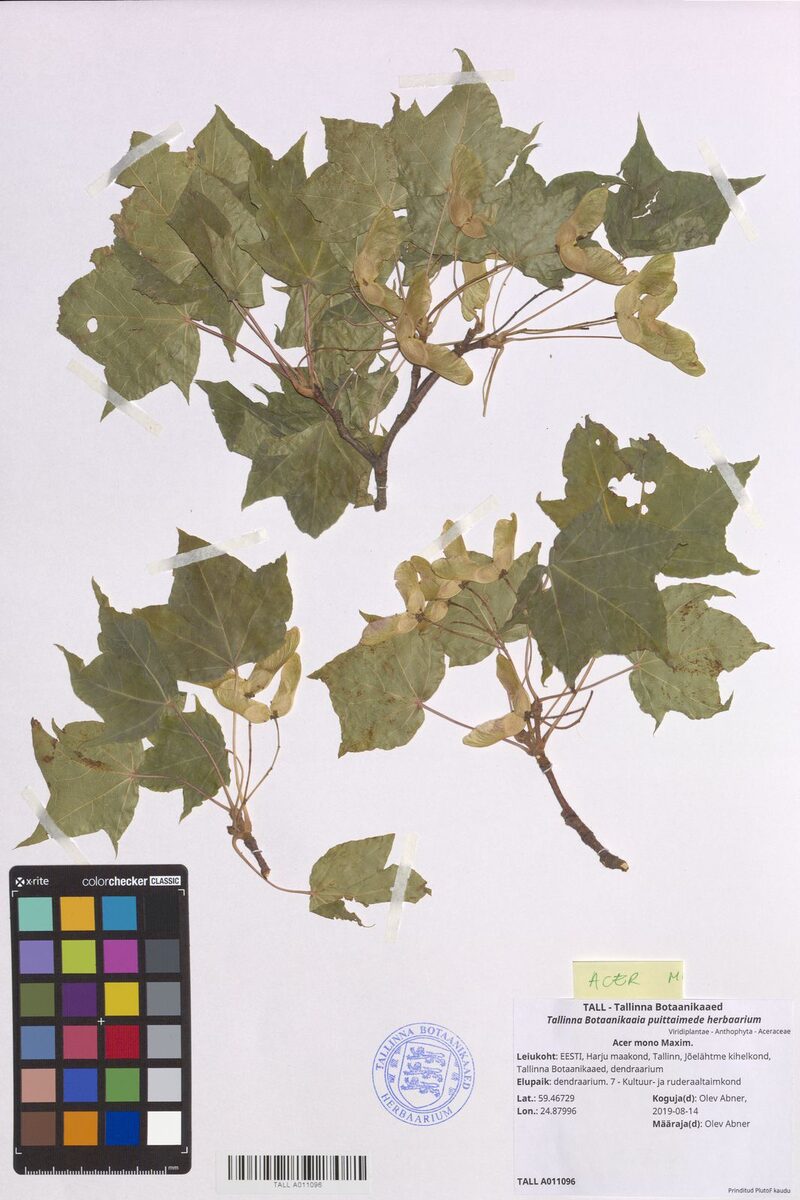
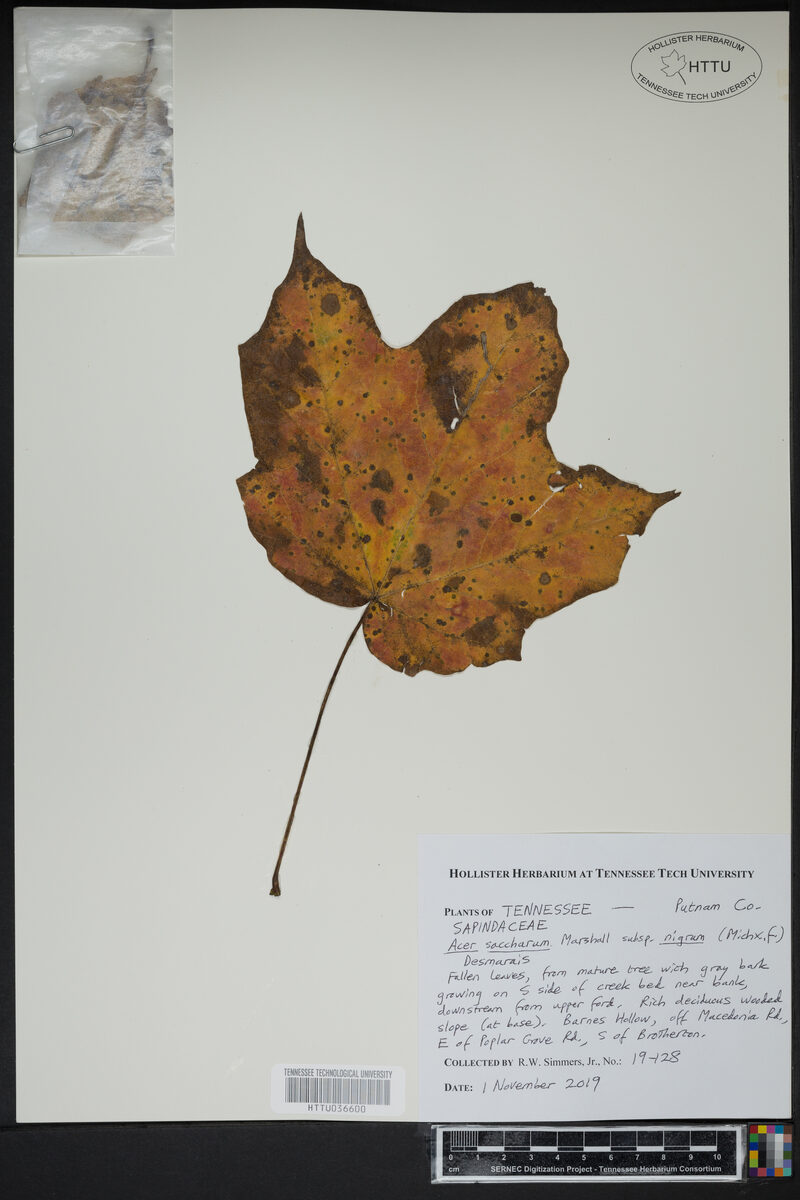
Acer saccharum grandidentatum - (Torr.&A.Gray.)Desmarais.
(Torr.&A.Gray.)Desmarais.
Big-Tooth Maple, Canyon Maple, Rocky Mountain Sugar Maple
gbif· cc0
Baylor University Herbarium (BAYLU-BAYLU)
gbif· cc0
Botanical Research Institute of Texas
Description
Acer saccharum grandidentatum is a deciduous Tree growing to 12 m (39ft) by 8 m (26ft). See above for USDA hardiness. It is hardy to UK zone 3. It is in flower from April to May, and the seeds ripen in September. Suitable for: light (sandy), medium (loamy) and heavy (clay) soils, prefers well-drained soil and can grow in heavy clay soil. Suitable pH: mildly acid, neutral and basic (mildly alkaline) soils. It can grow in semi-shade (light woodland) or no shade. It prefers moist soil.
Edible Uses
Sweetener. The sap is relatively rich in sugar and can be made into a drink or concentrated into a syrup by boiling off the water. The syrup is used as a sweetener on many foods. It can be harvested in late winter or early spring, the flow is best on a warm sunny day after a frost. Trees on southern slopes in sandy soils give the best yields. It is best to make a hole about 7cm deep and about 1.3 metres above the ground. Yields of 40 - 100 litres per tree can be obtained. The best sap production comes from cold-winter areas with continental climates. Seed - boiled then roasted. The seed is about 6mm long and is produced in small clusters. Inner bark cooked. It is dried, ground into a powder and then used as a thickening in soups etc or mixed with cereals when making bread. Foraging: Sap: Produces a sweet syrup when boiled down, and is sometimes considered the western counterpart to sugar maple (A. saccharum). A reliable source of minerals and sweetness. Leaves: Young leaves are edible after cooking; raw they are too bitter. They can be prepared as a side vegetable, though their coarse hairs may affect texture. Buds and Flowers: Presumed edible. Buds are bitter but edible once cooked. Flowers are inconspicuous but mild, with a flavor resembling lettuce mixed with slight maple bitterness. Cooking improves both palatability and safety. Fruits (samaras): Young samaras are soft and chewable, tasting slightly acidic and bean-like. They are edible raw in small amounts or cooked. Inner Bark: Edible in theory, yielding a fibrous flour of little nutritional value.
Distribution
Western N. America - Rocky Mountains.
Where It Grows
Arizona, Colorado, Idaho, Mexico Northeast, Mexico Northwest, Montana, Nevada, New Mexico, Oklahoma, Texas, Utah, Wyoming
Cultivation
Grows well in heavy clay soils. Trees need full light and a lot of space if they are to grow well. Plants are hardy to about -45°c when fully dormant. This species is not a great success in Britain, though it does better than once thought. It grows well in Cornwall. Slow growing when young. Plants produce prodigious root growth but very little top growth in first year from seed. A very ornamental tree but a bad companion plant, inhibiting the growth of nearby plants. This species is commercially exploited in America for its sap. Along with A. saccharum and the sub-species A. s. nigrum it is the major source of maple syrup. There are some named varieties. The sap can be tapped within 10 - 15 years from seed but it does not flow so well in areas with mild winters.
Propagation
Seed - best sown as soon as it is ripe in a cold frame, it usually germinates in the following spring. A lot of the seed is non-viable, it is best to cut a few open to see if there is an embryo. An average of 95% germination can be achieved from viable seed. Pre-soak stored seed for 24 hours and then stratify for 2 - 4 months at 1 - 8°c. It can be slow to germinate, sometimes taking two years. The seed can be harvested 'green' (when it has fully developed but before it has dried and produced any germination inhibitors) and sown immediately. It should germinate in late winter. If the seed is harvested too soon it will produce very weak plants or no plants at all. When large enough to handle, prick the seedlings out into individual pots and grow them on until they are 20cm or more tall before planting them out in their permanent positions. Layering, which takes about 12 months, is successful with most species in this genus. Cuttings of young shoots in June or July. The cuttings should have 2 - 3 pairs of leaves, plus one pair of buds at the base. Remove a very thin slice of bark at the base of the cutting, rooting is improved if a rooting hormone is used. The rooted cuttings must show new growth during the summer before being potted up otherwise they are unlikely to survive the winter.
Other Uses
Fuel Preservative Wood. The leaves are packed around apples, rootcrops etc to help preserve them. Wood - close grained, tough, hard, heavy. Used for furniture, ship building, etc. It is a good fuel.
Synonyms
Also Known As
Acer grandidentatum (Bigtooth or Canyon Maple).