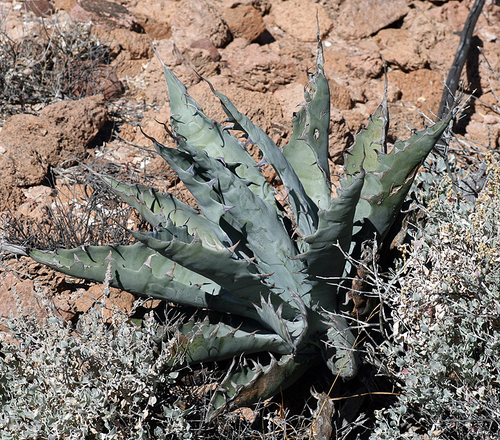
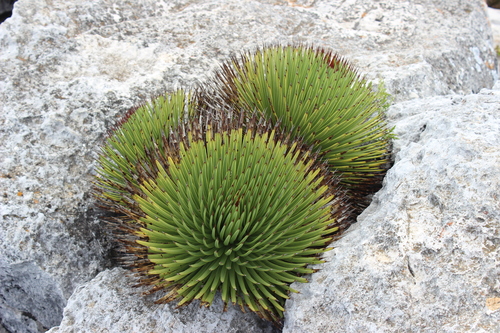
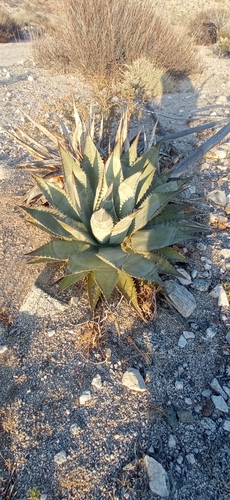
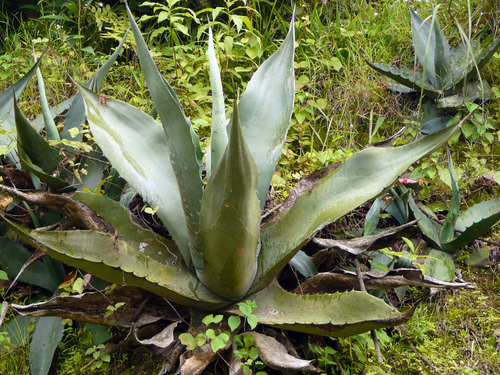
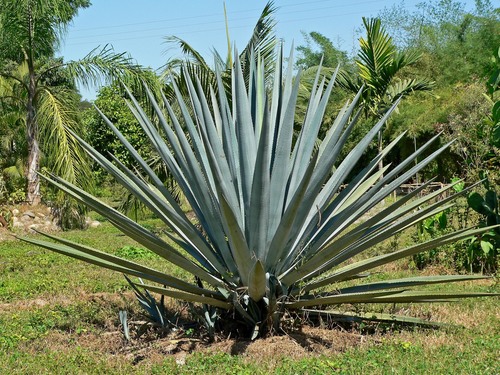
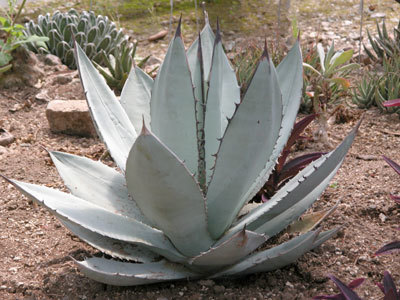
Agave americana var. expansa
L., (Jacobi) Gentry
Spreading century plant
iNaturalist· cc-by-nc
(c) Flor, some rights reserved (CC BY-NC)
iNaturalist· cc-by-nc
(c) Flor, some rights reserved (CC BY-NC)
iNaturalist· cc-by-nc
(c) adob05, some rights reserved (CC BY-NC)
Summary
Source: WikipediaAgave americana, commonly known as the century plant, maguey, or American aloe, is a flowering plant species belonging to the family Asparagaceae. It is native to Mexico and the United States, specifically Texas. This plant is widely cultivated worldwide for its ornamental value and has become naturalized in various regions, including Southern California, the West Indies, South America, the Mediterranean Basin, Africa, the Canary Islands, India, China, Thailand, New Zealand and Australia. Despite being called "American aloe" in common parlance, Agave americana is not closely related to Aloe species.
Description
An agave with a short stem and leaves in rings. The leaves are erect and 120-150 cm long by 18-24 cm wide.
This description is brief — help expand it
Edible Uses
Agave americana has various uses starting in pre-Columbian Mexico. If the flower stem is cut before flowering, a sweet liquid known as aguamiel ("lit. 'honey water') can be collected from the plant's hollowed heart. This liquid can be fermented to produce the alcoholic drink called pulque or octli used in pre-Columbian Mexico. In the tequila-producing regions of Mexico, agaves are known as mezcales. Mezcal refers to the high-alcohol product obtained through fermented agave distillation, and A. americana is among the several Agave species used for this purpose. The specific mezcal known as tequila is produced from Agave tequilana, commonly referred to as "blue agave." Mezcal comes in various types, some of which may be flavored with the intensely pungent mezcal worm. Mezcal and tequila, despite being produced from agave plants, differ from pulque in their sugar extraction techniques and classification as distilled spirits. In mezcal and tequila production, the sugars are obtained by heating the piñas (or hearts) of the plants in ovens, as opposed to collecting aguamiel from the cut stalk of the plant. Therefore, if pulque were to be distilled, it would not be classified as mezcal but rather as a distinct beverage. Agaves are also found throughout Latin America and are used in similar ways. In Ecuador, the equivalent of pulque is known as guarango, which has recently been distilled as miske. Agave nectar is marketed as a natural sweetener with a low glycemic index, primarily due to its high fructose content.
Traditional Uses
It is used to make a drink.
This uses section is brief — help expand it
Distribution
It is a temperate plant. It grows in grassland between 500-1,300 m above sea level. It grows in the Sonoran desert.
Where It Grows
Australia, Mexico, North America, USA
Cultivation
It is grown by sections of the old plant.
Notes
There are about 250 Agave species. The Agavaceae are mostly in the tropics and subtropics.
Synonyms
References (2)
- Flora of North America @ efloras.org
- Wiersema, J. H. & Leon, B., 2013, World Economic Plants. A Standard Reference CRC Press. 2nd Ed. p 24