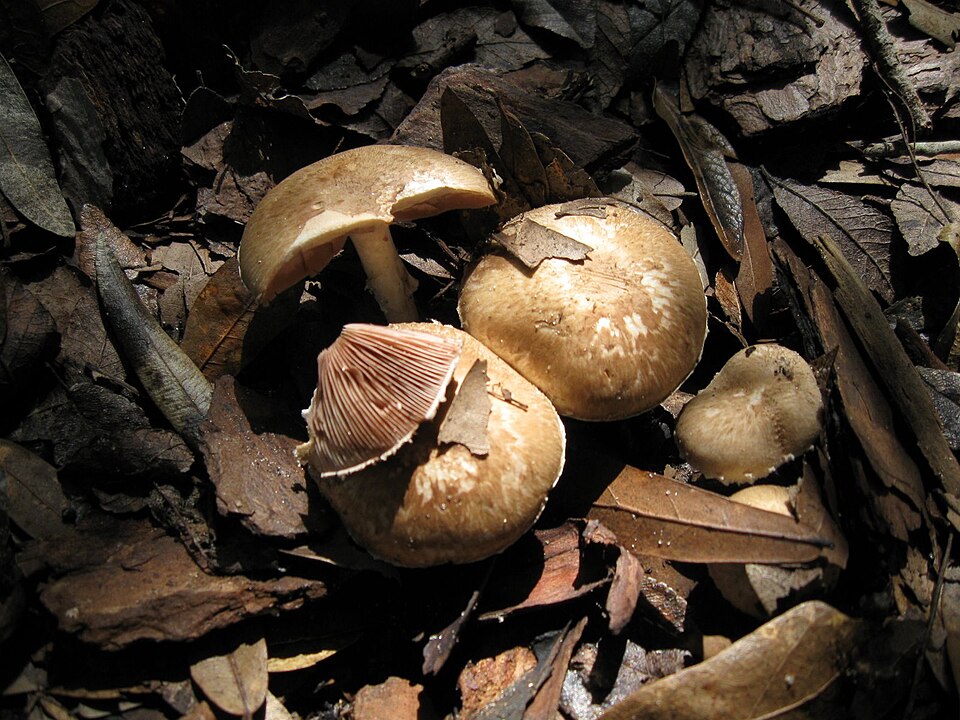
Agaricus campestris
(L.) Fries
Field mushroom
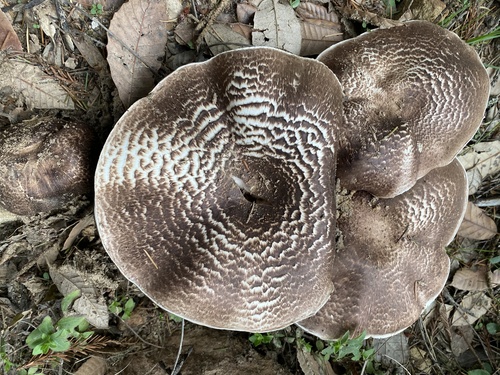
iNaturalist· cc-by-nc
(c) Felipe Hidalgo, some rights reserved (CC BY-NC), uploaded by Felipe Hidalgo
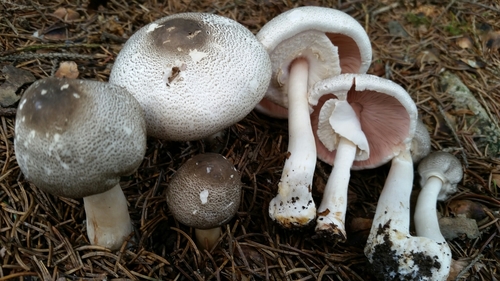
iNaturalist· cc-by-sa
(c) anonymous, some rights reserved (CC BY-SA)
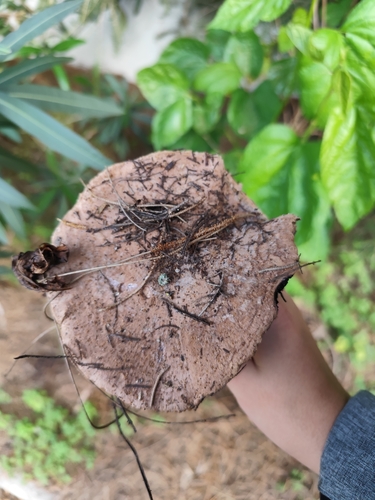
iNaturalist· cc-by-sa
(c) Andreas Kunze, some rights reserved (CC BY-SA)
Summary
Source: WikipediaAgaricus campestris is a widely eaten gilled mushroom closely related to the cultivated A. bisporus (button mushroom). A. campestris is commonly known as the field mushroom or, in North America, meadow mushroom. The cap is white and up to 12 centimetres (4+3⁄4 inches) across. The species is found in grassy areas around the world. It is considered a choice edible but resembles some poisonous species.
Description
A mushroom. The cap is 3-7 cm wide.
This description is brief — help expand it
Edible Uses
Although edible and choice, this mushroom is not commercially cultivated on account of its fast maturing and short shelf life. Care is needed to distinguish it from poisonous species. There have been cases (notably in France) in which the deadly Amanita virosa was consumed by individuals who mistook it for this species. Additionally, specimens collected from lawns could be contaminated by pesticides or other chemicals. Culinary uses include eating it sauteed or fried, in sauces, or even sliced raw and included in salads. In flavor and texture, this mushroom is similar to the white button mushroom (A. bisporus) available in grocery stores in most Western countries.
Traditional Uses
The fruiting bodies are eaten cooked. The are used to flavour casseroles and rice dishes. They can be fried in butter and thickened with a little flour and milk.
Distribution
A temperate plant. It grows in most temperate regions. They need special compost and a farily dark humid location with temperatures between 10-13°C. It suits hardiness zones 5-11.
Where It Grows
Africa, Alaska, Albania, Andorra, Armenia, Asia, Australia, Balkans, Britain, Bulgaria, Canada, Caucasus, Central Africa, Central America, Central Asia, China, Congo DR, Czech Republic, East Africa, Egypt, Ethiopia, Europe, Georgia, Ghana, Greece, Guatemala, Himalayas, Hong Kong, Hungary, India, Indochina, Iraq, Israel, Italy, Japan, Jordan, Kenya, Kosovo, Kyrgyzstan, Madagascar, Malawi, Malaysia, Mediterranean, Mexico, Middle East, Mongolia, Nepal, Netherlands, New Zealand, Nigeria, North Africa, North America, Northeastern India, Pakistan, Russia, Scandinavia, SE Asia, Sicily, Slovenia, Somalia, South Africa, Southern Africa, St Helena, Sweden, Switzerland, Tasmania, Tanzania, Turkey, Türkiye, Ukraine, USA, Vietnam, West Africa, Zambia, Zimbabwe,
Production
They are usually harvested within 5 weeks of planting.
Other Information
It is sold in local markets.
Notes
There are about 300 Agaricus species.
Dangerous Lookalikes
This plant can be confused with the following toxic species. Always verify identification carefully before consuming any wild plant.
Destroying Angel
Amanita virosa
en:User:Rafti Institute & en:User:Ms. havisham
Field mushroom
Agaricus campestris
(c) Felipe Hidalgo, some rights reserved (CC BY-NC), uploaded by Felipe Hidalgo
Destroying Angel: White gills that stay white, white spore print, bulbous base with volva (sack), faint sickly-sweet smell.
Field mushroom: Pink-to-chocolate-brown gills, brown spore print, no volva (cup) at base, pleasant mushroom smell.
Synonyms
Also Known As
Angschampinjon, Bangerchhatta, Gewone weidechampignon, Grass mushroom, Kharerhay, Khumb, Khumbi, Kukkago-dugu, Meadow mushroom, Mogu, Olatany, Olatra, Prataiolo, Pucerci, Sanjuanero, Shethi, Shong, Sumbal
References (62)
- Ahmad, I., et al, 2011, Ethnobotanical Study of Tehsil Kabal, Swat District, KPK, Pakistan. Hindawi Publishing Corporation Journal of Botany Volume 2011, Article ID 368572, 9 pages
- Ambasta S.P. (Ed.), 2000, The Useful Plants of India. CSIR India. p 19
- Beckstrom-Sternberg, Stephen M., and James A. Duke. "The Foodplant Database." http://probe.nalusda.gov:8300/cgi-bin/browse/foodplantdb.(ACEDB version 4.0 - data version July 1994)
- Bhaben, T., et al, 2010, Wild edible fungal resources by ethnic tribes of nagaland, India. Indian Journal of Traditional Knowledge. Vol 10(3) p 513
- Bianchini, F., Corbetta, F., and Pistoia, M., 1975, Fruits of the Earth. Cassell. p 120 (As Psalliota arvensis)
Show all 62 references Hide references
- Boa, E. R., Wild edible fungi and their importance to people. FAO Non Wood Forest Products Booklet 17
- Burkill, I.H., 1966, A Dictionary of the Economic Products of the Malay Peninsula. Ministry of Agriculture and Cooperatives, Kuala Lumpur, Malaysia. Vol 2 (I-Z) p 1843 (As Psalliota campestris)
- Bussman, R. W., et al, 2016, A comparative ethnobotany of Khevsureti, Samtskhe-Javakheti, Tusheti, Svaneti, and Racha-Lechkhumi, Republic of Georgia (Sakartvelo), Caucasus. Journal of Ethnobiology and Ethnomedicine (2016) 12:43
- Bussman, R. W., et al, 2021, Unity in diversity—food plants and fungi of Sakartvelo (Republic of Georgia), Caucasus. Journal of Ethnobiology and Ethnomedicine (2021) 17:72 p 15
- Caballero, J. N., & Mapes, C. S., 1985, Gathering and Subsistence Patterns among the P'urhepecha Indians of Mexico. J. Ethnol. 5(1): 31-47
- Cerne, M., 1992, Wild Plants from Slovenia used as Vegetables. Acta Horticulturae 318
- Cheifetz, A., (ed), 1999, 500 popular vegetables, herbs, fruits and nuts for Australian Gardeners. Random House p 29
- Christensen, M., et al, 2008, Collection and Use of Wild Edible Fungi in Nepal. Economic Botany, 62(1), 2008, pp. 12–23
- Ciesla, W.M., 1998, Non-wood forest products from conifers. Non-wood forest products 12, FAO, Rome, p 91
- Cribb, A.B. & J.W., 1976, Wild Food in Australia, Fontana. p 198
- Crowe, A., 1997, A Field Guide to the Native Edible Plants of New Zealand. Penguin. p 129
- Dashorst, G.R.M., and Jessop, J.P., 1998, Plants of the Adelaide Plains & Hills. Botanic Gardens of Adelaide and State Herbarium. p 30
- Dongol, et al, 1995, Edible Mushrooms in Nepal
- Ertug, F., 2004, Wild Edible Plants of the Bodrum Area. (Mugla, Turkey. Turk. J. Bot. 28 (2004): 161-174
- Estrada-Martinez, E., et al, 2009, Contribucion al conocimiento etnomicologico de los Hongos Comestibles Silvestres de Mercados Regionales y Comunidades de la Sierra Nevada (Mexico). Intercienca Jan 2009 Vol. 34 No. 1
- Facciola, S., 1998, Cornucopia 2: a Source Book of Edible Plants. Kampong Publications, p 249
- Fox, F. W. & Young, M. E. N., 1982, Food from the Veld. Delta Books. p 234 (As Psalliota arvensis)
- Fuhrer, B., 2005, A field guide to Australian Fungi. Bloomings Books. p
- Guild, B., 1979, The Alaskan Mushroom Hunter's Guide. Alaska Northwest Publishing Company. p 148
- Hall, I. R., et al, 2003, Edible and Poisonous Mushrooms of the World. Timber Press. p 197
- Harter, J.(Ed.), 1988, Plants. 2400 copyright free illustrations. Dover p 3.2, 5.11
- https://en.wikipedia.org/wiki/List of wild edible plants in Mongolian cuisine (As Psalliota arvensis)
- Hu, Shiu-ying, 2005, Food Plants of China. The Chinese University Press. p 266
- Imai, S., 1938, Studies on the Agaricaceae of Hokkaido. 2. Jour. Facul. Agr., Hokkaido Imp. Univ., Sapporo, Vol. XLIII, Pt. 2, August, 1938
- Jardin, C., 1970, List of Foods Used In Africa, FAO Nutrition Information Document Series No 2.p 113
- Jordan, P., 2000, The Mushroom Guide and Identifier, Hermes House, p 30
- Kalac, P. and Svoboda, L., 1999, A review of trace element concentrations in edible mushrooms. Food Chemistry 69: 273-281
- Kang, J. et al, 2016, Wild food plants and fungi used in the mycophilous Tibetan community of Zhagana (Tewo Country, Gansu, China) Journal of Ethnobiology and Ethnomedicine. 12:21
- Kaufmann, B. et al, 1999, The Great Encyclopedia of Mushrooms. Konemann. p 162
- Khan, A. H., et al, 2023, Traditional foraging for ecological transition? Wild food ethnobotany among three ethnic groups in the highlands of the eastern Hindukush, North Pakistan. Journal of Ethnobiology and Ethnomedicine 19:9
- Kiple, K.F. & Ornelas, K.C., (eds), 2000, The Cambridge World History of Food. CUP p 318, 322, 1818
- Kiple, K.F. & Ornelas, K.C., (eds), 2000, The Cambridge World History of Food. CUP p 320 (As Psalliota campestris)
- Kuhnlein, H. V. and Turner, N. J., 1991, Traditional Plant Foods of Canadian Indigenous Peoples. Food and Nutrition in History and Anthropology Volume 8. Gordon and Breach. p 22
- Lentini, F. and Venza, F., 2007, Wild food plants of popular use in Sicily. J Ethnobiol Ethnomedicine. 2007; 3: 15
- Mabey, R., 1973, Food for Free. A Guide to the edible wild plants of Britain, Collins. p 45
- Maiden, J. H., 1889, The Useful Native Plants of Australia (including Tasmania). The Technology Museum of NSW, Sydney. p 3
- Michael, P., 2007, Edible Wild Plants and Herbs. Grub Street. London. p 153
- Murugan, Pal M., et al, 2010, Phytofoods of Nubra valley, Ladakh - The cold desert. Indian Journal of Traditional Knowledge. Vol. 9(2): 303-308
- Nanagulyan, S., et al, 2020, Wild plants and fungi sold in the markets of Yerevan (Armenia). Journal of Ethnobiology and Ethnomedicine 16:26
- Pace, G., 1998, Mushrooms of the world. Firefly books. p 45 (As Psalliota campestris)
- Perez-Moreno, J. et al, 2008, Wild Mushroom Markets in Central Mexico and a Case Study at Ozumba. Economic Botany, 62(3), 2008, pp. 425–436
- Pieroni, A., 1999, Gathered wild food plants in the Upper Valley of the Serchio River (Garfagnana), Central Italy. Economic Botany 53(3) pp 327-341
- Pieroni, A., et al, 2005, Food for two seasons: Culinary uses of non-cultivated local vegetables and mushrooms in a south Italian village. International Journal of Food Sciences and Nutrition, 56(4): 245-272
- Pieroni, A., 2017, Traditional uses of wild food plants, medicinal plants, and domestic remedies in Albanian, Aromanian and Macedonian villages in South-Eastern Albania. Journal of Herbal Medicine Volume 9, September 2017, Pages 81-90
- Quinonez-Martinez, M., et al, 2014, Knowledge and use of edible mushrooms in two municipalities of the Sierra Tarahumara, Chihuahua, Mexico. Journal of Ethniobiology and Ethnomedicine 10:6
- Santiago, F, H., et al, Traditional knowledge and use of wild mushrooms by Mixtecs or Ñuu savi, the people of the rain, from Southeastern Mexico. Journal of Ethnobiology and Ethnomedicine (2016) 12:35
- Semwal, K. C., et al, 2014, Edible mushrooms of the Northwestern Himalaya, India: a study of indigenous knowledge, distribution and diversity. Mycosphere 5(3): 440–461
- Siemonsma, J. S. & Kasem Piluek, eds. 1993. Vegetables. In: Plant Resources of South-East Asia (PROSEA) 8:311
- Stoyneva-Gartner, M.P. & Uzunov, B.A., 2015, An Ethnobiological Glance on Globalization Impact on the Traditional Use of Algae and Fungi as Food in Bulgaria. J Nutr Food Sci 2015, 5:5
- Stryamets, N., et al, 2015, From economic survival to recreation: contemporary uses of wild food and medicine in rural Sweden, Ukraine and NW Russia. Journal of Ethnobiology and Ethnomedicine (2015) 11:53
- Svanberg, I., & Lindh, H., 2019, Mushroom hunting and consumption in twenty-first century post-industrial Sweden. Journal of Ethnobiology and Ethnomedicine (2019) 15:42
- Tibuhwa, 2013, Wild Mushroom - an underutilized healthy food resource and income generator: experience from Tanzania rural areas. Journal of Ethnobiology and Ethnomedicine 9:49
- Tredgold, M.H., 1986, Food Plants of Zimbabwe. Mambo Press. p 20
- Vetner, J., 2004, Arsenic content of some edible mushroom species. Eur. Food Res. Technol. 219: 71-74
- Vorstenbosch, T., et al, 2017, Famine food of vegetal origin consumed in the Netherlands during World War II. Journal of Ethnobiology and Ethnomedicine (2017) 13:63
- www.plantnames.unimelb.edu.au
- Yanovsky, E., 1936, Food Plants of the North American Indians. United States Department of Agriculture Miscellaneous Publication No 237. Washington, D.C. p 2