Diplocyclos palmatus
(L.) C Jeffrey
Striped cucumber, Native Bryony
iNaturalist· cc-by-nc
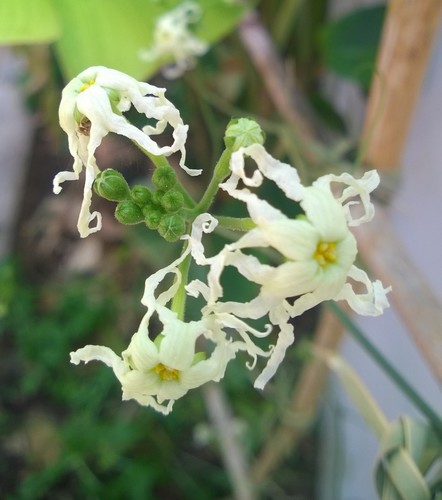
(c) Roddy CJ Ward, some rights reserved (CC BY-NC), uploaded by Roddy CJ Ward
iNaturalist· cc-by-nc
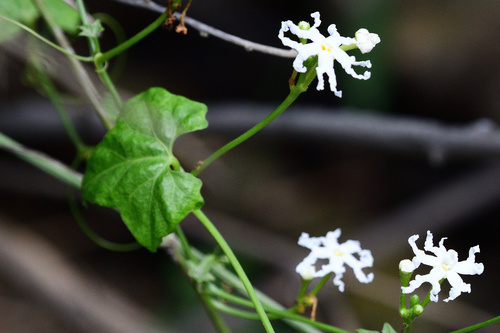
(c) kerrycoleman, some rights reserved (CC BY-NC)
iNaturalist· cc-by
(c) Katja Schulz, some rights reserved (CC BY)
Summary
Source: WikipediaDiplocyclos palmatus is a vine in the family Cucurbitaceae. It is commonly known as native bryony or striped cucumber. In Marathi, it is called shivlingi due to its seed which resembles a lingam.
Description
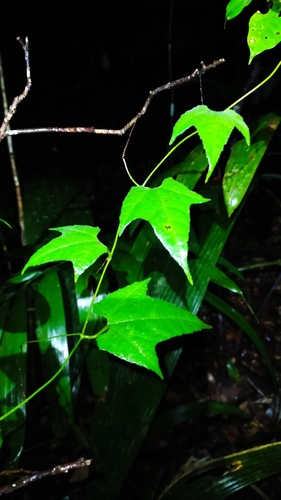
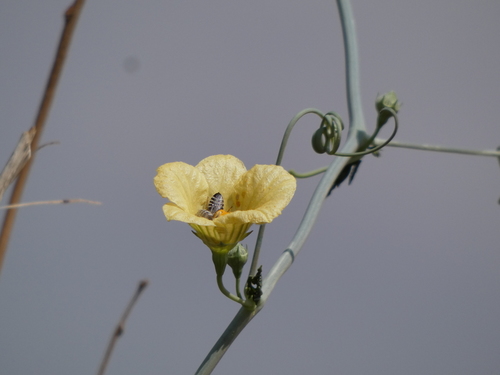
A herb. It is a pumpkin family plant. It is a slender climbing plant with angular stems. The stems are weak but the lower part can be somewhat woody. It can climb to 2-4 m high. The stems are angular and grooved. The rootstock is fleshy. The leaves have 3 or 5 lobes divided like fingers on a hand and are 10-15 cm wide by 6-17 cm long. There are fine teeth on the top edges of the leaves and the leaves are angular. The leaves are rough on top but smooth underneath. The leaf stalks are 3-9 cm long. The stem has tendrils which have 1 or 2 branches. Flowers are small and yellow or green. Male and female flowers are separate but often together near a leaf. Often one or two female flowers are surrounded by several male flowers. The fruit is 4 cm long and green with pale streaks along it. The leaves and stems give off a bad smell when damaged.
Edible Uses
The leaves are eaten cooked. Young fruits are occasionally cooked and eaten, though they require thorough cooking.
Traditional Uses
The leaves are eaten, cooked. CAUTION The fruit are claimed to be poisonous. It is considered to be poisonous in Australia, but is eaten in India and Nepal. It probably needs to be well cooked. The young fruits are occasionally cooked and eaten.
Medicinal Uses
The roots are used as an antivenom The fruits and leaves are used to cure stomach-ache. The stems are used as an expectorant. The fruits are used as a laxative. The seeds are febrifuge.
Known Hazards
The fruits are claimed to be poisonous. Considered poisonous in Australia, though eaten in India and Nepal after proper cooking. Because of its poisonous components, its use as food should probably not be encouraged.
Distribution
It is a tropical plant. It occurs on the coast in Papua New Guinea and grows up to about 1000 m above sea level. It Africa it grows to 1,830 m above sea level. It needs a well drained soil and can grow in a sunny or partial shady position. The plant also grows in Africa, India, Malaysia, China and Australia. There are a couple of subspecies. It can grow in arid places.
Where It Grows
Africa, Asia, Australia, Bhutan, Cambodia, Central Africa, China, Congo, East Africa, East Timor, Egypt, Himalayas, India, Indochina, Indonesia, Japan, Kenya, Laos, Madagascar, Malaysia, Mozambique, Myanmar, Nepal, New Caledonia, Norfolk Island, North Africa, Pacific, Pakistan, Papua New Guinea, PNG, Philippines, Rwanda, Sao Tome and Principe, SE Asia, Solomon Islands, Southern Africa, Sri Lanka, Sudan, Taiwan, Tanzania, Thailand, Timor-Leste, Uganda, USA, Vanuatu, Vietnam, Zimbabwe,
Cultivation
Plants can be grown from seeds or cuttings.
Propagation
Seed - best sown fresh with the pulp removed. Stem cuttings.
Other Information
A reasonably common wild creeper in coastal areas of Papua New Guinea and many tropical countries. Leaves are used in the Gazelle Peninsula. Because of its poisonous components, its use as a food should probably not be encouraged.
Notes
The seeds are used as medicine in Nepal. There are 3-5 Diplocyclos species.
Synonyms
Also Known As
Aattupudal, Ba-da, Ban kakra, Bankarela, Ghungarubhaji, Kavdoli, Kongakonga, Korek kotok, Kuniyanchappu, Lollipop climber, Luongluan chan-vit, Mahadevpind, Malaipusanni, Shanker-vel, Shivlingi, Sivalingakkai, Sivalingi, Tendu, Uvakandasopu
References (43)
- Acharya K. P. and Acharya, R., 2010, Eating from the Wild: Indigenous knowledge on wild edible plants in Parroha VDC of Rupandehi District, Central Nepal. International Journal of Social Forestry. 3(1):28-48
- Arinathan, V., et al, 2007, Wild edibles used by Palliyars of the western Ghats, Tamil Nadu. Indian Journal of Traditional Knowledge. 6(1) pp 163-168
- Arora, R. K., 2014, Diversity in Underutilized Plant Species - An Asia-Pacific Perspective. Bioversity International. p 48
- Bodkin, F., 1991, Encyclopedia Botanica. Cornstalk publishing, p 347
- Chandrakumar, P., et al, 2015, Ethnobotanical studies of wild edible plants of Gond, Halba and Kawar tribes of Salekasa Taluka, Gondia District, Maharashtra State, India. International Research Journal of Pharmacy 6(8)
Show all 43 references Hide references
- Cooper, W. and Cooper, W., 2004, Fruits of the Australian Tropical Rainforest. Nokomis Editions, Victoria, Australia. p 140
- Cowie, I, 2006, A Survey of Flora and vegetation of the proposed Jaco-Tutuala-Lore National Park. Timor-Lests (East Timor) www.territorystories.nt/gov.au p 46
- Elliot, W.R., & Jones, D.L., 1984, Encyclopedia of Australian Plants suitable for cultivation. Vol 3. Lothian. p 289
- Flora of Australia, Volume 8, Lecythidales to Batales, Australian Government Publishing Service, Canberra (1982) p 178
- Flora of Australia Volume 49, Oceanic Islands 1, Australian Government Publishing Service, Canberra. (1994) p 129
- Flora of Pakistan. www.eFloras.org
- French, B.R., 1986, Food Plants of Papua New Guinea, A Compendium. Asia Pacific Science Foundation p 85
- French, B.R., 2010, Food Plants of Solomon Islands. A Compendium. Food Plants International Inc. p 322
- Gautam, R. S., et al, 2020, Wild Edible Fruits of Nepal. Int. J. Appl. Sci. Biotechnol. Vol 8(3): 289-304
- Gautam, R. S., et al, 2022, Ethnobotanical Review of Wild Edible Plants of Nepal. Journal of Natural History Museum Volume 32, 2021-22 p 110
- Grubben, G. J. H. and Denton, O. A. (eds), 2004, Plant Resources of Tropical Africa 2. Vegetables. PROTA, Wageningen, Netherlands. p 289
- Jackes, B.R., 2001, Plants of the Tropics. Rainforest to Heath. An Identification Guide. James Cook University. p 48
- Jadhav, R., et al, 2015, Forest Foods of Northern Western Ghats: Mode of Consumption, Nutrition and Availability. Asian Agri-History Vol. 19, No. 4: 293-317
- Jones, D.L. & Gray, B., 1977, Australian Climbing Plants. Reed. p 98
- Kachenchart, B., et al, 2008, Phenology of Edible Plants at Sakaerat Forest. In Proceedings of the FORTROP II: Tropical Forestry Change in a Changing World. Bangkok, Thailand.
- Kew Bull. 15:352. 1962
- Kiran, K. C., et al, 2019, Diversity and Seasonal Availability of Potential Wild Edible Plants from Vidarbha Region of Maharashtra State, India. Int.J.Curr.Microbiol.App.Sci (2019) 8(2): 1434-1446
- Kuvar, S. D. & Shinde, R. D., 2019, Wild Edible Plants used by Kokni Tribe of Nasik District, Maharashtra. Journal of Global Biosciences. Volume 8, Number 2, 2019, pp. 5936-5945
- Lazarides, M. & Hince, B., 1993, Handbook of Economic Plants of Australia, CSIRO. p 82
- Manandhar, N.P., 2002, Plants and People of Nepal. Timber Press. Portland, Oregon. p 204
- Melzer, R. & Plumb, J., 2011, Plants of Capricornia. Belgamba, Rockhampton. p 362
- Morley, B.D., & Toelken, H.R., (Eds), 1983, Flowering Plants in Australia. Rigby. p 99
- Mukhia, P.K., et al, 2013, Wild plants as Non Wood Forest Products used by the rural community of Dagana, a southern foothill district of Bhutan, SAARC Journal, 27 pages
- Mutie, F. M., et al, 2023, Important Medicinal and Food Taxa (Orders and Families) in Kenya, Based on Three Quantitative Approaches. Plants 2023, 12, 1145
- Narayanan Ratheesh, M. K. et al, 2011, Wild edible plants used by the Kattunaikka, Paniya and Kuruma tribes of Wayanad District, Kerala, India. Journal of Medicinal Plants Research Vol. 5(15), pp. 3520-3529
- Nicholson, N & H., 1996, Australian Rainforest Plants 3, Terania Rainforest Publishing. NSW. p 22
- Njoroge, G. & Newton, L. E. 1994, Edible and Poisonous Species of Cucurbitaceaea in the Central Highlands of Kenya. Journal of East African Natural History. 83:101-115
- Paczkowska, G. & Chapman, A.R., 2000, The Western Australian Flora. A Descriptive Catalogue. Western Australian Herbarium. p 221
- Peekel, P.G., 1984, (Translation E.E.Henty), Flora of the Bismarck Archipelago for Naturalists, Division of Botany, Lae, PNG. p 547, 546
- Pham-Hoang Ho, 1999, An Illustrated Flora of Vietnam. Nha Xuat Ban Tre. p 576
- Rajasab, A. H. et al, 2004, Documentation of folk knowledge on edible wild plants of North Karnataka. Indian Journal of Traditional Knowledge. Vol 3(4) pp 419-429
- Royal Botanic Gardens, Kew (1999). Survey of Economic Plants for Arid and Semi-Arid Lands (SEPASAL) database. Published on the Internet; http://www.rbgkew.org.uk/ceb/sepasal/internet [Accessed 16th April 2011]
- Sarvalingam, A., et al, 2014, Wild edible plant resources used by the Irulas of the Maruthamalai Hills, Southern Western Ghats, Coimbatore, Tamil Nadu. Indian Journal of Natural Products and Resources 5(2):198-201
- Townsend, K., 1994, Across the Top. Gardening with Australian Plants in the tropics. Society for Growing Australian Plants, Townsville Branch Inc. p 162
- Wheeler, J.R.(ed.), 1992, Flora of the Kimberley Region. CALM, Western Australian Herbarium, p 249
- Wild edible plants of Himachal Pradesh
- World Checklist of Useful Plant Species 2020. Royal Botanic Gardens, Kew
- Yang, Si-Lin and Walters, T. W., 1992, Ethnobotany and the Economic role of the Cucurbitaceae of China. Economic Botany, Vol. 46, No. 4, pp. 349-367