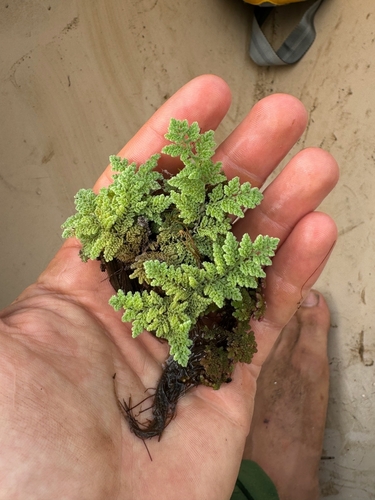
Azolla pinnata
R. Br.
Red azolla, Water fern
iNaturalist· cc-by
(c) Auradyme, some rights reserved (CC BY), uploaded by Auradyme
iNaturalist· cc-by-nc
(c) Ben Travaglini, some rights reserved (CC BY-NC), uploaded by Ben Travaglini
iNaturalist· cc-by-nc
(c) Chris Jonkers, some rights reserved (CC BY-NC), uploaded by Chris Jonkers
Summary
Source: WikipediaAzolla pinnata is a species of fern known by several common names, including mosquitofern, feathered mosquitofern and water velvet. It is native to much of Africa, Asia (Brunei Darussalam, China, India, Japan, Korea, and the Philippines) and parts of Australia. It is an aquatic plant, it is found floating upon the surface of the water. It grows in quiet and slow-moving water bodies because swift currents and waves break up the plant. At maximum growth rate, it can double its biomass in 1.9 days, with most strains attaining such growth within a week under optimal conditions. A. pinnata is a small fern with a triangular stem measuring up to 2.5 centimeters in length that floats on the water. The stem bears many rounded or angular overlapping leaves each 1 or 2 millimeters long. They are green, blue-green, or dark red in color and coated in tiny hairs, giving them a velvety appearance. The hairs make the top surface of the leaf water-repellent, keeping the plant afloat even after being pushed under. A water body may be coated in a dense layer of the plants, which form a velvety mat that crowds out other plants. The hairlike roots extend out into the water. The leaves contain the cyanobacterium Anabaena azollae, which is a symbiont that fixes nitrogen from the atmosphere that the fern can use. This gives the fern the ability to grow in habitats that are low in nitrogen. The plant reproduces vegetatively when branches break off the main axis, or sexually when sporocarps on the leaves release spores. It is present in New Zealand as an introduced species and an invasive weed that has crowded out a native relative, Azolla rubra. It is a pest of waterways because its dense mats reduce oxygen in the water. The weevil Stenopelmus rufinasus is used as an agent of biological pest control to manage Azolla filiculoides, and it has been found to attack A. pinnata as well. Rice farmers sometimes keep this plant in their paddies because it generates valuable nitrogen via its symbiotic cyanobacteria. The plant can be grown in wet soil and then plowed under, generating a good amount of nitrogen-rich fertilizer. The plant has the ability to absorb a certain amount of heavy metal pollution, such as lead, from contaminated water. It is 25-30% protein and can be added to chicken feed.
Description
A water fern. It is a small plant that grows in water. The stems are densely divided with leaves less than 1 mm long.
This description is brief — help expand it
Edible Uses
None known
Medicinal Uses
None known
Known Hazards
Although we have found no reports of toxicity for this species, a number of ferns contain carcinogens so some caution is advisable. Many ferns also contain thiaminase, an enzyme that robs the body of its vitamin B complex. In small quantities this enzyme will do no harm to people eating an adequate diet that is rich in vitamin B, though large quantities can cause severe health problems. The enzyme is destroyed by heat or thorough drying, so cooking the plant will remove the thiaminase.
Distribution
It is a tropical plant.
Where It Grows
Africa, Asia, Australia, Central African Republic, CAR, China, East Africa, Madagascar, New Zealand, South Africa, Thailand, Vietnam,
Cultivation
Succeeds in tropical and subtropical areas. It grows best in areas where annual daytime temperatures are within the range 20 - 35°c, but can tolerate 15 - 40°c. Succeeds in ponds and lakes. Plants are able to tolerate a very wide range of pH from 3.5 - 10.5. Plants increase so prolifically that they can become invasive. The presence of Azolla in a waterway is generally beneficial. However, in circumstances where waterways are extremely rich in nutrients, prolific growth may be a problem. It also is possible that thick, complete coverings of Azolla can cause de-oxygenation of the water. This can affect organisms such as fish and other aquatic plants, and the decay of the latter can lead to a strong odour. However, situations like this are rare because coverage of the waterway by the Azolla needs to be almost total for it to have a negative impact on the ecosystem. Self-fertile? Azolla pinnata does not produce flowers; it reproduces primarily through vegetative means and produces spores. Azolla can be harvested throughout the growing season, typically in spring and summer when it is actively growing and flourishing. Azolla does not flower in the traditional sense; it produces spores, which can occur year-round under suitable conditions.
Propagation
Division.
Other Uses
Compost Green manure Other uses rating: High (4/5). Suitable for bogs, ponds and water gardens. Agroforestry Uses: The plant is used as a green manure in paddy fields, in particular to add nitrogen and organic matter to the soil. The nitrogen-rich roots can be added to compost heaps, where they act as an activator to speed up the compost-making process. Other Uses: It is a food source for waterfowl, fish, shrimp, insects, worms, snails and crustaceans. It provides habitat for many of the small organisms mentioned above. Mats of Azolla can actually discourage blue-green algal blooms. They restrict the penetration of sunlight into the water, which is essential for algal growth, and take up nutrients from the water column, limiting the availability of this food source for the algae. The mats of Azolla can be a form of biological mosquito control, preventing mosquito larvae surfacing for air. The presence of Azolla can also restrict the growth of exotic aquatic plants, including Salvinia and Water Hyacinth, as it limits the availability of nutrients to these plants. 1. Nectary - Flowers rich in nectar and pollen: No – Azolla pinnata does not produce flowers; it reproduces primarily through vegetative means and produces spores. 2. Wildlife - Food (Fruit, Seeds, Leaf litter, Shelter, Nesting, Roosting): Yes – Azolla can serve as a food source for various aquatic wildlife, including fish and invertebrates. It may not provide direct nesting or roosting sites but can contribute to the overall habitat quality in aquatic ecosystems. 3. Invertebrate Shelter (Overwintering sites, Leaf litter, Groundcover): Yes – Azolla forms dense mats on the water’s surface, providing shelter for invertebrates and creating habitat diversity in aquatic environments. 4. Pest Confuser (Smell): No – Azolla does not have a strong aromatic quality that would help confuse pests. Special Uses Attracts Wildlife Food Forest Nitrogen Fixer
Notes
Also put in the family Azollaceae.
Synonyms
Also Known As
Ramilamina
References (4)
- Harris, D. J., 2002, The vascular plants of the Dzanga-Sangha Reserve, Central African Republic. National Botanic Garden of Belgium, 2002. – 274 pages p 28
- Razanameharizaka, J., et al, 2022, Catalogue Legumes Traditionnels de Madagascar. Université d’Antananarivo, Antananarivo (101), Madagascar. Vol. 1. p 54
- World Checklist of Useful Plant Species 2020. Royal Botanic Gardens, Kew
- Zeven, A. C. & de West, J. M. J., 1982, Dictionary of cultivated plants and their regions of diversity. Wageningen. p 50