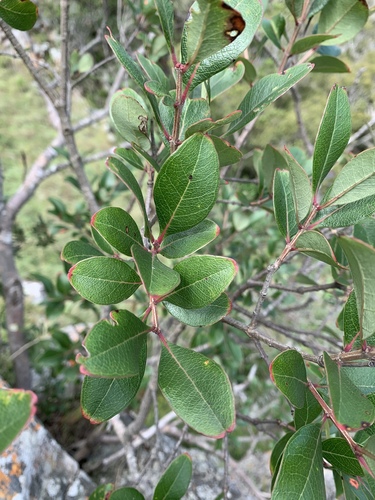
Crypteronia paniculata
Blume
Java crypteronia tree
iNaturalist· cc-by-nc
(c) ab_satta, some rights reserved (CC BY-NC), uploaded by ab_satta
iNaturalist· cc-by-nc
(c) Aditya Gadkari, some rights reserved (CC BY-NC)
Description
A tree. It grows 10-20 m tall. It usually branches near the base. The crown is irregular and dense. The branches are reddish brown. The leaves are opposite and have short leaf stalks. They are narrowly oval. The base is rounded or wedge shaped. They taper to the tip. They are light green. They are 7-25 cm long by 3-12 cm wide. The leaf stalk has a furrow on the upper side. The flowering shoots are slender and drooping. They are in the axils of fallen leaves. They are 7-30 cm long and have many flowers. The flowers are pale green or yellow. The fruit are 2-celled capsules. The seeds are very small.
Edible Uses
Young shoots are eaten as a vegetable and used to flavor rice.
Traditional Uses
The young shoots are eaten as a vegetable. They are used to flavour rice.
This uses section is brief — help expand it
Medicinal Uses
The young shoots are used to flavor rice.
Distribution
It is a tropical plant. It grows in dense forest. It grows from near sea level to 1,500 m above sea level in Java.
Where It Grows
Andamans, Asia, Cambodia, India, Indochina, Indonesia, Laos, Malaysia, Myanmar, Pacific, Philippines, SE Asia, Thailand,
Other Uses
The yellowish-red timber is hard and durable. It is used for furniture, cart wheels and casing. The wood is used for fuel.
Notes
Also put in the family Crypteroniaceae.
Synonyms
Also Known As
Bekoi, Berkol, Buah babi, Champrenh, Goru-mora, Ka sawm, Kayu cheleng, Ki banen, Krawn, Mai kesai, Pi kui, Pohon keriptera jawa, Rupal, Sempoh, Trab tum, Tukoi
References (9)
- Ambasta, S.P. (Ed.), 2000, The Useful Plants of India. CSIR India. p 148
- Burkill, I.H., 1966, A Dictionary of the Economic Products of the Malay Peninsula. Ministry of Agriculture and Cooperatives, Kuala Lumpur, Malaysia. Vol 1 (A-H) p 703
- Cengel, D. J. & Dany, C., (Eds), 2016, Integrating Forest Biodiversity Resource Management and Sustainable Community Livelihood Development in the Preah Vihear Protected Forest. International Tropical Timber Organization p 119
- Flora of China. www.eFloras.org
- Martin, F.W. & Ruberte, R.M., 1979, Edible Leaves of the Tropics. Antillian College Press, Mayaguez, Puerto Rico. p 98, 189
Show all 9 references Hide references
- Ochse, J.J. et al, 1931, Vegetables of the Dutch East Indies. Asher reprint. p 181
- Phon, P., 2000, Plants used in Cambodia. © Pauline Dy Phon, Phnom Penh, Cambodia. p 182
- Sukarya, D. G., (Ed.) 2013, 3,500 Plant Species of the Botanic Gardens of Indonesia. LIPI p 215
- World Checklist of Useful Plant Species 2020. Royal Botanic Gardens, Kew