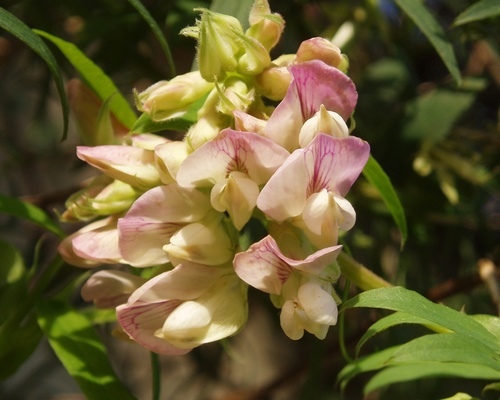
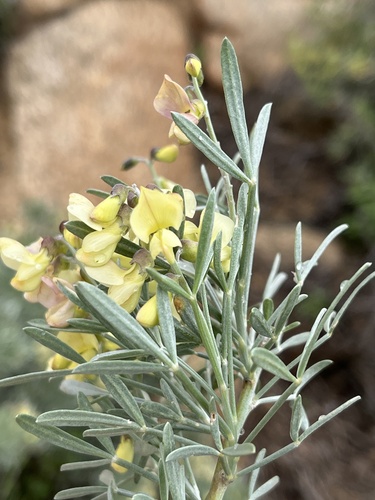
Crotalaria retusa
L.
Wedge-leafed rattlepod
iNaturalist· cc-by-nc
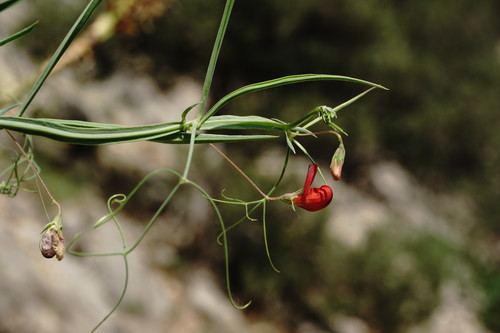
(c) ShainaDeCiryan.com, some rights reserved (CC BY-NC), uploaded by ShainaDeCiryan.com
iNaturalist· cc-by-nc
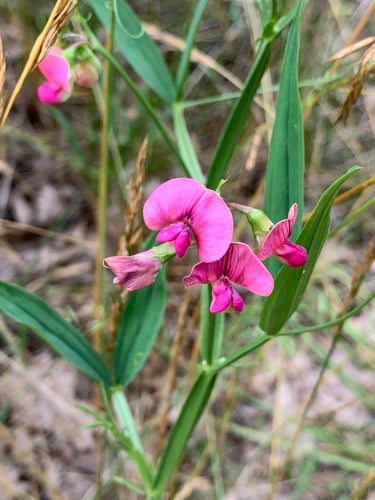
(c) wadesworld19, some rights reserved (CC BY-NC)
iNaturalist· cc-by-nc
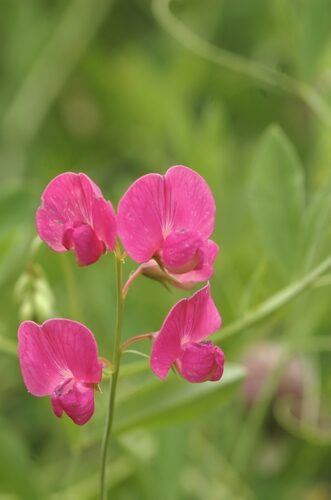
(c) 中大魚叟, some rights reserved (CC BY-NC)
Summary
Source: WikipediaCrotalaria retusa is a species of flowering plant in the legume family known by various common names including devil-bean, rattleweed, shack shack, and wedge-leaf rattlepod. It is poisonous to livestock, and contaminates human food. Its original native range is unclear, probably including tropical Asia, Africa and Australia. It has been introduced as a crop plant in many tropical areas and has escaped from cultivation to become a troublesome weed; it is listed as a noxious weed in several US states, Puerto Rico, the Virgin Islands, and is listed as an invasive weed in India, Cuba, and Cocos Island. Unlike some other species of Crotalaria, it is an annual plant.
Description
An annual plant. It grows to 1-1.5 m high and spreads to 1 m across. The stems are erect and slender. The branches are stiff, and shortly hairy. The leaves are oblong to sword shaped, with a blunt end. They are 3-8 cm long by 1-2.5 cm wide. The leaves are green above and pale underneath. They have a short leaf stalk. The flowers occur in clusters 15-30 cm long. These are at the ends of branches. The flowers are yellow and pea shaped. They are 1.5-2 cm long. The fruit are pods 2-5 cm long which are black when ripe. The pods are spreading at right angles. The seeds are golden brown and about 4 mm long.
Edible Uses
The flowers and leaves have a sweet flavour and are edible as a vegetable. Their alkaloid content is very low. The roasted dehulled seeds are eaten in Vietnam. The seedpods contain about 10 - 20 yellow-brown to blackish heart-shaped seeds measuring about 5 mm x 3 mm. Some caution is advised, see notes on toxicity.
Traditional Uses
CAUTION: It causes cirrhosis of the liver. The leaves have been recorded as eaten. The flowers are cooked as a vegetable or pickled following boiling.
Medicinal Uses
The plant is used in traditional medicine.
Known Hazards
The plant causes cirrhosis of the liver and has been blamed for poisoning horses in Australia due to alkaloids that damage the liver. Caution is advised.
Distribution
A tropical plant. It grows in light, well-drained soils. It prefers an open sunny position. It is drought resistant but frost tender. They occur naturally in moist, sandy, patches on flood plains of large rivers. In Papua New Guinea it is mostly in places at low altitude where there is a low and seasonal rainfall. It grows in Nepal to about 200 m altitude in open places. It suits hardiness zones 10-11.
Where It Grows
Asia, Africa, American Samoa, Australia, Bangladesh, Bhutan, Burkina Faso, Cambodia, Central Africa, Central African Republic, CAR, Central America, China, Congo, Dominican Republic, East Africa, Guiana, Guianas, Guinea, Guinée, Guinea-Bissau, Guyana, Haiti, Himalayas, India, Indochina, Kiribati, Laos, Madagascar, Malaysia, Mariana Islands, Marquesas, Mozambique, Myanmar, Nepal, Nigeria, Pacific, Pakistan, Papua New Guinea, PNG, Philippines, Puerto Rico, Sao Tome and Principe, SE Asia, Senegal, Sierra Leone, Somalia, South America, Sri Lanka, Suriname, Thailand, Venezuela, Vietnam, West Africa, West Indies,
Cultivation
Plants are grown from seed which needs treatment to enable it to grow.
Propagation
Seed - sow in situ. Pre-soaking the seed for 12 hours in warm water can help to reduce germination time.
Other Uses
A strong fibre is obtained from the bark and stems. It is used for cordage and making canvas. Used as a dye plant in East Africa. A non-edible, non-drying oil of low unsaturtion is obtained from the seed. It has a potential for use in the production of hair shampoos, skin cream and shoe polish. Crotalaria retusa is grown as a green manure and as a cover plant in plantations of coffee, oil palm etc. It is an excellent source of organic matter - its fresh foliage usually contains between 0.5 - 1% nitrogen, which when incorporated into the soil improves fertility and nutrient retention, while providing structure to the soil by enriching it of humus and retarding erosion. Like many other members of the genus, the plant is nematode-resistant. It is grown as a green manure in order to reduce nematode infection in the soil - the growing plant encourages nematodes to hatch, these are then unable to feed on the Crotalaria and so many of them die.
Notes
It has been blamed for poisoning horses in Australia. Alkaloids affect their livers. There are about 550 Crotalaria species. They are mostly tropical.
Synonyms
Also Known As
Atoshi, Banta-djaule, Bhuban jhar, Buli-laua, Duku todore, Giring badak, Orok-orok cina, Palpaltog, Potokan, Sucsac lom, Tav-tav, Taw-pikesan, Werendi
References (28)
- Ara, R. I. T., 2015, Leafy Vegetables in Bangladesh. Photon eBooks. p 119
- Blomberry, A.M., 1979, Australian Native Plants. Angus and Robertson p 158
- Bodkin, F., 1991, Encyclopedia Botanica. Cornstalk publishing, p 301
- Burkill, H. M., 1985, The useful plants of west tropical Africa, Vol. 3. Kew.
- Cundall, P., (ed.), 2004, Gardening Australia: flora: the gardener's bible. ABC Books. p 437
Show all 28 references Hide references
- Ekman Herbarium records Haiti
- Elliot, W.R., & Jones, D.L., 1984, Encyclopedia of Australian Plants suitable for cultivation. Vol 3. Lothian. p 114
- Flora of Pakistan. www.eFloras.org
- Grubben, G. J. H. and Denton, O. A. (eds), 2004, Plant Resources of Tropical Africa 2. Vegetables. PROTA, Wageningen, Netherlands. p 560
- Henty, E.E., & Pritchard, G.S., 1973, Weeds of New Guinea and their control. Botany Bulletin No 7, Division of Botany, Lae, PNG. p 120
- Henty, E.E., 1980, Harmful Plants in Papua New Guinea. Botany Bulletin No 12. Division Botany, Lae, Papua New Guinea. p 83, 84
- Jardin, C., 1970, List of Foods Used In Africa, FAO Nutrition Information Document Series No 2.p 71
- Lazarides, M. & Hince, B., 1993, Handbook of Economic Plants of Australia, CSIRO. p 69
- Manandhar, N.P., 2002, Plants and People of Nepal. Timber Press. Portland, Oregon. p 176 (As Crotalaria spectabilis)
- Martin, F.W. & Ruberte, R.M., 1979, Edible Leaves of the Tropics. Antillian College Press, Mayaguez, Puerto Rico. p 80, 198
- Paczkowska, G . & Chapman, A.R., 2000, The Western Australian Flora. A Descriptive Catalogue. Western Australian Herbarium. p 422
- Pham-Hoang Ho, 1999, An Illustrated Flora of Vietnam. Nha Xuat Ban Tre. p 990
- Phon, P., 2000, Plants used in Cambodia. © Pauline Dy Phon, Phnom Penh, Cambodia. p 180
- Plants of Haiti Smithsonian Institute http://botany.si.edu/antilles/West Indies
- PROSEA (Plant Resources of South East Asia) handbook, Volume 11, 1997, Auxiliary plants
- Purseglove, J.W., 1968, Tropical Crops Dicotyledons, Longmans. p 250
- Recher, P, 2001, Fruit Spirit Botanical Gardens Plant Index. www.nrg.com.au/~recher/ seedlist.html p 5
- Sp. pl. 2:715. 1753
- Terra, G.J.A., 1973, Tropical Vegetables. Communication 54e Royal Tropical Institute, Amsterdam, p 41
- Thaman, R. R., 1987, Plants of Kiribati: A listing and analysis of vernacular names. Atoll Research Bulletin No. 296
- Verdcourt, B., 1979, Manual of New Guinea Legumes. Botany Bulletin No 11, Division of Botany, Lae, Papua New Guinea. p 582
- Wheeler, J.R.(ed.), 1992, Flora of the Kimberley Region. CALM, Western Australian Herbarium, p 388
- World Checklist of Useful Plant Species 2020. Royal Botanic Gardens, Kew