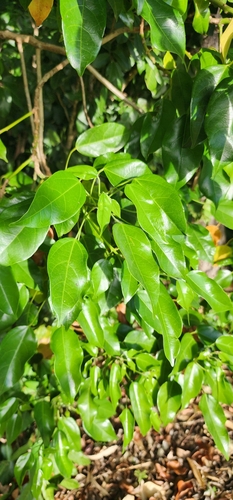
Hernandia nymphaeifolia
(J. Presl) Kubitzki
iNaturalist· cc-by-sa
(c) Tauʻolunga, some rights reserved (CC BY-SA)
iNaturalist· cc-by-nc
(c) juju98, some rights reserved (CC BY-NC), uploaded by juju98
iNaturalist· cc-by
(c) coenobita, some rights reserved (CC BY), uploaded by coenobita
Summary
Source: WikipediaHernandia nymphaeifolia is a species of plant in the Hernandiaceae family. Its common name is lantern tree.
Description
A tree. The bark is smooth. The leaves are oval to heart-shaped. They are 20-40 cm long by 15-30 cm wide. The flowers are in the axils of the leaves. The fruit is fleshy and urn shaped. They are 3-4 cm across.
Edible Uses
The ripe fruit are eaten fresh.
Traditional Uses
The ripe fruit are eaten fresh.
This uses section is brief — help expand it
Medicinal Uses
Hernandia nymphaeifolia has a light, perishable wood. It has been used in South Pacific islands for fishing rods, fish net floats, wooden sandals, fan handles, drawing boards, canoe accessories, furniture and firewood, etc. A woody layer surrounds the seed of the lantern tree fruit. The Tahaitians polish the round brown seeds to a high gloss and fashion them into necklaces. The Marshallese bathe children in a healing bath made from H. nymphaeifolia leaves and relieve headaches with a preparation from other tree parts. The effect of lignans from this species on Ca2+ signaling in human neutrophils has been studied. In parts of New Britain and Vanuatu, its wood is used for to make canoe hulls. In New Britain, the Nakanai people also use its wood to make hourglass drums. The flowers are used to treat asthma on Waya Island, Fiji.
Distribution
It is a tropical plant. It grows on atolls.
Where It Grows
Asia, China, Fiji, Indonesia, Kiribati, Niue, Pacific, Samoa, SE Asia, Tokelau, Tonga,
Cultivation
A plant of lowland tropical climates. Prefers a rich, humid, moisture-retentive soil and a position in full sun. Well suited to coastal gardens in the tropics, tolerating maritime exposure. Established plants are moderately drought tolerant. Plants can flower intermittently all year round.
Propagation
Seed - Cuttings of mature wood.
Other Uses
The juice from the leaves is depilatory, destroying hair without pain. The seeds are often strung as necklaces. The oily seeds can be burnt as candles, though they produce a great deal of smoke. The greyish wood is soft and light in weight. It is sometimes used in the same ways as balsawood. It has been used for making canoes, but needs to be painted and protected from the weather or it soon becomes water-logged and useless. The wood catches fire easily, even from a spark generated by a flint and steel. It makes a good tinder.
Synonyms
Also Known As
Kampak, Kampis, Pukavaka
References (5)
- Nurfadilah, S., et al, 2017, Species richness, conservation status, and potential uses of plants in Segara Anakan Area of Sempu Island, East Java, Indonesia. BIODIVERSITAS. Volume 18, Number 4
- Parham, B. E. V., 1971, The Vegetation of the Tokelau Islands with special reference to the Plants of Nukunonu Atoll. New Zealand Journal of Botany. 9:4, 576-609 (As Hernandia peltata)
- Parham, B. E. V., 1972, Plants of Samoa. New Zealand Department of Scientific and Industrial Research. Information Series. No. 85 p 103 (As Hernandia peltata)
- Sosef, M. S. M., Hong, L. T., & Prawirohatmodjo, S., (Eds.), 1998, Timber tree: Lesser-known timbers. Plant Resources of South-East Asia, 5(3), p 288
- World Checklist of Useful Plant Species 2020. Royal Botanic Gardens, Kew