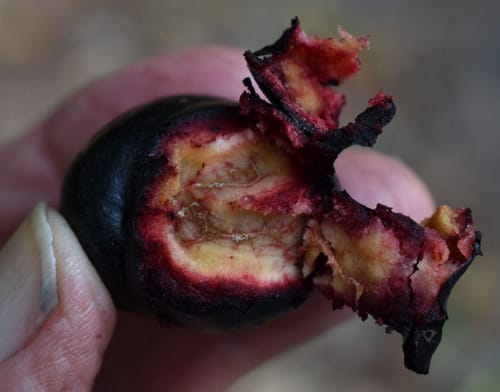
Crataegus douglasii
Lindl.
Black hawthorn
iNaturalist· cc-by-nc
(c) hdcooper, some rights reserved (CC BY-NC)
iNaturalist· cc-by-nc
(c) Kristen Miskelly, some rights reserved (CC BY-NC)
Summary
Source: WikipediaCrataegus douglasii is a North American species of hawthorn known by the common names black hawthorn and Douglas' thornapple. It is most abundant in the Pacific Northwest.
Description
A small tree. It grows to 11 m tall. The leaves are small and 2-8 cm long. They have coarse double teeth around the edge. There are shallow lobes. The thorns are short, less than 3 cm. The fruits are oval and 8-10 mm across. They are dark reddish-purple or black.
Edible Uses
The fruit has a very pleasant sweet, juicy, and succulent flesh, making it an excellent dessert fruit that can be eaten in quantity. It can also be cooked in pies and preserves, or dried for later use. The fruit is about 8mm in diameter and borne in small clusters, though some specimens produce considerably larger fruit. Up to five fairly large seeds sit in the centre of each fruit and tend to stick together, giving the experience of eating a cherry-like fruit with a single stone.
Traditional Uses
The fruit can be eaten fresh. They are used for jams, sauces, drinks and jellies. They can be dried and stored for future use.
This uses section is brief — help expand it
Medicinal Uses
An infusion of the shoots has been used to treat diarrhoea in children and mouth sores in babies. A poultice of chewed leaves has been applied to swellings. An infusion of the bark has been used for diarrhoea and dysentery, while an infusion of the sapwood, bark, and roots has served as a stomach medicine. The thorns have been used as an arthritis treatment: the tip of a thorn was inserted into the skin at the affected site, the other end lit and burned down to the buried point. Though very painful, the treatment was said to relieve arthritic pain once the resulting scab had healed. Thorns have also been used as probes for boils and ulcers. More generally, the fruits and flowers of hawthorns are well established as a heart tonic, producing a hypotensive effect and acting as a mild, direct cardiotonic, particularly for weak heart combined with high blood pressure. Prolonged use is required, and it is normally taken as a tea or tincture.
Known Hazards
Thorns are present on branches.
Distribution
Temperate. It grows in damp meadows and along waterways.
Where It Grows
Australia, Canada, North America, USA,
Cultivation
A very easily grown plant, it prefers a well-drained moisture retentive loamy soil but is not at all fussy. Once established, it succeeds in excessively moist soils and also tolerates drought. It grows well on a chalk soil and also in heavy clay soils. A position in full sun is best when plants are being grown for their fruit, they also succeed in semi-shade though fruit yields and quality will be lower in such a position. Most members of this genus succeed in exposed positions, they also tolerate atmospheric pollution. Hybridizes freely with other members of this genus. Seedling trees take from 5 - 8 years before they start bearing fruit, though grafted trees will often flower heavily in their third year. The flowers have a foetid smell somewhat like decaying fish. This attracts midges which are the main means of fertilization. When freshly open, the flowers have more pleasant scent with balsamic undertones. Seedlings should not be left in a seedbed for more than 2 years without being transplanted.
Propagation
Sow seed as soon as it is ripe in autumn in a cold frame; some will germinate the following spring, though most will likely take a further year. Stored seed is slow and erratic — warm stratify for 3 months at 15°C, then cold stratify for 3 months at 4°C, and germination may still take another 18 months. Scarifying before stratification may help, as may fermenting the seed in its own pulp for a few days. Another option is to harvest seed green — once the embryo is fully developed but before the seedcoat hardens — and sow immediately in a cold frame for possible spring germination. For small quantities, pot seedlings individually once large enough to handle, grow on for a year, then plant out in late spring to nursery beds or final positions. For larger quantities, sow direct into an outdoor seedbed with protection from mice and other seed-eaters, and undercut roots if plants will remain in the seedbed for more than two years.
Other Uses
The branch spines serve as needles for lancing boils and removing splinters. The wood is close-grained, heavy, hard, and tough, and is used for tool handles and similar items.
Notes
There are 200 or more Crataegus species.
Nutrition
| Part | Moisture | kJ | kcal | Protein | Vit A | Vit C | Iron | Zinc |
|---|---|---|---|---|---|---|---|---|
| Fruit | 84 | 305 | 73 | 0.3 | — | 9.5 | 0.5 | 0.2 |
Synonyms
Also Known As
Kwinaa pisa, Q'ay
References (18)
- Beckstrom-Sternberg, Stephen M., and James A. Duke. "The Foodplant Database." http://probe.nalusda.gov:8300/cgi-bin/browse/foodplantdb.(ACEDB version 4.0 - data version July 1994)
- Coutre, M. D., et al, 1986, Foraging Behaviour of a Contemporary Northern Great Basin Population. Journal of California and Great Bason Anthropology Vol. 8(2) pp 150-160
- Edward's Bot. Reg. 21: t. 1810. 1835
- Esperanca, M. J., 1988. Surviving in the wild. A glance at the wild plants and their uses. Vol. 1. p 114
- Facciola, S., 1998, Cornucopia 2: a Source Book of Edible Plants. Kampong Publications, p 197
Show all 18 references Hide references
- Farrar, J.L., 1995, Trees of the Northern United States and Canada. Iowa State University press/Ames p 390
- Fisk, J. R. & Hoover, E., 2015, Wild Fruits of Minnesota. A Field Guide. University of Minnesota p 23
- Flowerdew, B., 2000, Complete Fruit Book. Kyle Cathie Ltd., London. p 180
- Hedrick, U.P., 1919, (Ed.), Sturtevant's edible plants of the world. p 225
- Kiple, K.F. & Ornelas, K.C., (eds), 2000, The Cambridge World History of Food. CUP p 1734
- Kuhnlein, H. V., et al, 2009, Indigenous Peoples' food systems. FAO Rome
- MacKinnon, A., et al, 2009, Edible & Medicinal Plants of Canada. Lone Pine. p 80
- Plants for a Future database, The Field, Penpol, Lostwithiel, Cornwall, PL22 0NG, UK. http://www.scs.leeds.ac.uk/pfaf/
- Saunders, C.F., 1948, Edible and Useful Wild Plants. Dover. New York. p 92
- Tozer, F., 2007, The Uses of Wild Plants. Green Man Publishing. p 72
- Turner, N., 1995, Food Plants of Coastal First Peoples. Royal BC Museum Handbook p 111
- Turner, N., 1997, Food Plants of Interior First Peoples. Royal BC Museum Handbook p 142
- World Checklist of Useful Plant Species 2020. Royal Botanic Gardens, Kew