Cornus sanguinea
Linn.
Dogwood, Cornel wood, Bloodtwig, Cornel dogwood, Dogberry, Pegwood
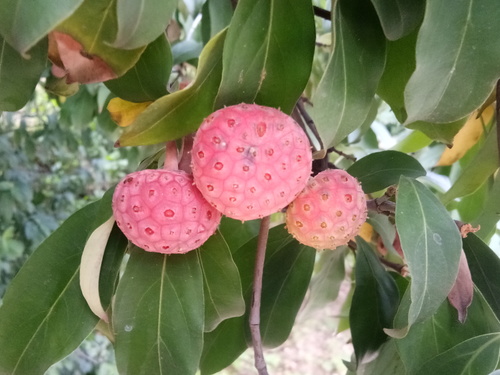
iNaturalist· cc-by-nc
(c) Юрій Бенгус, some rights reserved (CC BY-NC), uploaded by Юрій Бенгус
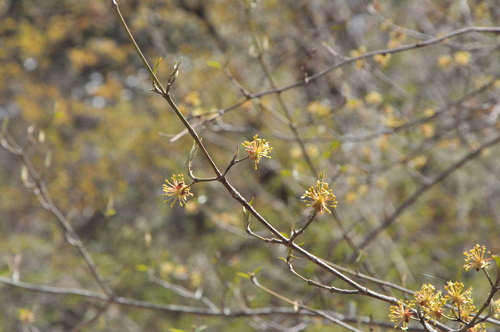
iNaturalist· cc-by-nc
(c) Ирина, some rights reserved (CC BY-NC), uploaded by Ирина
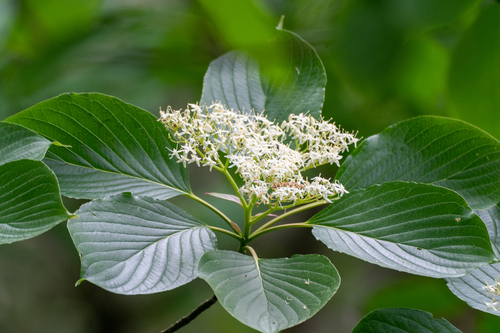
iNaturalist· cc-by
(c) Jason Grant, some rights reserved (CC BY), uploaded by Jason Grant
Summary
Source: WikipediaCornus sanguinea, the common dogwood or bloody dogwood, is a species of dogwood native to most of Europe and western Asia, from England and central Scotland east to the Caspian Sea. It is widely grown as an ornamental plant.
Description
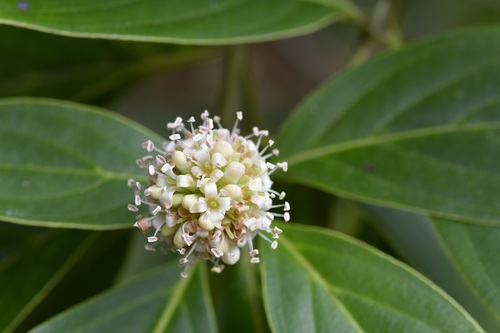
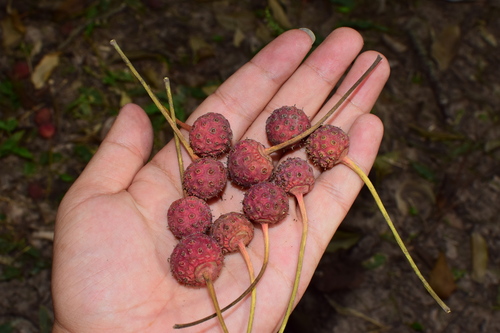
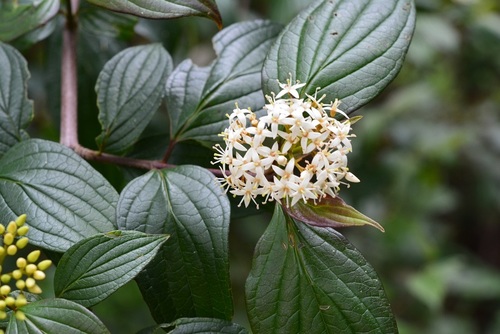
A deciduous shrub. It grows 4.5 m tall. The shoots are red-green. The leaves are narrowly oval and pale green and hairy. They have 3-4 main veins. They have short stalks. The leaves turn red-purple in autumn. The flowers are white and have a scent. They are 8-10 mm across. They occur in dense clusters. The fruit are blue-black. They are round and 5-8 mm across.
Edible Uses
The fruit can be eaten raw or cooked, though it has a bitter flavour and can have an emetic effect on the body, making it not particularly worthwhile. The fruit is about 8mm in diameter. An oil extracted from the seed is edible once refined.
Traditional Uses
Australia, Balkans, Britain, Central Asia, Czech Republic, Estonia, Europe*, Greece, Hungary, India, Italy, Macedonia, Mediterranean, San Marino, Slovenia, Spain, Sweden, Tajikistan, Turkey, Türkiye,
Medicinal Uses
The bark is astringent and febrifuge, used to treat fevers. The leaves are sometimes applied externally as an astringent. The fruit is emetic.
Known Hazards
Contrary to some reports, the fruit is not poisonous, but the leaves can cause skin irritations to sensitive people.
Distribution
Temperate. It grows in woodland and on the edges of ditches and roadsides. It is best in calcareous soils. It is resistant to frost but damaged by drought. Melbourne Botanical gardens. It suits hardiness zones 7-9.
Where It Grows
TEMPERATE ASIA: Iran, Iraq, Lebanon, Syria, Turkey, Russian Federation-Ciscaucasia (Ciscaucasia), Armenia, Azerbaijan, Georgia, Russian Federation (Dagestan) EUROPE: Denmark, United Kingdom, Ireland, Norway, Sweden, Czechoslovakia, Austria, Belgium, Switzerland, Germany, Hungary, Netherlands, Poland, Russian Federation (European part), Belarus, Estonia, Lithuania, Latvia, Moldova, Ukraine (incl. Krym), Former Yugoslavia, Albania, Bulgaria, Greece, Italy (incl. Sardinia, Sicily), Romania, Spain, France (incl. Corsica), Portugal
Cultivation
An easily grown plant, it succeeds in any soil of good or moderate fertility, ranging from acid to shallow chalk. Grows well in heavy clay soils. Plants are relatively shade tolerant, though they are not happy when growing in dense shade. They grow badly when exposed to strong cold winds. Plants are hardy to about -25°c. The flowers have a rather unpleasant smell to most people, though they are attractive to insects. Plants have a suckering habit and can quickly form dense thickets. They can be coppiced regularly and will throw up long straight stems after being cut back. Plants in this genus are notably resistant to honey fungus.
Propagation
Seed is best sown as soon as it is ripe, either in a cold frame or an outdoor seedbed if sufficient seed is available. The seed must be separated from the fruit flesh, which contains germination inhibitors. Stored seed should be cold stratified for 3–4 months and sown as early in the year as possible. Scarification may also help, as may a period of warm stratification before the cold stratification. Germination, especially of stored seed, can be very slow, taking 18 months or more. Prick out cold-frame seedlings into individual pots once large enough to handle, grow on through their first winter under glass, and plant out in spring after the last expected frosts. Cuttings of half-ripe side shoots can be taken in July/August in a frame. Cuttings of mature wood of the current year's growth, taken with a heel if possible, can be taken in autumn in a cold frame, with a high success rate. Layering of new growth in June/July takes around 9 months to root.
Other Uses
The seed contains 45% of a non-drying oil used in soap making and lighting. A non-drying oil is also obtained from the pericarp, which contains 19–35% oil, and is used for lighting. A greenish-blue dye is obtained from the fruit. The young stems are very flexible and used in basketry. The wood is tough and hard, used for small items such as tool handles and turnery. A good quality charcoal is obtained from the wood, which also makes an excellent fuel. The plant can be used as a hedge.
Production
There are about 45 Cornus species. The seeds yield a fatty oil.
Synonyms
Also Known As
Kiren, Komppuu, Kontpuu, Rdeči dren, Sanguinelo, Somfa
References (16)
- Ambasta, S.P. (Ed.), 2000, The Useful Plants of India. CSIR India. p 142
- Blamey, M and Grey-Wilson, C., 2005, Wild flowers of the Mediterranean. A & C Black London. p 153 (As Cornus sanguinea)
- Bodkin, F., 1991, Encyclopedia Botanica. Cornstalk publishing, p 283 (As Cornus sanguinea)
- Cundall, P., (ed.), 2004, Gardening Australia: flora: the gardener's bible. ABC Books. p 416
- Denes, A., et al, 2012, Wild plants used for food by Hungarian ethnic groups living in the Carpathian Basin. Acta Societatis Botanicorum Poloniae 81 (4): 381-396
Show all 16 references Hide references
- Ertug, F, Yenen Bitkiler. Resimli Türkiye Florası -I- Flora of Turkey - Ethnobotany supplement
- Etherington, K., & Imwold, D., (Eds), 2001, Botanica's Trees & Shrubs. The illustrated A-Z of over 8500 trees and shrubs. Random House, Australia. p 229
- Harris, E & J., 1983, Field Guide to the Trees and Shrubs of Britain. Reader's Digest. p 62 (Says fruit are inedible)
- Hedrick, U.P., 1919, (Ed.), Sturtevant's edible plants of the world. p 220
- Kremer, B.P., 1995, Shrubs in the Wild and in Gardens. Barrons. p 66 (Says fruit inedible.)
- Lord, E.E., & Willis, J.H., 1999, Shrubs and Trees for Australian gardens. Lothian. p 218
- Mattalia, G., et al, 2012, Traditional uses of wild food and medicinal plants among Brigasc, Kye ́, and Provenc ̧al communities on the Western Italian Alps. Genet Resour Crop Evol. Springer
- Plants for a Future database, The Field, Penpol, Lostwithiel, Cornwall, PL22 0NG, UK. http://www.scs.leeds.ac.uk/pfaf/
- Sfikas, G., 1984, Trees and shrubs of Greece. Efstathiadis Group. Athens. p 132
- Simkova, K. et al, 2014, Ethnobotanical review of wild edible plants used in the Czech Republic. Journal of Applied Botany and Food Quality 88, 49-67
- Sp. pl. 1:117. 1753