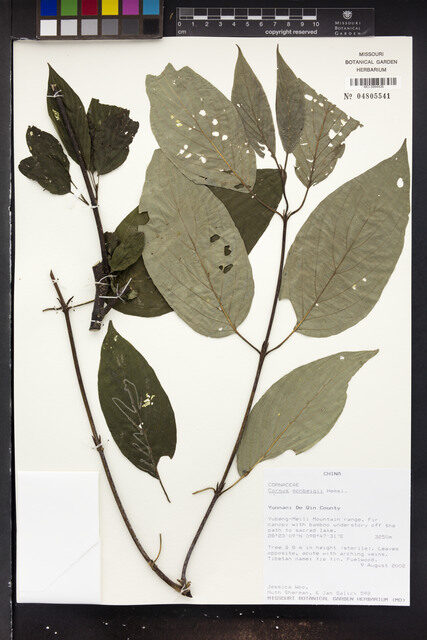
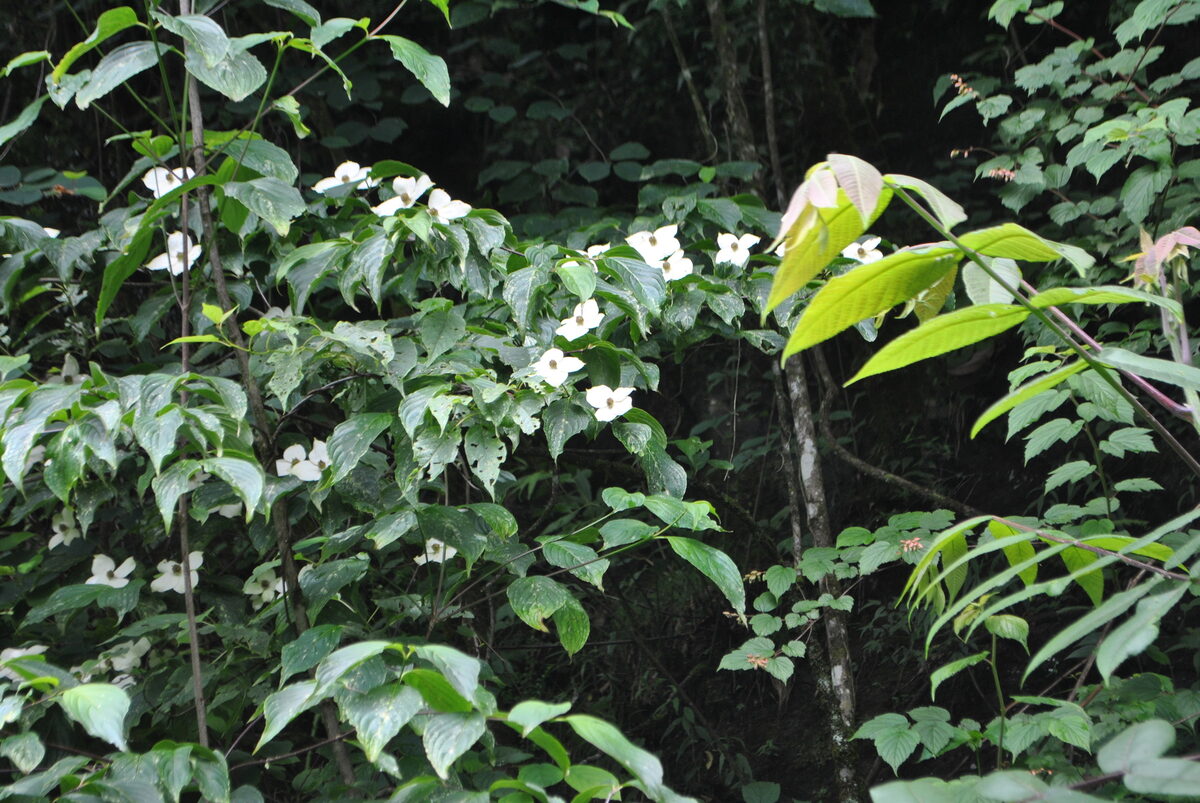
Cornus poliophylla
C. K. Schneid. & Wangerin
wikimedia· cc-by
Wikimedia Commons - Yong Ge, Houyuan Lu, Can Wang & Xing Gao
gbif· cc0
President and Fellows of Harvard College
Summary
A deciduous shrub growing to 4m tall. Hardy to UK zone 7. Flowers July to August. Hermaphroditic flowers pollinated by insects. Accommodates light sandy, medium loamy, and heavy clay soils. Tolerates mildly acid, neutral, and basic to mildly alkaline pH. Grows in semi-shade or full sun and prefers moist soil.
Description
A deciduous shrub growing to 4m tall. Hardy to UK zone 7. Flowers July to August. Hermaphroditic flowers pollinated by insects. Accommodates light sandy, medium loamy, and heavy clay soils. Tolerates mildly acid, neutral, and basic to mildly alkaline pH. Grows in semi-shade or full sun and prefers moist soil.
Edible Uses
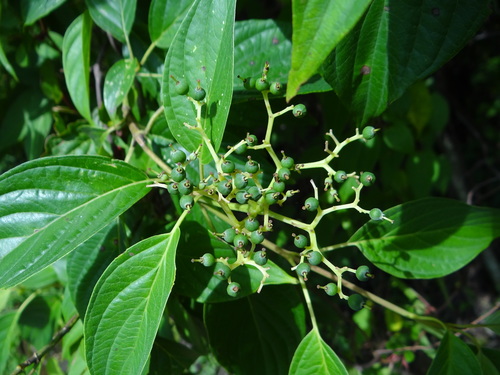
Based on notes for the closely related C. macrophylla, which very probably apply to this species as well, the fruit can be eaten raw or cooked. The fruit is about 6mm in diameter.
Medicinal Uses
Based on notes for the closely related C. macrophylla, which very probably apply to this species as well, the plant is anodyne, astringent, and tonic. The wood is anodyne and acts as a uterosedative. The stem bark is used in the treatment of dysentery.
Distribution
Temperate. Melbourne Botanical Gardens. Mt Lofty Botanical Gardens.
Where It Grows
Asia, Australia, China,
Cultivation
An easily grown plant, it succeeds in any soil of good or moderate fertility, ranging from acid to shallow chalk. Grows well in heavy clay soils. Succeeds in full sun or light shade. This species is closely related to C. monbeigii. Plants in this genus are notably resistant to honey fungus.
Propagation
Seed is best sown as soon as it is ripe, either in a cold frame or an outdoor seedbed if sufficient seed is available. The seed must be separated from the fruit flesh, which contains germination inhibitors. Stored seed should be cold stratified for 3–4 months and sown as early in the year as possible. Scarification may also help, as may a period of warm stratification before the cold stratification. Germination, especially of stored seed, can be very slow, taking 18 months or more. Prick out cold-frame seedlings into individual pots once large enough to handle, grow on through their first winter under glass, and plant out in spring after the last expected frosts. Cuttings of half-ripe side shoots can be taken in July/August in a frame. Cuttings of mature wood of the current year's growth, taken with a heel if possible, can be taken in autumn in a cold frame, with a high success rate. Layering of new growth in June/July takes around 9 months to root.
Other Uses
Based on notes for the closely related C. macrophylla, which very probably apply to this species as well, the wood is hard and close-grained but warps badly, and makes a good charcoal.
Notes
There are about 45 Cornus species.
References (2)
- Plants for a Future database, The Field, Penpol, Lostwithiel, Cornwall, PL22 0NG, UK. http://www.scs.leeds.ac.uk/pfaf/
- Repert. Spec. Nov. Regni Veg. 7:228. 1909