Cordyla africana
Lour.
Bush mango, Sunbird tree
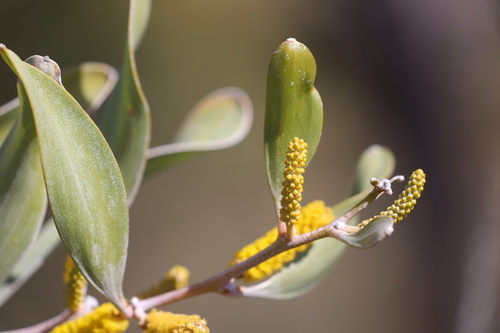
iNaturalist· cc-by-nc-sa
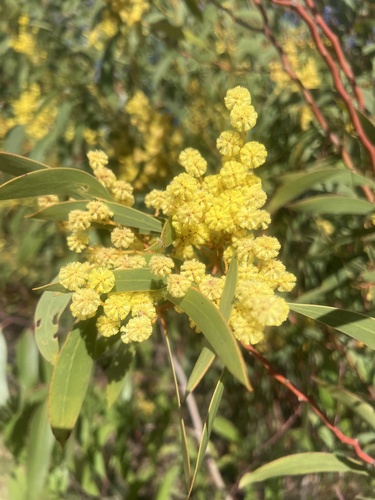
(c) c michael hogan, some rights reserved (CC BY-NC-SA), uploaded by c michael hogan
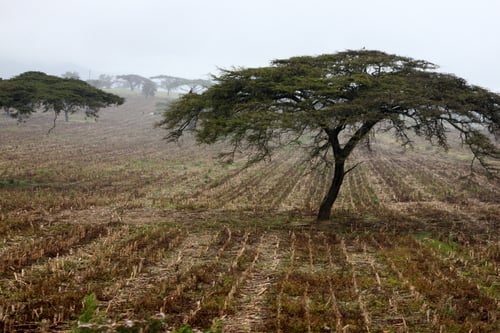
iNaturalist· cc-by-nc
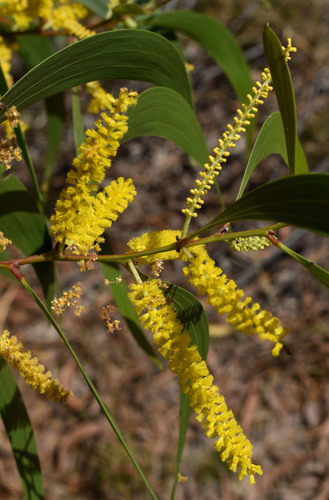
(c) carlbodenstaff, some rights reserved (CC BY-NC), uploaded by carlbodenstaff
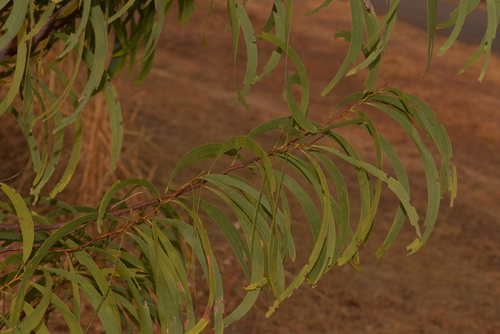
iNaturalist· cc-by-nc
(c) carlbodenstaff, some rights reserved (CC BY-NC), uploaded by carlbodenstaff
Summary
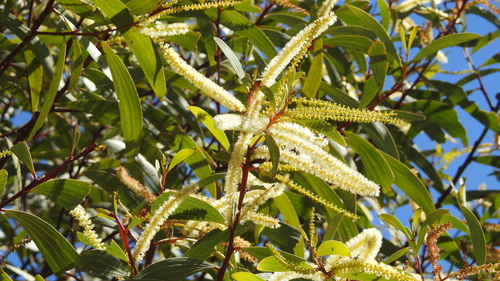
Source: WikipediaCordyla africana is a species of flowering plant in the legume family, Fabaceae. It is a deciduous African tree that grows up to 25 m or 82 ft, with a large, spreading, much-branched crown, and a bole of some 2.2 m (7 ft 3 in) dbh. It is sometimes referred to by the common name wild mango. It is found up to 1,000 m (3,300 ft) elevation in large river valleys, in miombo woodland and coastal swampy evergreen forest, mostly on sandy soils, along the eastern parts of central and southern Africa. It occurs in South Africa in KwaZulu-Natal and Mpumalanga provinces, the Kruger National Park, Eswatini, Mozambique, Zimbabwe, Zambia, Malawi, Kenya and Tanzania. 'Cordyla' is from the Greek word 'kordyle', meaning a 'club' and is a reference to the club-shaped fruit and stalk. The mature bark is rough, dark brown and fissured, and a blaze showing yellow with orange streaks. The flowers are without petals and display yellow to orange stamens in axillary racemes 50 mm (2.0 in) long with up to 12 flowers, and these appear with the new leaves in September. As with Schotia flowers they face up and are nectar-filled, attracting a wide variety of birds. Unusually for the legume family, the fruit develops from the standard pod shape when young, into an indehiscent, up to 80 mm (3.1 in) long golden-yellow and glossy ovoid fruit with a thick stalk. When mature it has a soft, thin skin with a slight depression on one side. Fruit falls when not quite ripe, and fully ripens on the ground. One to eight large brown seeds are enclosed in a yellow, sticky pulp, and these frequently germinate from within the fruit. The fruit is rich in vitamin C and is sought after by many mammals, including elephants (see Mfuwe Lodge). The leaflets show transparent gland dots and streaks when backlit. The twigs and green fruit exude latex when damaged. The tree was first described from Portuguese East Africa by the Jesuit priest João de Loureiro (1710–1791), who spent time as a missionary in Goa, Macao and Cochin China, but was also a naturalist and mathematician. There are eight species of Cordyla currently recognised, confined to the eastern parts of Africa and the island of Madagascar.
Description
It is a large tree. It grows up to 22 m tall. The trunk can be 1.2 m across. The branches spread widely. The bark is greyish brown and has furrows along it. The leaves are divided once. They are 25 cm long with about 9-12 pairs of leaflets with one at the end. The leaflets are 2.5-4 cm long. They are dark green and smooth. There are dots which let light through scattered over the leaf surface. The flowers occur in small sprays in the axils of leaves. The flowers face upwards and are filled with nectar. The fruit is a yellow fleshy succulent fruit. It is about 4 cm long and oval. It has a leathery skin and 1-8 seeds inside. The seeds are embedded in the sticky flesh. The fruit are edible.
Edible Uses
The yellow fruits are eaten raw and fresh or cooked, though they have little taste but are high in Vitamin C. The flower nectar is eaten. The seeds are dried and then eaten.
Traditional Uses
The fruit are eaten raw and fresh or cooked. Caution: The fruit can cause giddiness. The nectar if the flower is eaten. The seeds are dried then eaten.
Known Hazards
The fruit can cause giddiness.
Distribution
A tropical tree. It grows in low altitudes in hot areas. It is often in swamp forest and along rivers. It grows between 10-900 m above sea level. It can grow in arid places.
Where It Grows
Africa, East Africa, Eswatini, Gambia, Guinea, Guinée, Kenya, Madagascar, Malawi, Mozambique, Somalia, South Africa, Southern Africa, South Sudan, Sudan, Swaziland, Tanzania, West Africa, Zambia, Zimbabwe,
Cultivation
Trees can be grown from fresh seeds.
Propagation
Seed - germinates easily when fresh.
Other Uses
A gum resin exudes from the bark and is used mixed with water to make a kind of size or whitewash for houses. The heartwood is a yellowish-brown with darker bands; it is moderately distinct from the 5 - 8cm wide band of pale yellow sapwood. The texture is coarse; the grain wavy or interlocked, showing an attractive stripe figure; cut surfaces are somewhat oily. The wood is hard; it is very durable and resistant to termite attack. It dries rapidly, with some tendency to check but with little warp. It is moderately easy to work with machine tools; shapes cleanly except where the grain is irregular; drills and mortises well; is difficult to work with hand tools; does not dress smoothly in turnings. It is used for purposes such as general heavy construction, railroad crossties, bridge timber, wooden spoons, drums and stools.
Production
In Tanzania ripe fruit are collected during November and December.
Other Information
The fruit has little taste. It is high in Vitamin C.
Notes
There are 5 Cordyla species. The fruit pulp is rich in Vitamin C.
Also Known As
Imbubuli, Mbachanga, Mgwata, Mndundu, Mpachama, Mroma, Mtondo, Mufondo, Mutondo, Thunzikhulu, Tondo, Umbubuli, Vovovo
References (31)
- Bunderson, W. T. et al, 2002, Common Agroforestry Species in Malawi. Malawi Agroforestry Extension Project, Pubication No. 46, Lilongwe. p 28
- Dalziel, J. M., 1937, The Useful plants of west tropical Africa. Crown Agents for the Colonies London.
- Fl. Cochinch. 412. 1790
- Fowler, D. G., 2007, Zambian Plants: Their Vernacular Names and Uses. Kew. p 36
- Fox, F. W. & Young, M. E. N., 1982, Food from the Veld. Delta Books. p 206
Show all 31 references Hide references
- Grivetti, L. E., 1980, Agricultural development: present and potential role of edible wild plants. Part 2: Sub-Saharan Africa, Report to the Department of State Agency for International Development. p 27, 71
- ILDIS Legumes of the World http:www:ildis.org/Legume/Web
- Long, C., 2005, Swaziland's Flora - siSwati names and Uses http://www.sntc.org.sz/flora/
- Lovett, J. C. et al, Field Guide to the Moist Forest Trees of Tanzania. p 91
- Mbuya, L.P., Msanga, H.P., Ruffo, C.K., Birnie, A & Tengnas, B., 1994, Useful Trees and Shrubs for Tanzania. Regional Soil Conservation Unit. Technical Handbook No 6. p 210
- Menninger, E.A., 1977, Edible Nuts of the World. Horticultural Books. Florida p 92
- Msuya, T. S., et al, 2010, Availability, Preference and Consumption of Indigenous Foods in the Eastern Arc Mountains, Tanzania, Ecology of Food and Nutrition, 49:3, 208-227
- Palgrave, K.C., 1996, Trees of Southern Africa. Struik Publishers. p 295
- Palmer, E and Pitman, N., 1972, Trees of Southern Africa. Vol. 2. A.A. Balkema, Cape Town p 889
- Peters, C. R., O'Brien, E. M., and Drummond, R.B., 1992, Edible Wild plants of Sub-saharan Africa. Kew. p 131
- Plowes, N. J. & Taylor, F. W., 1997, The Processing of Indigenous Fruits and other Wildfoods of Southern Africa. in Smartt, L. & Haq. (Eds) Domestication, Production and Utilization of New Crops. ICUC p 189
- Royal Botanic Gardens, Kew (1999). Survey of Economic Plants for Arid and Semi-Arid Lands (SEPASAL) database. Published on the Internet; http://www.rbgkew.org.uk/ceb/sepasal/internet [Accessed 28th April 2011]
- Ruffo, C. K., Birnie, A. & Tengnas, B., 2002, Edible Wild Plants of Tanzania. RELMA p 236
- Ruiters-Welcome, A. K., 2019, Food plants of southern Africa. Ph.D. thesis. Univ. of Johannesburg p 56
- Schatz, G.E., 2001, Generic Tree Flora of Madagascar. Royal Botanical Gardens, Kew and Missouri Botanical Garden. p 185 (Genus)
- Schmidt, E., Lotter, M., & McCleland, W., 2007, Trees and shrubs of Mpumalanga and Kruger National Park. Jacana Media p 186
- Scudder, 1962, 1971,
- Swaziland's Flora Database http://www.sntc.org.sz/flora
- van Wyk, Be, & Gericke, N., 2007, People's plants. A Guide to Useful Plants of Southern Africa. Briza. p 38
- van Wyk, Br, van Wyk, P, and van Wyk B., 2000, Photographic guide to Trees of Southern Africa. Briza. p 102
- van Wyk, Ben-Erik, 2019, The diversity and multiple uses of southern African legumes. Australian Systematic Botany, 2019, 32, 519–546
- Welcome, A. K. & Van Wyk, B.-E., 2019, An inventory and analysis of the food plants of southern Africa. South African Journal of Botany 122 (2019) 136–179
- White, F., Dowsett-Lemaire, F. and Chapman, J. D., 2001, Evergreen Forest Flora of Malawi. Kew. p 307
- Williamson, J., 2005, Useful Plants of Malawi. 3rd. Edition. Mdadzi Book Trust. p 79
- World Checklist of Useful Plant Species 2020. Royal Botanic Gardens, Kew
- www.zimbabweflora.co.zw 2011