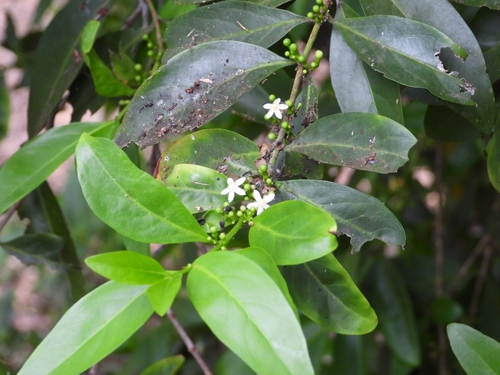
Coprosma hirtella
Labill.
Coffee berry, Rough Coprosma, Mirror plant
iNaturalist· cc-by
(c) Russell Best, some rights reserved (CC BY), uploaded by Russell Best
iNaturalist· cc-by-nc
(c) georgetelehin, some rights reserved (CC BY-NC)
iNaturalist· cc-by-nc
(c) georgetelehin, some rights reserved (CC BY-NC)
Summary
Source: WikipediaCoprosma hirtella, or coffee-berry, is a shrub in the family Rubiaceae. It is endemic to south-eastern Australia. It grows to about 2 metres high and has leaves that are between 15 and 50 mm long and 10 to 25 mm wide. Plants have male and female flower clusters that appear between August and April. These are followed by orange to reddish fruits that are 7 to 8 mm in diameter. The species was formally described by French botanist Jacques Labillardière in 1805, based on plant specimens collected in Tasmania. It is a common plant of moist montane forests in New South Wales, Victoria and Tasmania. The 1889 book The Useful Native Plants of Australia records "Fruit sweet, eatable, not agreeable. The fruits of other species may be eaten also."
Description
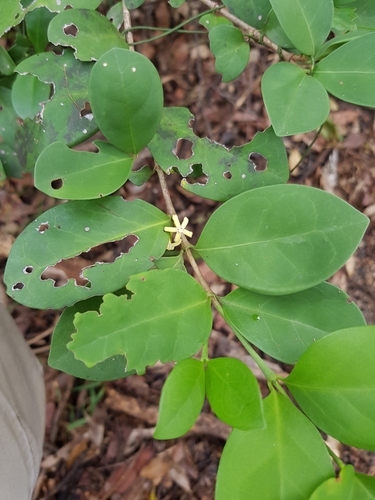
A small shrub. It is slender. It grows 1-2.5 m high and spreads 0.5-1.5 m wide. The leaves are 1-7 cm long by 1-1.5 cm wide. They are broadly oval. They are roughened and dull green with a long point. Male and female flowers are on separate plants. The flowers are 0.6 cm long and greenish. They occur in clusters. The fruit are fleshy with a stone inside. They are 1 cm across. They are orange-red or brown. They occur in clusters. The fruit are edible.
Edible Uses
The dark red fruit, about 6mm in diameter, can be eaten raw or cooked, though the flavour is sweetish but not particularly pleasant. The roasted seed makes an excellent coffee substitute.
Traditional Uses
The fruit are eaten when fully ripe.
This uses section is brief — help expand it
Medicinal Uses
None known.
Distribution
It is a warm temperate plant. It grows in open forest country. It needs adequate moisture and good drainage. It suits sub-alpine climates. It can grow in most soils in a protected and partly shaded position. It is resistant to frost but sensitive to drought. It suits hardiness zones 8-10. Tasmania Herbarium. Arboretum Tasmania.
Where It Grows
Australia*, Tasmania*,
Cultivation
Requires a moist, very well-drained neutral to slightly acid soil in full sun or light shade. Succeeds in most soils. Somewhat intolerant of frost, this species is only likely to succeed outdoors in the milder areas of Britain. Plants are hardy to at least -7°c in Australian gardens though this cannot be translated directly to British gardens because of our cooler summers and longer, colder and wetter winters. Hybridizes freely with other members of this genus. Plants are tolerant of heavy clipping or pruning. Plants are normally dioecious, though in some species the plants produce a few flowers of the opposite sex before the main flowering and a few hermaphrodite flowers are sometimes produced. Male and female plants must usually be grown if seed is required.
Propagation
Seed is probably best sown as soon as it is ripe in a greenhouse or cold frame. Stored seed should be sown in spring in a cold frame. Germination can be slow, often taking more than 12 months even with fresh seed. Prick seedlings out into individual pots once large enough to handle. Grow plants through at least their first winter under glass before planting out in late spring or early summer, and give some cold protection during their first winter outdoors. Cuttings of mature wood from the current year's growth can be taken in autumn and rooted in a frame.
Other Uses
A yellow dye is obtained from the wood and requires no mordant.
Notes
There are about 90 Coprosma species.
Synonyms
References (16)
- Bodkin, F., 1991, Encyclopedia Botanica. Cornstalk publishing, p 280
- Cameron, M., (Ed.) 1981, A Guide to Flowers & Plants of Tasmania. Reed p 36
- Cherikoff V. & Isaacs, J., The Bush Food Handbook. How to gather, grow, process and cook Australian Wild Foods. Ti Tree Press, Australia p 194
- Cribb, A.B. & J.W., 1976, Wild Food in Australia, Fontana. p 27
- Curtis, W.M., 1963, The Students Flora of Tasmania Vol 2 p 268
Show all 16 references Hide references
- Elliot, W.R., & Jones, D.L., 1984, Encyclopedia of Australian Plants suitable for cultivation. Vol 3. Lothian. p 84
- Etherington, K., & Imwold, D., (Eds), 2001, Botanica's Trees & Shrubs. The illustrated A-Z of over 8500 trees and shrubs. Random House, Australia. p 224
- Gilfedder, L et al, 2003, The Nature of the Midlands. Midlands Bushweb. PO Box 156 Longford, Tasmania. p 103
- Hibbert, M., 2002, The Aussie Plant Finder 2002, Florilegium. p 72
- Maiden, JH (1889) The Useful Native Plants of Australia. Compendium. Melbourne. Reprinted 1975.
- Morley, B.D., & Toelken, H.R., (Eds), 1983, Flowering Plants in Australia. Rigby. p 257
- Nov. Holl. pl. 1:70, t. 95. 1805
- Plants for a Future database, The Field, Penpol, Lostwithiel, Cornwall, PL22 0NG, UK. http://www.scs.leeds.ac.uk/pfaf/
- Tasmanian Herbarium Vascular Plants list p 51
- Whiting, J. et al, 2004, Tasmania's Natural Flora. Tasmania's Natural Flora Editorial Committee PO Box 194, Ulverstone, Tasmania, Australia 7315 p 294
- Zola, N., & Gott, B., 1992, Koorie Plants Koorie People. Koorie Heritage Trust. p 34