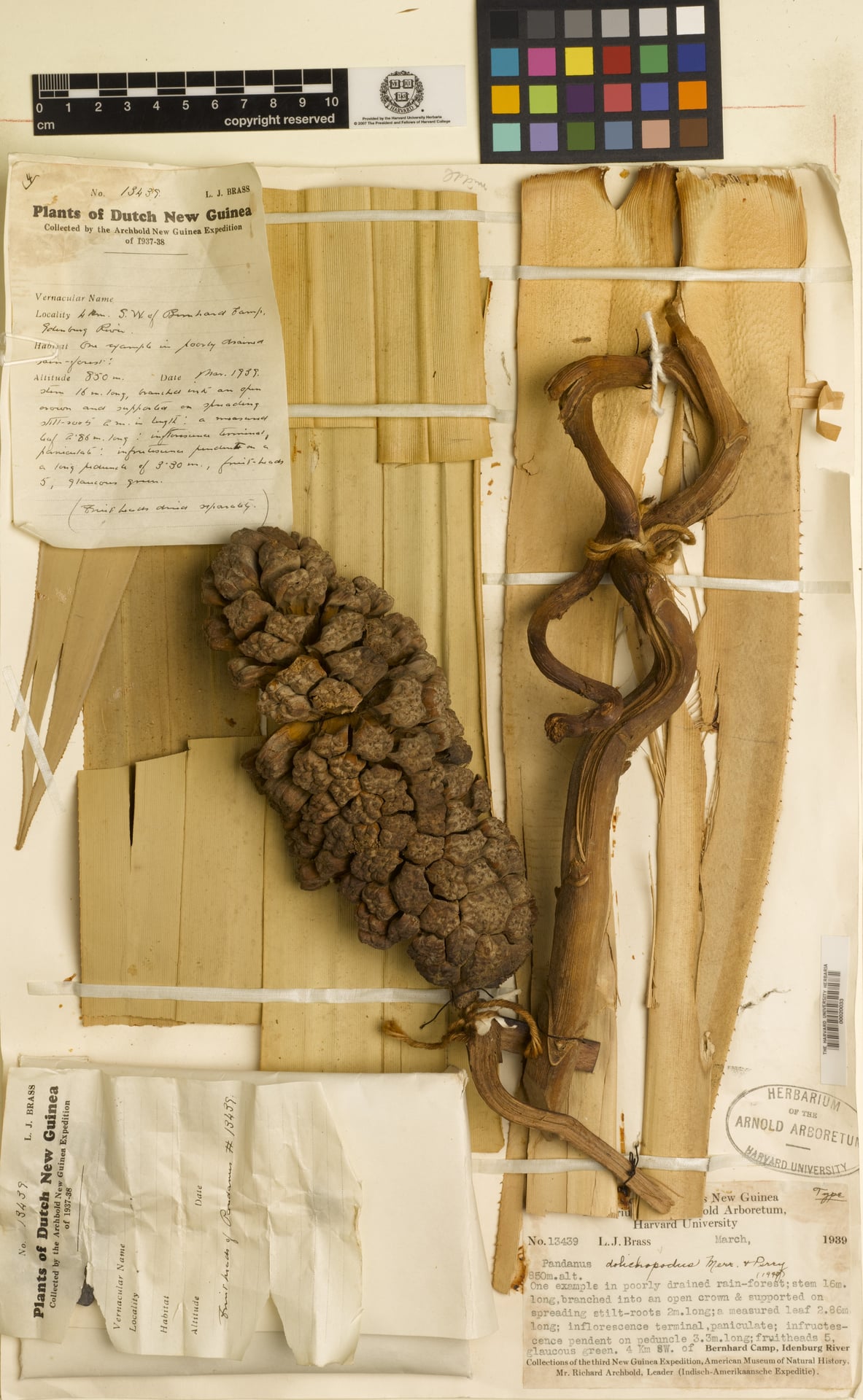
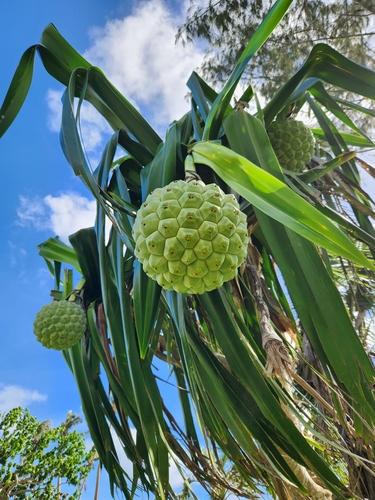
Sararanga sinuosa
Hemsl.
gbif· cc0
President and Fellows of Harvard College
gbif· cc0
President and Fellows of Harvard College
gbif· cc0
President and Fellows of Harvard College
Description
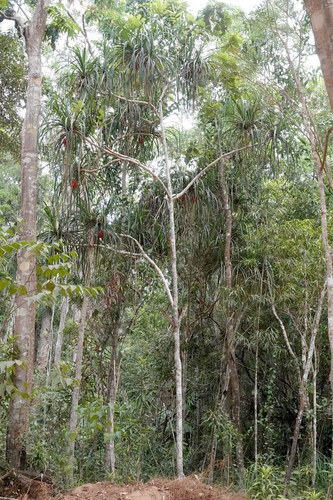
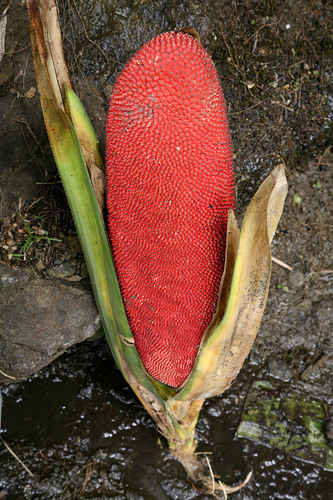
A solitary tree pandanus. It grows 9-10 m tall. The stem is 67 cm across. It can be branched. The leaves are in rings arranged in 4 ranks. They are a long sword shape and 300 cm long by 9-11 cm wide. They taper to the tip. There are spines along the edges. The leaves are yellowish-green. There are spine on the main vein. The fruiting body is large and branched. It can weigh 15 kg. They are at the end of the branch and green. There can be 10 heads 150-250 cm long. There are 100 fruit in each head.
Edible Uses
Fruit - raw. Fruits syncarpous, berries c. 100 per rachillae; kidney-shaped (reniform), pale green to red when mature, exocarp soft; seeds c. 60 per berry, triangle-shaped, flat and thin, pale brown.
Distribution
It is a tropical plant. It grows in the lowland tropical rainforest from sea level to 200 m above sea level. In PNG it occurs on Manus Island.
Where It Grows
Asia, Indonesia, Pacific, Papua, Papua New Guinea, PNG, SE Asia, Solomon Islands,
Also Known As
Kayari, Sararang
References (2)
- Keim, A.P., 2009, Pandanaceae of the island of Yapen, Papua (West New Guinea). Blumea 54, 2009: 255-266
- World Checklist of Useful Plant Species 2020. Royal Botanic Gardens, Kew