Codonocarpus cotinifolius
(Desf.) F. Muell.
Desert poplar, Bell-fruit, Native Poplar, Bell Fruit Tree, Horseradish Tree
iNaturalist· cc0
no rights reserved, uploaded by Connor Margetts
iNaturalist· cc-by-nc
(c) tr333s, some rights reserved (CC BY-NC)
iNaturalist· cc-by-nc
(c) Ian Dudley, some rights reserved (CC BY-NC), uploaded by Ian Dudley
Summary
Source: WikipediaCodonocarpus cotinifolius is a tall shrub or tree in the Gyrostemonaceae family found in all mainland states of Australia, including Victoria, and is also widespread in arid areas. It is suspected of being toxic to stock. Common names are native poplar (New South Wales, Western Australia), and bell-fruit tree (Victoria) The species was first described in 1822 as Gyrostemon cotinifolium by René Louiche Desfontaines. In 1862, Ferdinand von Mueller transferred it to the genus, Codonocarpus.
Description
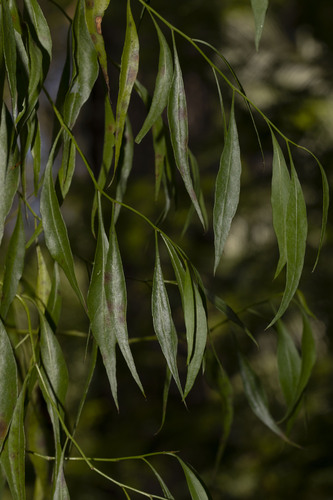
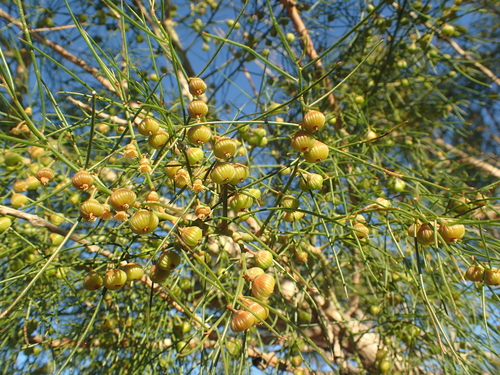
A medium sized shrub or small tree. It grows 3-12 m high and spreads 1.5-4 m wide. The bark is smooth and pink. The leaves are 2-5 cm long and broadly sword shaped. Male and female trees are separate. The flowers occur in flowering stalks in the axils of leave near the ends of branches. The fruit are bell shaped and 1 cm long and hang down in clusters. They are lime green. Bark, leaves and twigs have a horseradish taste.
Edible Uses
The sappy roots are eaten. Grubs are also consumed.
Traditional Uses
CAUTION The plant is probably posionous. The sappy roots are eaten.
This uses section is brief — help expand it
Known Hazards
The plant is probably poisonous.
Distribution
It is a subtropical plant. It needs well drained soil and full sun. It is frost and drought resistant. It suits semiarid regions.
Where It Grows
Australia*,
Cultivation
Plants are grown from seed. Plants can be transplanted easily. They can also be pruned.
Production
It grows very quickly. It has a life span of about 10-15 years.
Notes
The Gyrostemonaceae are endemic to Australia. There are 3 Codonocarpus species.
Synonyms
References (17)
- Bodkin, F., 1991, Encyclopedia Botanica. Cornstalk publishing, p 270
- Boomsma, C.D., 1972, Native Tree of South Australia. Woods & Forests Department South Australia, Bulletin No.19. p 71
- Cherikoff V. & Isaacs, J., The Bush Food Handbook. How to gather, grow, process and cook Australian Wild Foods. Ti Tree Press, Australia p 189
- Cribb, A.B. & J.W., 1976, Wild Food in Australia, Fontana. p 138
- Elliot, W.R., & Jones, D.L., 1984, Encyclopedia of Australian Plants suitable for cultivation. Vol 3. Lothian. p 56
Show all 17 references Hide references
- Flora of Australia, Volume 8, Lecythidales to Batales, Australian Government Publishing Service, Canberra (1982) p 364
- Hall, N. et al, 1972, The Use of Trees and Shrubs in the Dry Country of Australia, AGPS, Canberra. p 361
- Heywood, V.H., Brummitt, R.K., Culham, A., and Seberg, O. 2007, Flowering Plant Families of the World. Royal Botanical Gardens, Kew. p 161
- Kenneally, K.E., Edinger, D. C., and Willing T., 1996, Broome and Beyond, Plants and People of the Dampier Peninsula, Kimberley, Western Australia. Department of Conservation and Land Management. p 111
- Lazarides, M. & Hince, B., 1993, Handbook of Economic Plants of Australia, CSIRO. p 62
- Lim, T. K., 2015, Edible Medicinal and Non Medicinal Plants. Volume 9, Modified Stems, Roots, Bulbs. Springer p 25
- Lord, E.E., & Willis, J.H., 1999, Shrubs and Trees for Australian gardens. Lothian. p 14
- Low, T., 1992, Bush Tucker. Australia’s Wild Food Harvest. Angus & Robertson. p 148
- Morley, B.D., & Toelken, H.R., (Eds), 1983, Flowering Plants in Australia. Rigby. p 70
- Paczkowska, G. & Chapman, A.R., 2000, The Western Australian Flora. A Descriptive Catalogue. Western Australian Herbarium. p 264
- Pl. Vict. 1:200. 1862
- Wheeler, J.R.(ed.), 1992, Flora of the Kimberley Region. CALM, Western Australian Herbarium, p 265