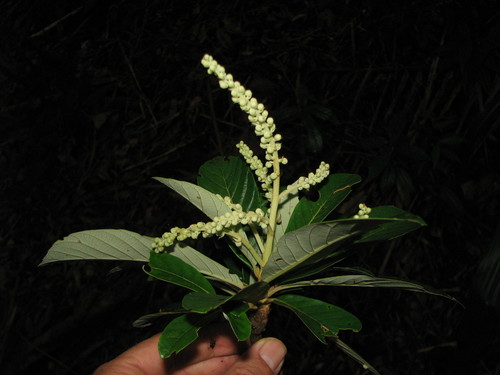
Clethra barbinervis
Sieb. & Zucc.
Japanese Clethra, White alder
iNaturalist· cc-by-sa
(c) harum.koh, some rights reserved (CC BY-SA), uploaded by harum.koh
iNaturalist· cc-by
(c) Marco Mussita, some rights reserved (CC BY)
Summary
Source: WikipediaClethra barbinervis, the Japanese clethra, is a species of flowering plant in the family Clethraceae. It is native to eastern Asia, where it is found in southern China, Korea, and Japan. Its natural habitat is in open mountain forests. It is a common species in Japan, and is often found in disturbed secondary forests. It is an upright shrub growing to 3 m (9.8 ft). Its leaves are deciduous, dark green, and are 5 cm (2 in) long. Racemes of small, fragrant, white flowers 15 cm (6 in) long are produced in late summer and autumn. Mature specimens have peeling bark. The bark is plain, blackish brown with twigs turning back. This plant has gained the Royal Horticultural Society's Award of Garden Merit. Though hardy in cultivation, it requires a sheltered location in temperate regions.
Description
A tree. It grows to 3-9 m high. In cultivation it is often only 3 m high. The bark is orange-brown and peeling. The shoots arch outwards. The leaves are dark green. The leaves have strong veins. There are very short hairs on the veins. The flowers appear in clusters at the tips of the branches. The flowers are white and in racemes at the ends of branches.
Edible Uses
Leaves are cooked and eaten with rice dishes.
Traditional Uses
The leaves are eaten with oil and salt.
This uses section is brief — help expand it
Medicinal Uses
No medicinal uses are known for this plant.
Distribution
It is a warm temperate plant. In China it grows in open, deciduous mountain forests between 800-1,800 m above sea level. It grows in mountain woodlands in Japan. It suits hardiness zones 8-9.
Where It Grows
Asia, Australia, Britain, Canada, China*, Europe, Japan, Korea, North America,
Cultivation
Requires a moist well-drained lime-free peaty soil succeeding in a sunny position or partial shade. Plants are hardy to about -20°c according to one report, this conflicts with another report that says it only succeeds outdoors in Britain from Sussex and westwards. A third report says that the plant is generally hardy but sometimes fails in very cold districts of Britain. The new growth in spring is very susceptible to damage by late frosts. The flowers are fragrant. Plants in this genus are notably resistant to honey fungus.
Propagation
Sow seed in early spring in a greenhouse, barely covering it, and keep the pot moist. Germination usually takes 1–3 months at 13°c. Prick seedlings into individual pots when large enough to handle and grow on in the greenhouse for at least their first winter. Plant out once they are more than 20cm tall, in late spring or early summer after the last expected frosts. Half-ripe cuttings with a heel, 7–10cm long, can be taken in July/August in a frame and root very easily. Root cuttings can be taken in December/January. Suckers can be divided in the dormant season and planted directly into permanent positions if required. Layering of the current year's growth in late autumn takes 18 months; layering can also be carried out in early spring.
Other Uses
No other uses are known for this plant.
Notes
There are 60-73-120 Clethra species.
Synonyms
Also Known As
Ryoubu
References (12)
- Abh. Math.-Phys. Cl. Koenigl. Bayer. Akad. Wiss. 4(3):128. 1846
- Bodkin, F., 1991, Encyclopedia Botanica. Cornstalk publishing, p 267
- Brickell, C. (Ed.), 1999, The Royal Horticultural Society A-Z Encyclopedia of Garden Plants. Convent Garden Books. p 281
- Chen, B. & Qiu, Z., Consumer's Attitudes towards Edible Wild Plants, Ishikawa Prefecture, Japan. p 23 www.hindawi.com/journals/ijfr/aip/872413.pdf
- Cundall, P., (ed.), 2004, Gardening Australia: flora: the gardener's bible. ABC Books. p 394
Show all 12 references Hide references
- Etherington, K., & Imwold, D., (Eds), 2001, Botanica's Trees & Shrubs. The illustrated A-Z of over 8500 trees and shrubs. Random House, Australia. p 217
- Hibbert, M., 2002, The Aussie Plant Finder 2002, Florilegium. p 70
- Plants for a Future database, The Field, Penpol, Lostwithiel, Cornwall, PL22 0NG, UK. http://www.scs.leeds.ac.uk/pfaf/
- READ,
- Ryan, S., 2008, Dicksonia. Rare Plants Manual. Hyland House. p 16
- Smith, N., Mori, S.A., et al, 2004, Flowering Plants of the Neotropics. Princeton. p 105
- Young, J., (Ed.), 2001, Botanica's Pocket Trees and Shrubs. Random House. p 256