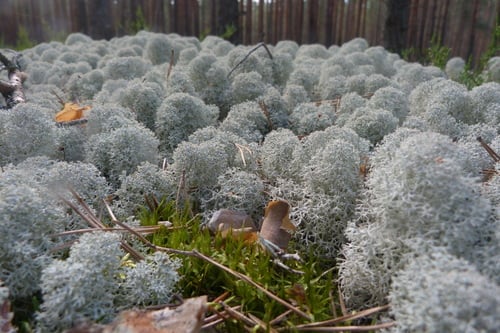
Cladonia rangiferina
(Linn.) Web.
Lichen, Reindeer moss
iNaturalist· cc-by-nc
(c) Vitaly Charny, some rights reserved (CC BY-NC), uploaded by Vitaly Charny
iNaturalist· cc-by-nc
(c) bheberlein, some rights reserved (CC BY-NC)
iNaturalist· cc-by-nc
(c) Cho Fungi, some rights reserved (CC BY-NC), uploaded by Cho Fungi
Summary
Source: WikipediaCladonia rangiferina, also known as reindeer cup lichen, reindeer lichen (cf. Sw. renlav) or grey reindeer lichen, is a light-coloured fruticose, cup lichen species in the family Cladoniaceae. It grows in both hot and cold climates in well-drained, open environments. Found primarily in areas of alpine tundra, it is extremely cold-hardy. Other common names include reindeer moss, deer moss, and caribou moss, but these names can be misleading since it is, though somewhat moss-like in appearance, not a moss. As the common names suggest, reindeer lichen is an important food for reindeer (caribou), and has economic importance as a result. Synonyms include Cladina rangiferina and Lichen rangiferinus.
Description
A lichen. It grows in carpet like masses. These can be 25 cm across. It is like sponge and made up of inter-tangled stalks.
This description is brief — help expand it
Edible Uses
The lichen is boiled and drunk as a beverage, and can be ground into flour and eaten during times of scarcity. It is also used for the production of glucose and alcohol.
Traditional Uses
It is used for the production of glucose and alcohol. Caution: Alcohol is a cause of cancer. The moss is also boiled and drunk. It is also ground into flour and eaten during famine.
Medicinal Uses
The reindeer lichen is edible, but crunchy. It can be soaked with wood ashes to remove its bitterness, then added to milk or other dishes. It is a source of vitamin D. This lichen can be used in the making of aquavit, and is sometimes used as decoration in glass windows. The lichen is used as a traditional remedy for removal of kidney stones by the Monpa in the alpine regions of the West Kameng district of Eastern Himalaya. The Inland Dena'ina used reindeer lichen for food by crushing the dry lichen and then boiling it or soaking it in hot water until it becomes soft. They eat it plain or, preferably, mixed with berries, fish eggs, or lard. The Inland Dena'ina also boil reindeer lichen and drink the juice as a medicine for diarrhea. Acids present in lichens mean their consumption may cause an upset stomach, especially if not well cooked. According to a study published in 2017, reindeer lichen was able to grow on burnt soil as soon as two years after a forest fire in Northern Sweden, indicating that artificial replanting of lichen could be a useful strategy for the restoration of reindeer pastures.
Known Hazards
Alcohol produced from this lichen is a known cause of cancer.
Distribution
It grows in arctic and subarctic regions.
Where It Grows
Alaska, Asia, Canada, Czech Republic, Europe, India, North America, Norway, Scandinavia, USA,
Notes
It is eaten by reindeer.
Synonyms
Also Known As
Dutohlavka sobi
References (10)
- Ambasta, S.P. (Ed.), 2000, The Useful Plants of India. CSIR India. p 130
- Beckstrom-Sternberg, Stephen M., and James A. Duke. "The Foodplant Database." http://probe.nalusda.gov:8300/cgi-bin/browse/foodplantdb.(ACEDB version 4.0 - data version July 1994)
- Etkin, N.L. (Ed.), 1994, Eating on the Wild Side, Univ. of Arizona. p 73
- Hedrick, U.P., 1919, (Ed.), Sturtevant's edible plants of the world. p 202 (As Claydonia rangifera)
- Heller, C. A., 1962, Wild Edible and Poisonous Plants of Alaska. Univ. of Alaska Extension Service. p 69
Show all 10 references Hide references
- Kuhnlein, H. V. and Turner, N. J., 1991, Traditional Plant Foods of Canadian Indigenous Peoples. Food and Nutrition in History and Anthropology Volume 8. Gordon and Breach. p 22 As Cladina rnagifera
- Simkova, K. et al, 2014, Ethnobotanical review of wild edible plants used in the Czech Republic. Journal of Applied Botany and Food Quality 88, 49-67
- Tozer, F., 2007, The Uses of Wild Plants. Green Man Publishing. p 69
- www.lichen.com/usetype.html
- Yanovsky, E., 1936, Food Plants of the North American Indians. United States Department of Agriculture Miscellaneous Publication No 237. Washington, D.C. p 3