Citrus paradisi
Macfayden
Grapefruit
iNaturalist· cc-by-nc
(c) James K. Wetterer, some rights reserved (CC BY-NC)
iNaturalist· cc-by-nc
(c) Klaus Bohn, some rights reserved (CC BY-NC)
iNaturalist· cc-by-nc
(c) James K. Wetterer, some rights reserved (CC BY-NC)
Description
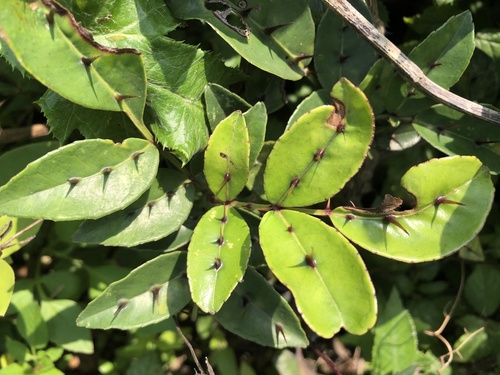
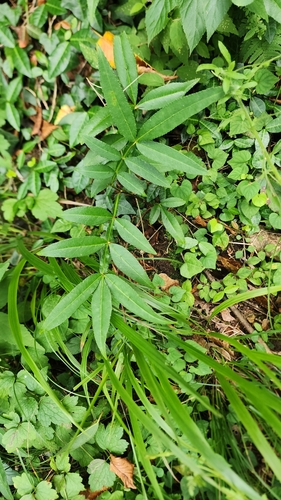
Probably a natural hybrid between sweet orange and pomelo. A medium sized evergreen tree up to 10-15 m high. They spread 5 m across. The stem is stout and crooked. The branches hang down giving a rounded crown. The thorns are small. The leaves are dark shiny green and sword shaped. They can be 18 cm long. The leaves are leathery and they have rounded teeth along the edge. The leaf stalk usually has a broad wing. The flowers are creamy white and large. The flowers occur either singly or in clusters (2-20) in the axils of leaves. The flowers are 4-5 cm across. The fruit are large, yellow and in clusters. Fruit can be 9-15 cm across. Fruit are very juicy with a sweet-sour pulp. The juice sacs are large but closely packed. There are many cultivated varieties.
Edible Uses
Like other citrus fruits, grapefruits are sour because of their citric acid content; grapefruit juice contains about half the citric acid content of lemon juice, and nearly 50% more than orange juice. In Costa Rica, especially in Atenas, grapefruit are often cooked with sugar to balance their sourness, rendering them as sweets; or they are stuffed with dulce de leche as a dessert. In Haiti, grapefruit is used primarily for its juice (French: jus de Chadèque), but also is used to make jam (French: confiture de Chadèque). Grapefruit varieties are differentiated by the flesh color of fruit they produce. Common varieties are yellow and pink pulp colors. Flavors range from highly acidic and somewhat sour to sweet and tart, resulting from composition of sugars (mainly sucrose), organic acids (mainly citric acid), and monoterpenes and sesquiterpenes providing aromas. Grapefruit mercaptan, a sulfur-containing terpene, is one of the aroma compounds influencing the taste and odor of grapefruit, compared with other citrus fruits.
Traditional Uses
The fruit is eaten as fresh fruit, or the juice is used in drinks. They are made into marmalade. The juice can be used for vinegar or wine. The peel is candied. The essential oil from the peel is used for flavouring drinks and desserts. The oil from the seed is bleached and refined into a culinary oil. Caution: Grapefruit can react dangerously with some medications, increasing the effect of the medicine.
Distribution
A subtropical plant. Plants grow from sea level up to 1,800 m altitude in the tropics. They are frost tender. Plants prefer well-drained soils and a protected sunny position. Plants are drought tender. They do best in humid climates. It suits hardiness zones 9-11.
Where It Grows
Africa, Argentina, Asia, Australia, Barbados, Bolivia, Brazil, Cambodia, Cameroon, Caucasus, Central Africa, Central America, China, Colombia, Cook Islands, Costa Rica, Cuba, East Africa, Ecuador, Europe, Fiji, French Guiana, Georgia, Ghana, Grenada, Guam, Guianas, Guinea-Bissau, Guyana, Haiti, India, Indochina, Indonesia, Israel, Jamaica, Kenya, Laos, Malawi, Malaysia, Marquesas, Mauritius, Mediterranean, Mexico, Middle East, Morocco, Mozambique, Myanmar, Nicaragua, Nigeria, North Africa, North America, Pacific, Pakistan, Papua New Guinea, PNG, Peru, Philippines, Samoa, SE Asia, Solomon Islands, Somalia, South Africa, Southern Africa, South America, Spain, Sri Lanka, Suriname, Tanzania, Thailand, Uganda, United Arab Emirates, UAE, USA, Vanuatu, Vietnam, West Africa, West Indies*, Zimbabwe,
Cultivation
Plants can be grown from seed. The seed should be sown fresh. Often seedling trees breed true. Trees are best grown by layering or grafting. A spacing of 6-8 m is suitable.
Production
Seedling trees take 3-5 years to produce while grafted trees take 2-3 years. Fruiting tends to be seasonal from April to August in the Southern hemisphere. Fruit take 6-8 months to mature. A healthy tree can produce 100 fruit in a year. Fruit can be left on the tree for 3 months after they first ripen.
Other Information
Becoming popular around the world. Not widely grown in Papua New Guinea. It is a cultivated food plant.
Notes
There are 20 Citrus species. Several hybrids have been formed.
Nutrition
| Part | Moisture | kJ | kcal | Protein | Vit A | Vit C | Iron | Zinc |
|---|---|---|---|---|---|---|---|---|
| Fruit | 43.5 | 45 | 11 | 0.3 | — | 19 | 0.1 | 0.1 |
Synonyms
Also Known As
Bombelmo, Chakotra, Dat-kywegaw, Kureip-purutu, Kuripa, Lawi hkaw, Lemu yamiku, Pu tao you, Shauk-hka, Shauk-waing, Taraja, Toronja
References (61)
- AAK, 1994, Jeruk, Penerbit Kanisius, Jogyakarta. p 202
- Abbiw, D.K., 1990, Useful Plants of Ghana. West African uses of wild and cultivated plants. Intermediate Technology Publications and the Royal Botanic Gardens, Kew. p 42
- Ambasta, S.P. (Ed.), 2000, The Useful Plants of India. CSIR India. p 129
- Bennett, B. C., 1990, Useful Plants of Amazonian Ecuador. US Agency for International Development. Fifth Progress Report. New York Botanical Gardens. p 39
- Blamey, M and Grey-Wilson, C., 2005, Wild flowers of the Mediterranean. A & C Black London. p 123
Show all 61 references Hide references
- Bodkin, F., 1991, Encyclopedia Botanica. Cornstalk publishing, p 262
- Brouk, B., 1975, Plants Consumed by Man. Academic Press, London. p 179
- Burkill, H. M., 1985, The useful plants of west tropical Africa, Vol. 4. Kew.
- Burkill, I.H., 1966, A Dictionary of the Economic Products of the Malay Peninsula. Ministry of Agriculture and Cooperatives, Kuala Lumpur, Malaysia. Vol 1 (A-H) p 581
- Bussman, R. W., et al, 2016, A comparative ethnobotany of Khevsureti, Samtskhe-Javakheti, Tusheti, Svaneti, and Racha-Lechkhumi, Republic of Georgia (Sakartvelo), Caucasus. Journal of Ethnobiology and Ethnomedicine.
- Bussman, R. W. et al, 2017, Ethnobotany of Samtskhe-Javakheti, Sakartvelo (Republic of Georgia), Caucasus. Indian Journal of Traditional Knowledge Vol. 16(1) pp 7-24
- Cameron, J.W. & Soost, R.K., 1979, Citrus, in Simmonds, N.W., (ed), Crop Plant Evolution. Longmans. London. p 261
- Cheifetz, A., (ed), 1999, 500 popular vegetables, herbs, fruits and nuts for Australian Gardeners. Random House p 182
- Cobley, L.S. (rev. Steele, W.M.) 2nd Ed., 1976, An Introduction to the Botany of Tropical Crops. Longmans. p 164
- Coe, F. G. and Anderson, G. J., 1999, Ethnobotany of the Sumu (Ulwa) of Southeastern Nicaragua and Comparisons with Miskitu Plant Lore. Economic Botany Vol. 53. No. 4. pp. 363-386
- Coronel, R.E., 1982, Fruit Collections in the Philippines. IBPGR Newsletter p 6
- Cundall, P., (ed.), 2004, Gardening Australia: flora: the gardener's bible. ABC Books. p 383
- Elevitch, C.R.(ed.), 2006, Traditional Trees of the Pacific Islands: Their Culture, Environment and Use. Permanent Agriculture Resources, Holualoa, Hawaii. p 245
- Facciola, S., 1998, Cornucopia 2: a Source Book of Edible Plants. Kampong Publications, p 218
- Flora of Pakistan. www.eFloras.org
- French, B.R., 1986, Food Plants of Papua New Guinea, A Compendium. Asia Pacific Science Foundation p 229
- French, B.R., 2010, Food Plants of Solomon Islands. A Compendium. Food Plants International Inc. p 229
- Hearne, D.A., & Rance, S.J., 1975, Trees for Darwin and Northern Australia. AGPS, Canberra p 47
- Hibbert, M., 2002, The Aussie Plant Finder 2002, Florilegium. p 68
- Hu, Shiu-ying, 2005, Food Plants of China. The Chinese University Press. p 495
- INFOODS:FAO/INFOODS Databases
- Jardin, C., 1970, List of Foods Used In Africa, FAO Nutrition Information Document Series No 2.p 129
- John, L., & Stevenson, V., 1979, The Complete Book of Fruit. Angus & Robertson p 148
- Katende, A.B., Birnie, A & Tengnas B., 1995, Useful Trees and Shrubs for Uganda. Identification, Propagation and Management for Agricultural and Pastoral Communities. Technical handbook No 10. Regional Soil Conservation Unit, Nairobi, Kenya. p 188
- Khan, D. & Shaukat, S.S., 2006, The Fruits of Pakistan: Diversity, Distribution, Trends of Production and Use. Int. J. Biol. Biotech., 3(3):463-499
- Kiple, K.F. & Ornelas, K.C., (eds), 2000, The Cambridge World History of Food. CUP p 1780
- Lazarides, M. & Hince, B., 1993, Handbook of Economic Plants of Australia, CSIRO. p 61
- Lorenzi, H., Bacher, L., Lacerda, M. & Sartori, S., 2006, Brazilian Fruits & Cultivated Exotics. Sao Paulo, Instituto Plantarum de Estuados da Flora Ltda. p 549
- Lyle, S., 2006, Discovering fruit and nuts. Land Links. p 129
- Macmillan, H.F. (Revised Barlow, H.S., et al) 1991, Tropical Planting and Gardening. Sixth edition. Malayan Nature Society. Kuala Lumpur. p 278
- Mahony, D., 1991, Trees of Somalia. A Field Guide for Development Workers. Oxfam Research Paper 3. p 9
- Mbuya, L.P., Msanga, H.P., Ruffo, C.K., Birnie, A & Tengnas, B., 1994, Useful Trees and Shrubs for Tanzania. Regional Soil Conservation Unit. Technical Handbook No 6. p 182
- Miguel, E., et al, 1989, A checklist of the cultivated plants of Cuba. Kulturpflanze 37. 1989, 211-357
- Morton, J. F., 1987, Fruits of Warm Climates. Wipf & Stock Publishers p 152
- Mulherin, J., 1994, Spices and natural flavourings. Tiger Books, London. p 106
- Omawale, 1973, Guyana's edible plants. Guyana University, Georgetown p 22
- Plants of Haiti Smithsonian Institute http://botany.si.edu/antilles/West Indies
- Purseglove, J.W., 1968, Tropical Crops Dicotyledons, Longmans. p 506
- Roa, J. A. G. & Boada, D. S. G., 2018, Fundación para el Fortalecimiento de la Fruticultura y Plantas Alimenticias no Convencionales en Colombia.
- Ruiters-Welcome, A. K., 2019, Food plants of southern Africa. Ph.D. thesis. Univ. of Johannesburg p 98
- Small, E., 2009, Top 100 Food Plants. The world's most important culinary crops. NRC Research Press. p 296
- Staples, G.W. and Herbst, D.R., 2005, A tropical Garden Flora. Bishop Museum Press, Honolulu, Hawaii. p 505
- Uphof,
- USDA, ARS, National Genetic Resources Program. Germplasm Resources Information Network - (GRIN). [Online Database] National Germplasm Resources Laboratory, Beltsville, Maryland. Available: www.ars-grin.gov/cgi-bin/npgs/html/econ.pl (10 April 2000)
- van Wyk, B., 2005, Food Plants of the World. An illustrated guide. Timber press. p 143
- Vasquez, R. and Gentry, A. H., 1989, Use and Misuse of Forest-harvested Fruits in the Iquitos Area. Conservation Biology 3(4): 350f
- Vickery, M.L. and Vickery, B., 1979, Plant Products of Tropical Africa, Macmillan. p 42
- Walter, A. & Lebot, V., 2007, Gardens of Oceania. ACIAR Monograph No. 122. p 133
- Welcome, A. K. & Van Wyk, B.-E., 2019, An inventory and analysis of the food plants of southern Africa. South African Journal of Botany 122 (2019) 136–179
- Wiersema, J. H. & Leon, B., 2013, World Economic Plants. A Standard Reference CRC Press. 2nd Ed. p 180
- Williamson, J., 2005, Useful Plants of Malawi. 3rd. Edition. Mdadzi Book Trust. p 67
- Yasukawa, K., Medicinal and Edible Plants as Cancer Preventive Agents. Drug Discovery Research in Pharmacognosy. p185 www.intechopen.com
- Young, J., (Ed.), 2001, Botanica's Pocket Trees and Shrubs. Random House. p 251
- Zaldivar, M. E., et al, 2002, Species Diversity of Edible Plants Grown in Homegardens of Chibehan Amerindians from Costa Rica. Human Ecology, Vol. 30, No. 3, pp. 301-316
- Zeven, A. C. & de West, J. M. J., 1982, Dictionary of cultivated plants and their regions of diversity. Wageningen. p 63
- Zuchowski W., 2007, Tropical Plants of Costa Rica. A Zona Tropical Publication, Comstock Publishing. p 200